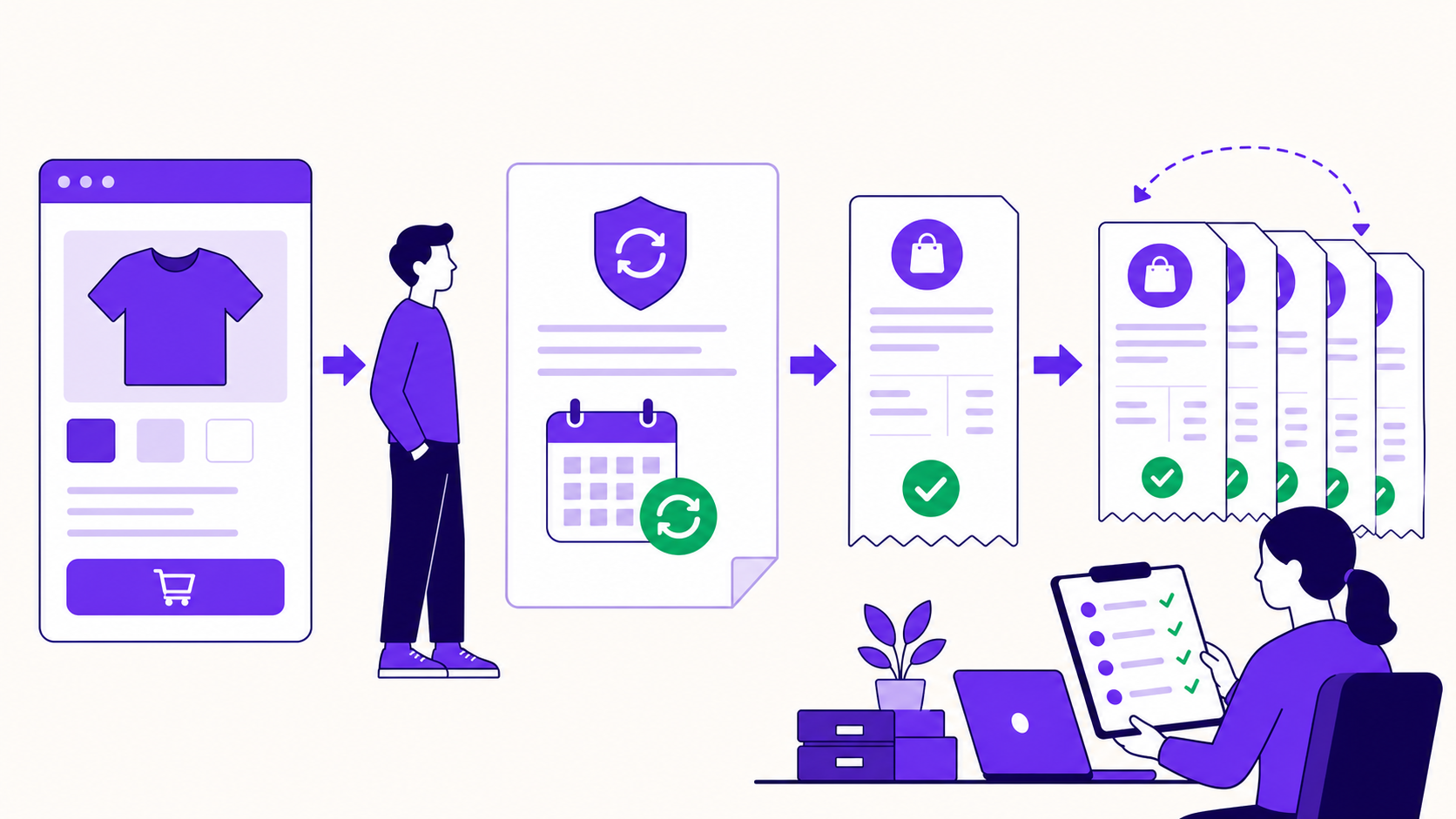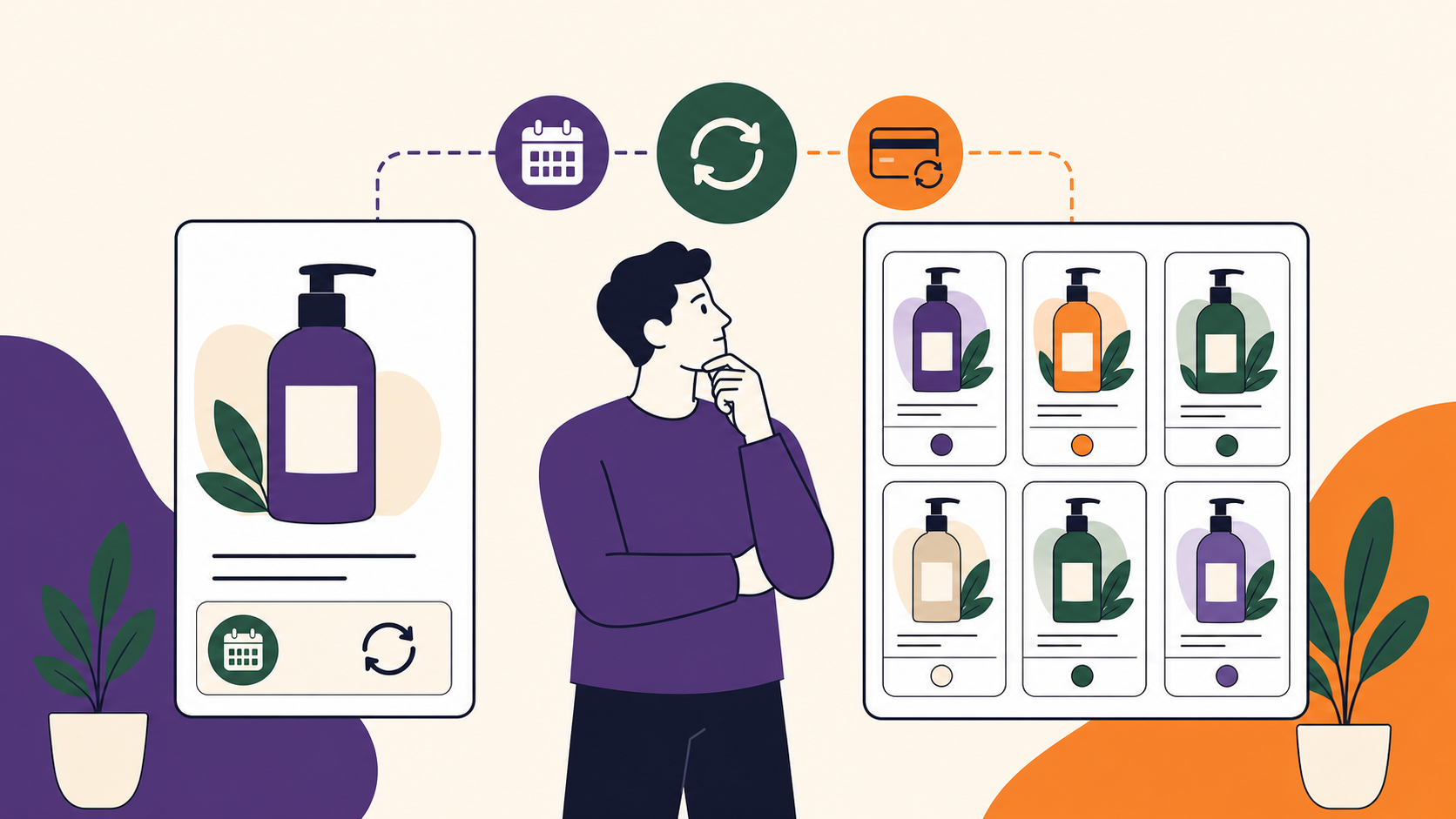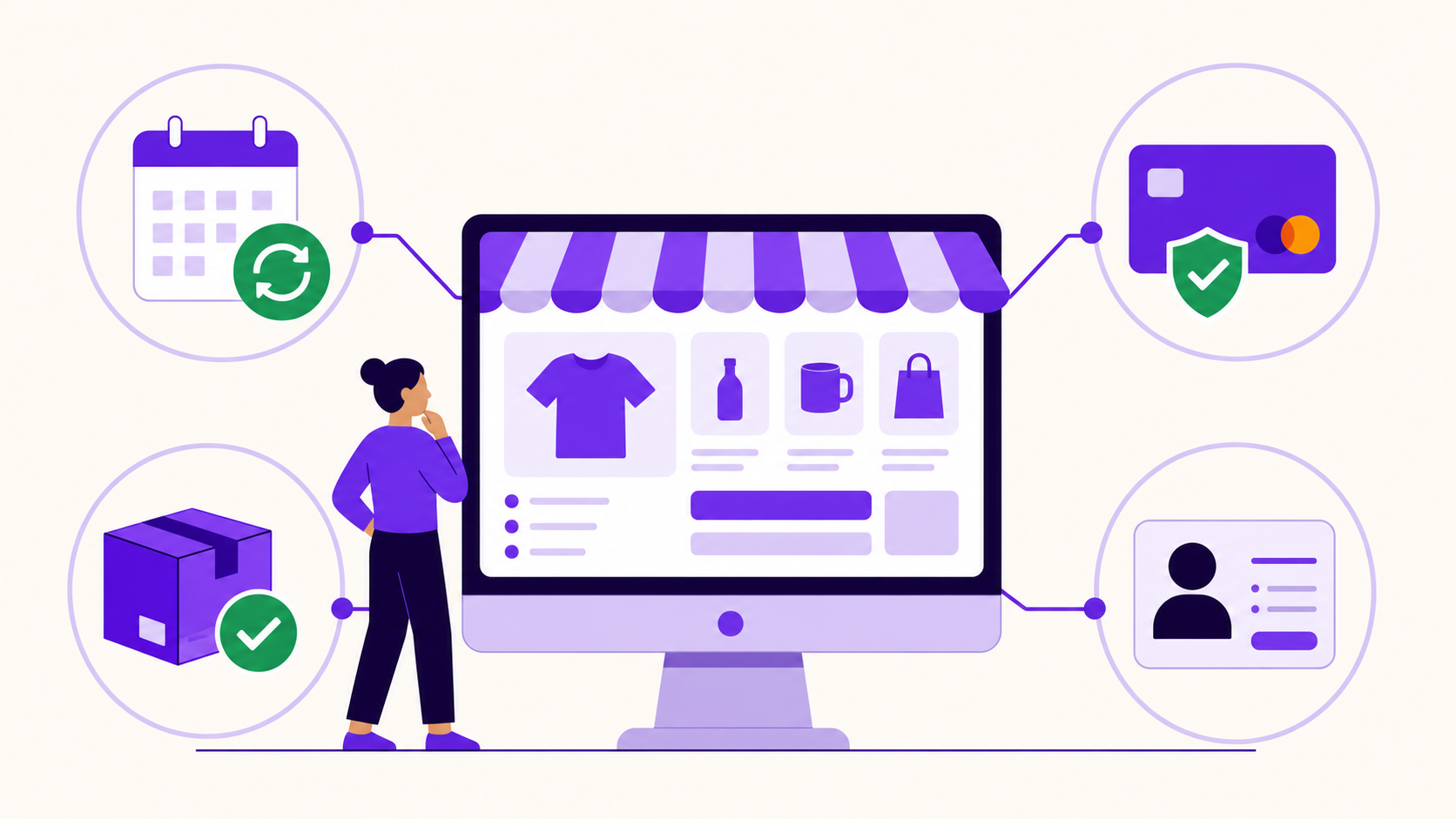
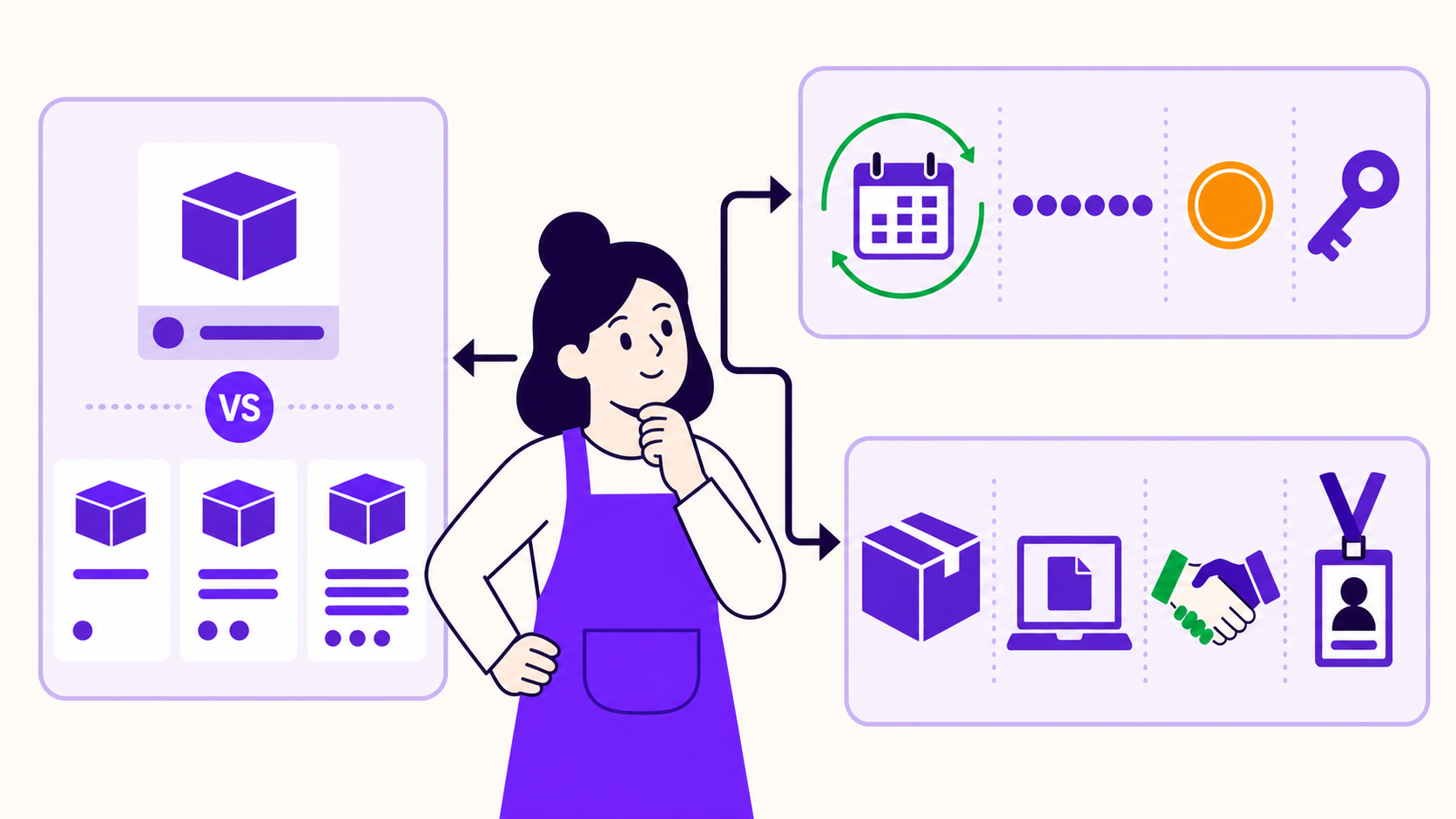
WooCommerce subscription products are best classified on three axes: product structure, billing model, and fulfillment. Choose a simple product for one offer or a variable product for customer-selectable tiers. Then choose ongoing, fixed-cycle, prepaid, installment, or lifetime payment terms, and define whether the customer receives goods, downloads, services, or access.
This three-part model prevents a common mistake: treating “monthly coffee box,” “annual membership,” or “lifetime course” as one technical product type. Each is a combination of catalog structure, payment promise, and delivery.
Key takeaways
- Simple versus variable is a catalog decision, not a term or payment decision.
- Ongoing, fixed-cycle, prepaid, installment, and lifetime describe different commercial promises.
- Physical, digital, service, and membership offers need different fulfillment or access rules.
- WooCommerce core needs a subscription extension for recurring lifecycle behavior.
- Start with the smallest product model that expresses a meaningful customer choice.
First, know what “product type” means
The phrase “WooCommerce subscription product types” can refer to three different questions:
- Catalog structure: Is there one purchasable configuration or several customer-selectable variations?
- Payment and duration model: Does the customer pay until cancellation, for a fixed number of cycles, upfront for a term, in installments, or once for lifetime access?
- Delivery model: Does the store ship goods, deliver files, provide a service, or grant access?
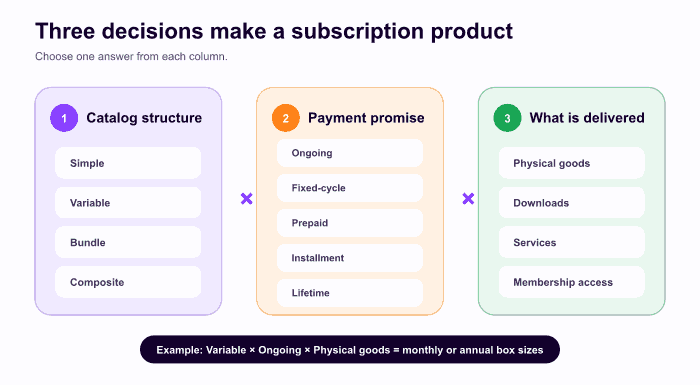
The three-axis framework is an ArraySubs editorial model, not a vendor taxonomy.
WooCommerce core includes standard product structures such as Simple, Grouped, External/Affiliate, and Variable. Virtual and Downloadable are product options that change shipping and file delivery; they do not add recurring billing. WooCommerce describes Subscriptions as an extension that must be installed to add subscription plans, agreements, schedules, and renewals (product editor settings, WooCommerce Subscriptions).
“WooCommerce-native” can mean an extension uses WooCommerce products, checkout, orders, coupons, tax, shipping, and HPOS. It does not mean subscription billing ships in WooCommerce core.
For the difference between a catalog product, customer agreement, and transaction orders, read What Is a WooCommerce Subscription?.
The product-type decision table
| Reader's actual need | Catalog structure | Payment model | Delivery | Best starting point | Main caution |
|---|---|---|---|---|---|
| One offer, one price, one cadence | Simple | Ongoing | Service, file, access, one physical SKU | Simple product + one plan | Do not create variations without a real choice |
| Customer chooses tier, size, or cadence | Variable | Ongoing or fixed-cycle | Tiered service, box size, monthly/annual | Variable product + named options | Variation and price-display complexity |
| Program ends after a known count | Simple or variable | Fixed-cycle recurring | Course, coaching, box series | Set total cycles/payments | Fixed-cycle is not a shared calendar date |
| Customer pays the term upfront | Simple or variable | Prepaid fixed-term | Time-based access | One prepaid term or dedicated feature | State the access end and refund rule |
| Customer prepays repeated shipments | Simple or variable | Prepaid + fulfillment schedule | Physical goods | Dedicated prepaid/fulfillment workflow | Payment cadence no longer creates each shipment |
| Buyer owes a fixed total over time | Usually simple or variable | Installment | High-ticket product/service | Genuine payment-plan tool | Not a cancel-anytime subscription |
| Buyer pays once for ongoing access | Simple or variable | Lifetime/one-time | Membership, software, digital library | One-time product + entitlement | Define “lifetime,” support, and updates |
| Everyone renews on the same day | Any supported structure | Recurring + alignment | Goods or access | Billing-date alignment | Alignment is not a shared end date |
| Everyone ends on a shared date | Any supported structure | Fixed-date term | Cohort or seasonal club | True fixed-date feature | Do not substitute cycle count without testing |
Axis 1: choose the catalog structure
Simple subscription product
A simple product has one purchasable configuration. Add one subscription plan or use the engine's simple-subscription controls when the customer sees one price, cadence, term, and benefit.
Good fits include:
- one $49-per-month care plan;
- one annual community membership;
- one weekly produce box size;
- one downloadable library tier;
- one six-week coaching program.
The operational benefit is clarity: fewer SKUs, simpler product copy, cleaner reporting, and fewer switching combinations. If customers do not need to choose between different terms on the product page, a simple product is usually the better starting point.
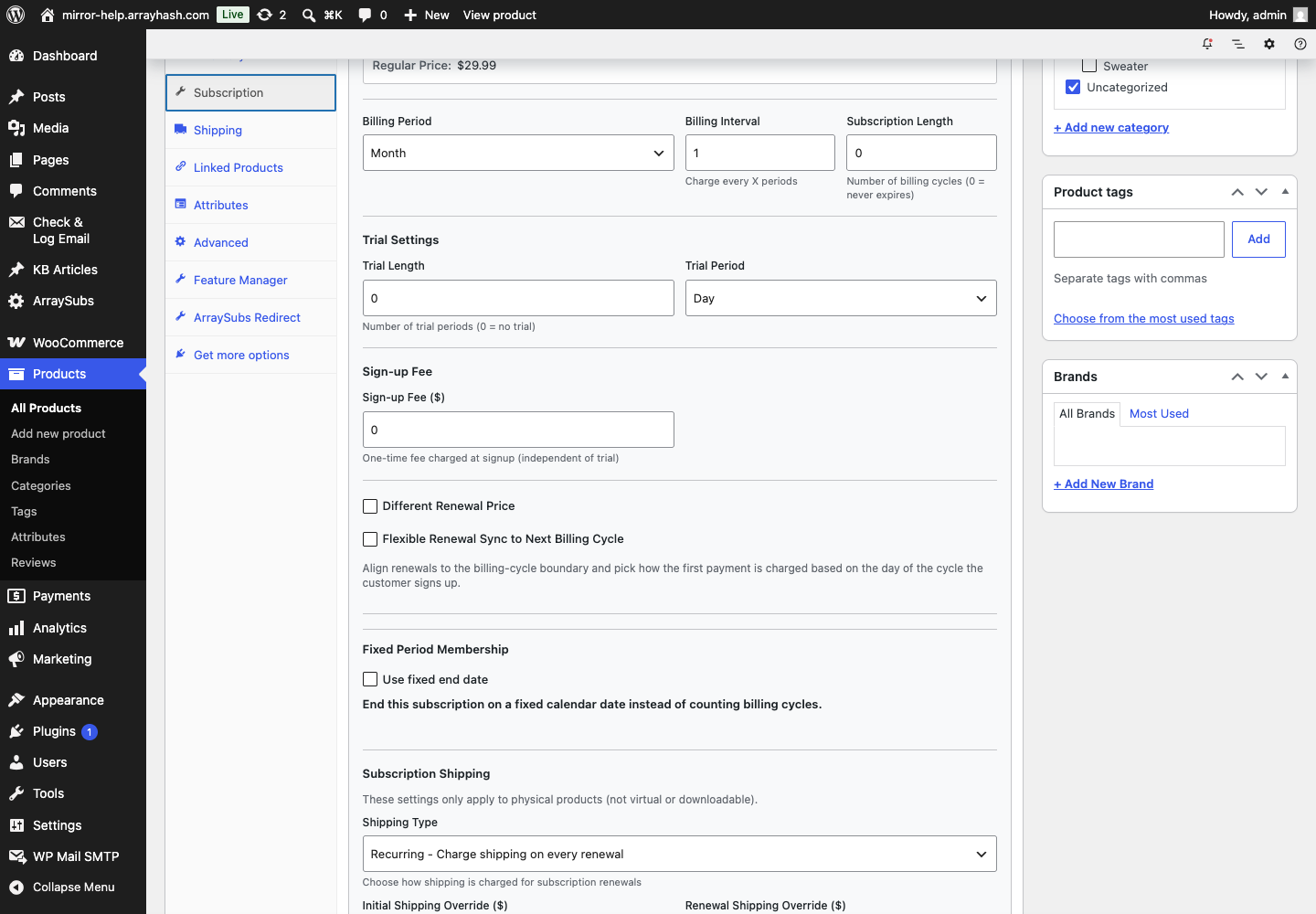
Current ArraySubs and ArraySubs Pro fields captured on the live test store on July 13, 2026. ArraySubs adds the subscription schedule to a normal WooCommerce product.
Variable subscription product
A variable product is useful when the customer selects a meaningful attribute such as tier, size, quantity, or billing schedule. Core WooCommerce lets variations carry their own price, SKU, stock, and attributes; a subscription extension can add recurring terms to the supported product or variation model (Variable Products).
Good fits include:
- Essential versus Growth service tiers;
- small versus large delivery boxes;
- monthly versus annual billing;
- a plan whose price and trial differ by tier.
The choice should be customer-visible. Do not use variations merely because two internal teams deliver the same offer.
Variable products create more test paths. WooCommerce also changes some dropdown behavior after more than 30 variations, and ambiguous attributes can produce unexpected cart data. Keep combinations intentional, name the terms clearly, and test each variation through signup and renewal (Variable Products).
The monthly-versus-annual recipe shows a practical customer-facing use of variations.
A current WooCommerce Subscriptions 9.0 note
As verified on July 13, 2026, WooCommerce Subscriptions 9.0.1 recommends subscription plans on supported standard simple, variable, bundle, and composite products for new stores. The older dedicated Simple Subscription and Variable Subscription types remain supported; Woo states there is no fixed removal date or forced migration (creating a subscription product, Subscriptions FAQ).
That is a WooCommerce Subscriptions-specific interface change, not a universal rule for every extension. ArraySubs' current public setup path focuses on enabling subscription behavior on simple and variable WooCommerce products. Review the ArraySubs product and checkout feature map for current scope.
Bundle, composite, and grouped structures
Woo's extension can attach subscription plans to Product Bundle and Composite products when the corresponding extensions are present. These are advanced assembly structures, not replacements for simple or variable products. Grouped products can also present several offers together, especially in older dedicated-product setups. Use them only when the catalog really needs an assembled or multi-product buying experience.
Do not assume ArraySubs bundle or composite behavior from Woo's documentation. Its current public setup guide documents simple and variable products; require a direct product test before promising another structure.
Axis 2: choose the payment and duration model
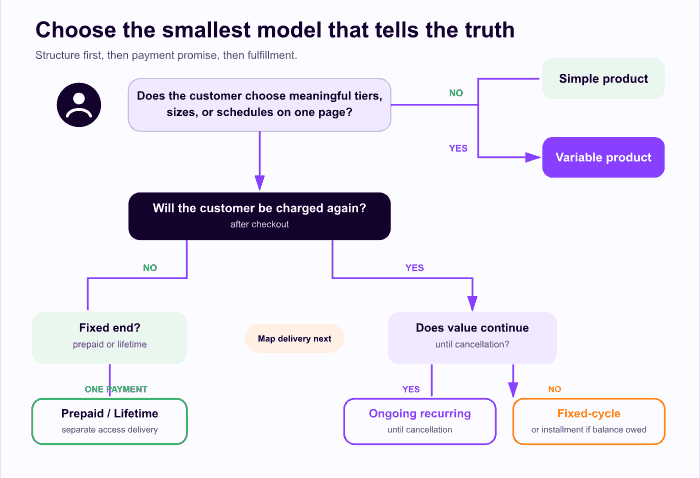
Choose how the agreement ends before choosing the billing interval.
Ongoing recurring
An ongoing subscription charges every period until the customer or store cancels. It fits offers whose value continues: replenishment, maintenance, support, software, publications, or community access.
Use it only when the customer promise is truly open-ended. State the cancellation timing and what happens to prepaid access or fulfillment after cancellation.
Fixed-cycle recurring
A fixed-cycle subscription charges repeatedly for a known number of payments or periods. It fits a six-week class, 12-box series, or time-boxed coaching program.
Woo's current plan documentation says configured total-payment counts include the initial purchase. A 12-total-payment monthly plan therefore has one signup payment and 11 later renewals (creating a subscription product). Check the counting convention in your engine and test the last cycle.
Fixed-cycle is not fixed-date. Customers who start on different dates usually finish on different dates. It is also not automatically an installment obligation: Woo says a subscriber can still cancel an expiring plan before its scheduled end.
Prepaid fixed-term
A prepaid term collects the full amount at checkout while access or delivery continues for a defined period. For six months of digital access, that can be one upfront payment plus a clear access end. For six monthly boxes, the store still needs six fulfillment events even though it does not need six future payments.
Woo documents both one-period configurations and a $0-recurring-plus-sign-up-fee workaround, and it offers a separate prepaid-plan extension. The workaround can expose $0 renewal orders, customer emails, and cancellation interactions, so do not call prepaid a single clean native product type across every setup (Subscriptions FAQ, Prepaid for WooCommerce Subscriptions).
The ArraySubs fixed-cycle recipe uses multiple scheduled charges. Treat it as a fixed-cycle implementation, not proof that the full term is collected upfront.
Installment or split-payment plan
An installment plan divides a known purchase balance across scheduled payments. Its promise is “pay this fixed total over time,” not “keep receiving value until you cancel.” Deposits, remaining balance, due dates, reminders, and collection rights often need a genuine payment-plan system (Deposit and Partial Payment Plan).
ArraySubs currently marks Installment / Split Payments as coming soon. Do not choose ArraySubs for a shipped installment workflow today, and do not disguise an owed balance as a cancel-anytime subscription.
Lifetime or one-time access
Lifetime access is one payment with no recurring renewal. It may be managed by a subscription-aware system, but it is not recurring billing. Define whose or what lifetime applies and whether updates, support, storage, transfers, and future features are included.
ArraySubs currently ships a Lifetime Deal billing period that collects once and schedules no renewal. See the lifetime-deal recipe for the implementation path.
Fixed date and billing alignment are separate controls
- Fixed-cycle: ends after a count or duration.
- Fixed-date: ends on a shared calendar date, such as a cohort close.
- Billing alignment: moves renewal timing to a shared weekday, day of month, or month of year.
Woo's billing-alignment guide explains that alignment changes renewal timing and does not retroactively change existing subscriptions when enabled (Billing Date Alignment). ArraySubs markets fixed-date subscriptions as a Pro capability. Do not use one term for all three behaviors.
Worked example: same total, different cash timing
The following chart uses a deterministic $150 example. It is not performance data and does not imply one model is more profitable.
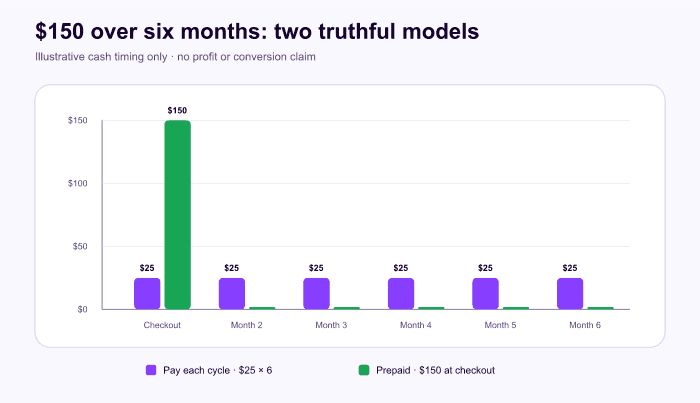
Illustrative cash timing for the same $150 stated price; excludes tax, fees, refunds, defaults, and the time value of money.
| Month | Pay each cycle | Prepaid |
|---|---|---|
| Checkout / month 1 | $25 | $150 |
| Months 2–6 | $25 each | $0 each |
| Stated total | $150 | $150 |
The recurring version needs five future collection attempts. The prepaid version needs no later charge but still needs the promised access or fulfillment to continue. That operational difference—not the total—is the reason to name the model correctly.
Trials and sign-up fees are modifiers
A trial changes when the recurring charge begins. A sign-up fee adds a one-time amount at signup. Neither is a standalone product type.
Woo's current example shows that a $75 recurring charge plus a $200 sign-up fee produces $275 at checkout when there is no trial. With a free trial, the $200 fee remains due at checkout while the $75 recurring charge is delayed (creating a subscription product).
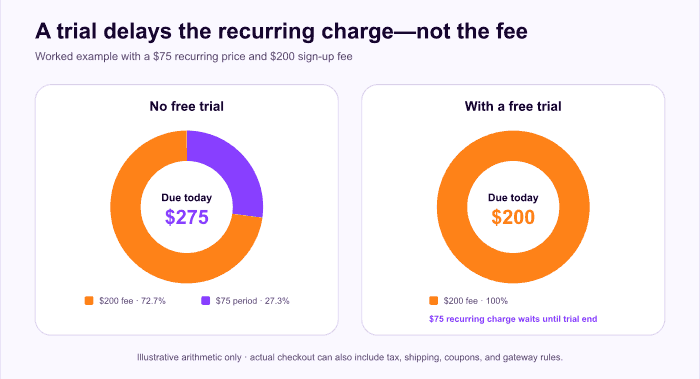
Worked example, not customer-behavior data: without a trial, $275 includes $200 fee and $75 first period; with a trial, $200 is due and the recurring charge waits.
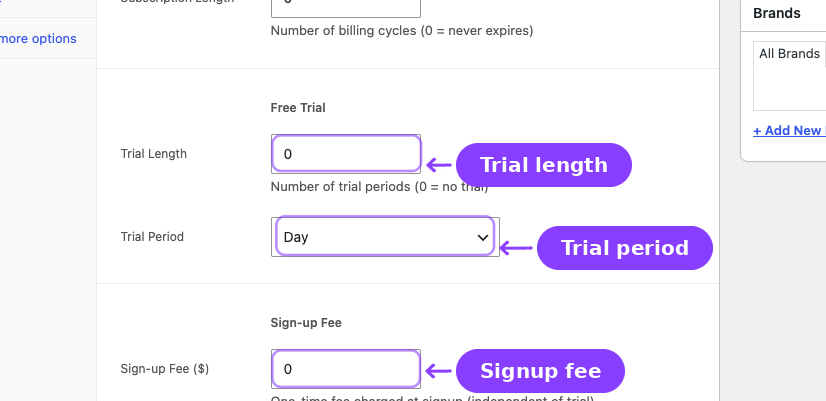
The trial and fee fields modify an offer; they do not create a different catalog product type.
For a limited subscription, Woo also says a free trial adds to the calendar length. Six paid months after a one-month trial spans seven calendar months. Test dates rather than assuming trial days are included inside the paid term.
Axis 3: define what the customer receives
Physical goods
Map renewal orders to shipments, stock, address changes, and recurring shipping charges. Woo recommends keeping billing and shipping schedules aligned when possible. Annual prepayment with monthly delivery requires a separate fulfillment mechanism because the payment schedule no longer creates a paid order each month.
Downloads and digital products
Decide whether customers buy temporary access to a changing library or permanent ownership of files. Woo documents that subscription downloads can depend on the subscription status: Active and Pending Cancellation may retain access while On-Hold, Cancelled, or Expired do not (Subscriptions FAQ).
Services
Use a simple product for one clear retainer or program. Use a variable product when customers choose a real service level or cadence. Avoid mirroring internal staffing in the catalog unless the customer receives a different promise.
Membership and access
Billing and entitlement are connected but separate. Woo's official stack treats WooCommerce Subscriptions and WooCommerce Memberships as distinct extensions that can work together. ArraySubs combines subscription and member-access capabilities in its own product. In either architecture, define what trial, active, grace, pending cancellation, cancelled, and expired mean for access.
Choose a model in seven questions
- Will anything repeat—payment, delivery, service, or access review? If no, use a one-time product; attach lifetime/unlimited access only if that is the promise.
- Does the customer choose meaningful tiers, sizes, or schedules on one page? If no, start simple. If yes, consider a variable product.
- Does value continue until cancellation? If yes, use ongoing recurring terms.
- Does the offer end after a count or on a shared date? Use fixed-cycle for a count; use a true fixed-date system for a cohort date.
- Is the full term paid at checkout? If yes, it is prepaid; separately schedule access or fulfillment.
- Does the buyer owe a fixed balance regardless of continued access? If yes, use an installment/payment-plan tool.
- For physical goods, does each payment correspond to one shipment? If no, document and test the two schedules independently.
Product complexity is a cost, not a feature
The following editorial score is a planning rubric, not measured store data. It estimates the number of operational dimensions a team must test: offer combinations, renewal paths, fulfillment schedules, and change/cancellation rules.
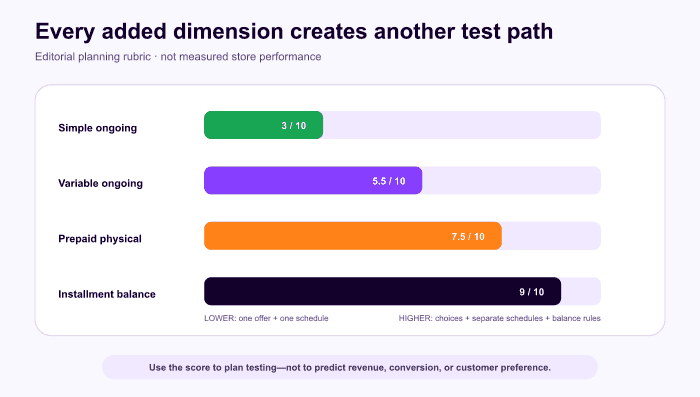
Illustrative planning rubric only. Use it to ask better questions, not to compare revenue or conversion.
Start simple whenever two models can communicate the same promise. Add variables, separate fulfillment schedules, or installment balances only when the customer experience requires them.
Limitations and current truth checks
- WooCommerce Subscriptions 9.0.1 is an extension, not WooCommerce core.
- Woo 9.0 recommends plans on supported standard products, while dedicated Simple/Variable Subscription types remain supported.
- Simple versus variable is independent from ongoing versus fixed-term.
- Fixed-cycle, fixed-date, and billing alignment are different controls.
- A free trial delays the recurring charge but does not automatically delay a sign-up fee.
- Physical subscriptions must map payment orders to shipment operations.
- Prepaid shipment workarounds can create $0 orders and cancellation edge cases.
- Automatic renewal depends on the exact gateway integration and payment method (payment gateway compatibility).
- ArraySubs installment/split payments are currently marked coming soon.
- ArraySubs publicly documents simple and variable products; require a current test before promising bundle or composite support.
- Lifetime is one-time, not recurring; publish a precise entitlement definition.
Frequently asked questions
What is the difference between simple and variable subscription products?
A simple subscription product presents one purchasable configuration. A variable subscription product lets customers choose meaningful options such as size, tier, or billing interval. This is a catalog-structure decision; it does not determine whether the agreement is ongoing, fixed-cycle, prepaid, or lifetime.
What is the difference between fixed-cycle and prepaid subscriptions?
A fixed-cycle recurring subscription charges once per billing cycle and stops after a defined number of total payments. A prepaid subscription collects the full term at checkout, then schedules access or fulfillment across that term. They can cover the same duration but create different cash timing and refund obligations.
Is lifetime access a recurring subscription?
No. Lifetime access normally uses one payment with no future renewal charge, so it is not recurring billing. A subscription or membership system may still manage the entitlement, but the customer promise must define what “lifetime” covers and how long the service is expected to remain available.
Are trials and sign-up fees separate product types?
No. Trials and sign-up fees are pricing modifiers applied to a broader payment model. A trial changes when recurring billing begins, while a sign-up fee changes the amount due at checkout. Test their interaction because a free trial does not necessarily delay a separate sign-up fee.
Which WooCommerce subscription product type should a store start with?
Start with the smallest model that represents a real customer choice: usually one simple offer with an explicit billing interval, end condition, and fulfillment rule. Add variations, prepaid delivery schedules, or installment balances only when the customer experience requires that extra operational complexity.
Final recommendation
Choose WooCommerce subscription product types in three passes. First select the simplest catalog structure that presents a real customer choice. Then define exactly when money is collected and what ends the agreement. Finally, map the physical fulfillment, digital delivery, service, or access behavior to every lifecycle state.
That produces a product customers can understand and a subscription team can operate. When the model is clear, review the ArraySubs overview and pricing to see whether its current product, gateway, and lifecycle scope matches the offer.
Editorial disclosure: ArraySubs is an ArrayHash product. Platform behavior is supported by linked official WooCommerce sources; ArraySubs feature statements use current first-party product and setup documentation.
Verification note: Sources were checked on July 13, 2026. WooCommerce Subscriptions 9.0.1 terminology and product-plan guidance are time-sensitive. No first-party ArraySubs end-to-end transaction test was run for this article.
Update log: July 2026 — Initial publication; three-axis taxonomy, WooCommerce Subscriptions 9.0.1 product-plan model, and ArraySubs feature truth gates verified.
Continue from strategy to setup
Use a recipe when the model is settled
These articles own the decision and operating model. The ArraySubs feature map and recipes cover the exact product, billing, and customer-workflow configuration.
Written by
Emran // ArrayHash
Research and practical guidance for WooCommerce subscription operators and implementation teams.
Technical review
ArraySubs Engineering Team
Reviewed against current ArraySubs code, product documentation, and the linked primary platform sources.