
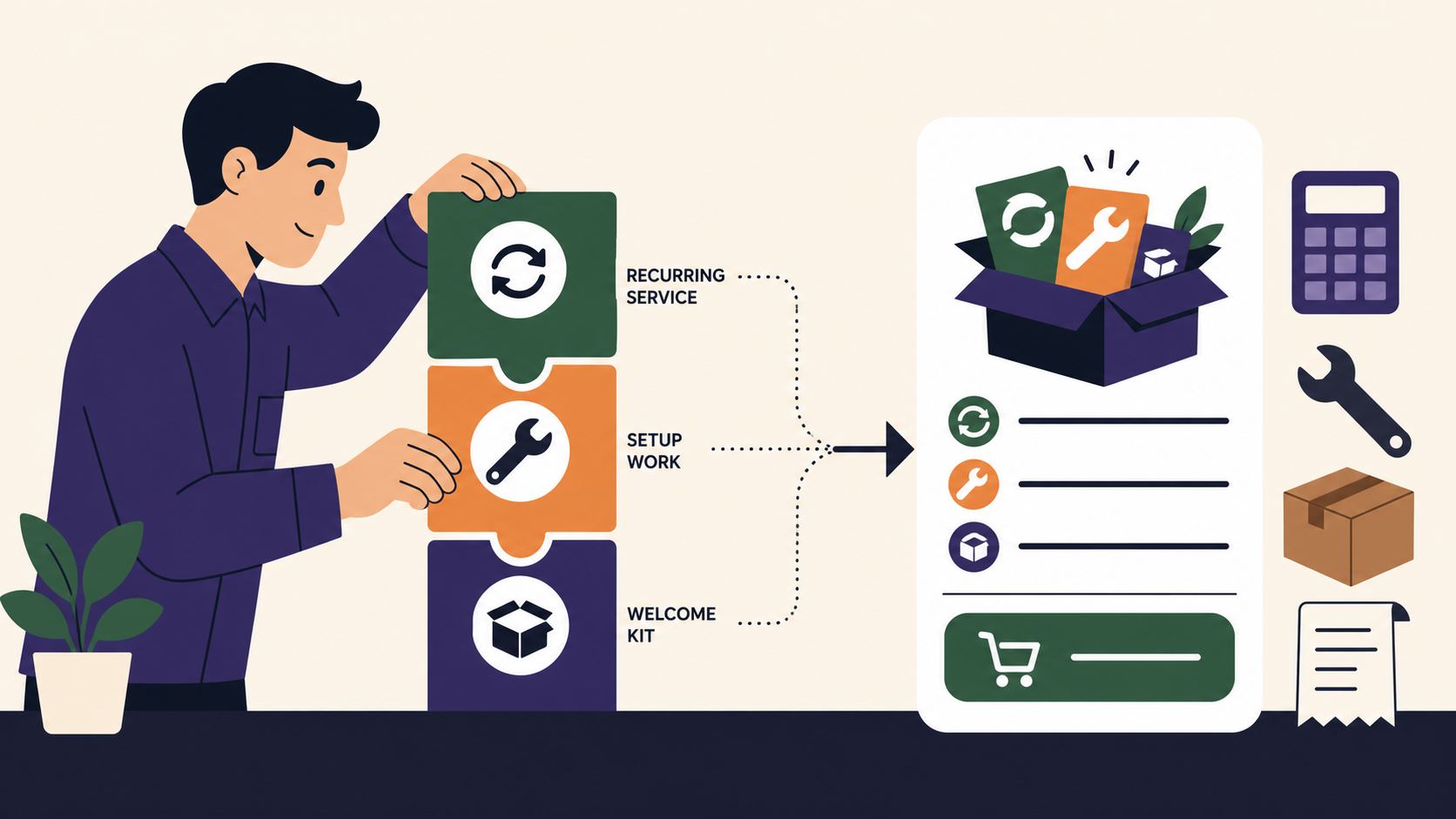
Charge a subscription sign-up fee only when starting a customer creates a real, explainable one-time cost, such as migration, installation, onboarding labor, or a welcome kit. Base the setup fee on that cost minus any subsidy you choose to absorb. Show the initial payment, recurring price, trial timing, and refund policy before WooCommerce checkout.
A sign-up fee should fund work that happens once. It should not disguise a higher recurring price, duplicate another line item, or operate as a cancellation penalty.
Key takeaways
- Tie the fee to specific one-time work or materials.
- There is no universal “one month” or percentage rule; calculate from your own costs.
- Display the fee separately from the recurring price and total due today.
- Cancellation stops future billing; a refund reverses money already paid. Define both policies.
- In ArraySubs, the fee is initial-only, charged during a free trial, and currently added once per subscription cart line—not per quantity.
What a subscription sign-up fee is
A sign-up fee is a one-time enrollment charge separate from the recurring price. It may be labeled setup, activation, onboarding, joining, or welcome-kit fee when that label accurately describes what the customer receives.
WooCommerce Subscriptions documents the basic arithmetic:
- without a trial: initial payment = first recurring payment + sign-up fee;
- with a free trial: initial payment = sign-up fee;
- renewals exclude the fee.
See Creating a Subscription Product for the Woo-specific behavior. A “free trial” with a fee is not a zero-cost checkout.
What the fee can fund
| Cost | Defensible when | Evidence to retain |
|---|---|---|
| Human onboarding | Discovery, configuration, training, or setup happens once | Scope, expected time, loaded labor cost |
| Data migration | Files are cleaned, mapped, imported, and validated | Volume assumptions and acceptance criteria |
| Installation | Equipment or an external service is activated | Work order, materials, completion definition |
| Welcome kit | A card, key, device, package, or starter inventory is supplied | Unit, packing, shipping, and return costs |
| Third-party provisioning | The merchant pays a per-customer vendor charge | Invoice and refundability |
| Kickoff deliverable | An audit, plan, or initial asset is created | Deliverable, revisions, and acceptance rule |
Ordinary monthly service belongs in the recurring price. General advertising, customer acquisition, arbitrary “commitment,” and cancellation penalties are not setup work. A refundable deposit should be labeled and accounted for as a deposit. A physical item needing stock, warranty, shipping class, or returns may be clearer as its own WooCommerce product line.
Ask one test question: Can support explain in one sentence what happens after this fee is paid that does not happen for an existing subscriber? If not, charge $0 or include the value transparently in the recurring offer.
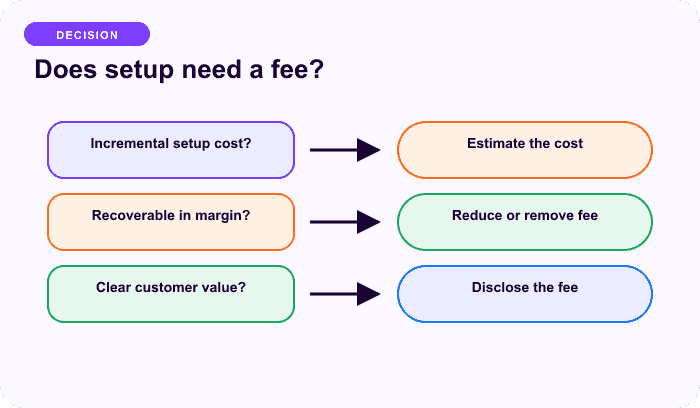
Calculate a defensible amount
Start with the merchant's actual one-time inputs:
Activation cost (C) = direct labor + materials or kit + per-customer vendor cost + measured rework
Then choose how much the customer will fund:
Candidate fee (F) = max(0, C × recovery share − planned acquisition subsidy)
Use loaded labor cost, not take-home pay. Derive rework from completed onboarding records; if the data does not exist, omit the estimate and begin measuring. Tax and payment treatment are jurisdiction- and configuration-specific, so model them separately.
Worked example
Assume a service onboarding requires:
- two implementation hours at a loaded $50/hour = $100;
- one $20 provisioning charge;
- $10 measured rework allowance;
- total activation cost C = $130;
- target recovery of 80% = $104;
- planned subsidy of $24;
- candidate sign-up fee F = $80.
If the plan is $120/month with no trial, the initial subtotal is $200 before tax: $80 setup plus $120 first period. With a free trial, the due-today subtotal is $80 before tax, and the recurring price begins according to the disclosed and tested trial schedule.
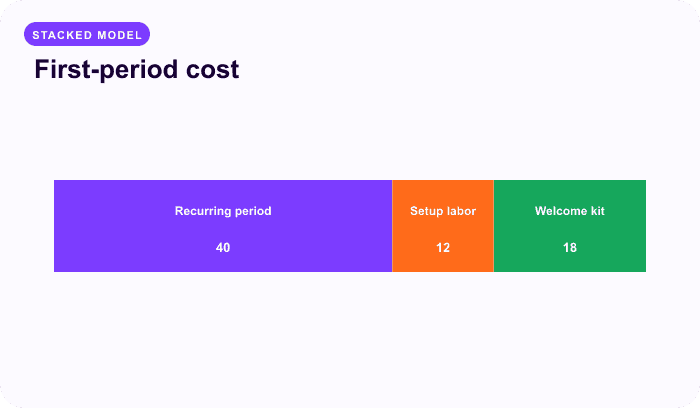
Fictional arithmetic for explaining the model, not a market price or benchmark.
Check initial contribution
Initial contribution = sign-up fee + first recurring revenue − activation cost − first-period variable cost − payment cost − expected refunds and chargebacks
With a free trial, first recurring revenue at checkout is zero. Use the store's own cohort data for expected refunds and chargebacks. A deliberately negative initial contribution can be a valid acquisition subsidy, but document the intended payback path rather than assuming retention will cover it.
Sanity-check the fee:
- Does it fund a named deliverable or process?
- Is any cost already recovered elsewhere?
- Is the due-today total clear after trial, tax, shipping, and coupons?
- Can support tell whether setup is unstarted, partial, or complete?
- Can finance reconcile fee revenue and refunds separately?
- Does the policy respect every selling region?
Make the initial payment predictable
The goal is not to make the fee visually small. The goal is to make the promise easy to predict. On the product page, cart, checkout, and receipt, show:
- recurring price and cadence;
- one-time fee and what it funds;
- total due today;
- first renewal amount and date or calculation rule;
- cancellation effect;
- refund policy and link.
Example copy:
Assisted onboarding plan — $120/month + $80 one-time implementation fee. Due today: $200 before tax. Renews at $120 monthly. The implementation fee covers account configuration and data import. Cancellation stops future renewals; setup refunds follow the published work-status policy.
When a trial applies, say “$80 setup fee due today; recurring service is free for 14 days,” not simply “14-day free trial.”
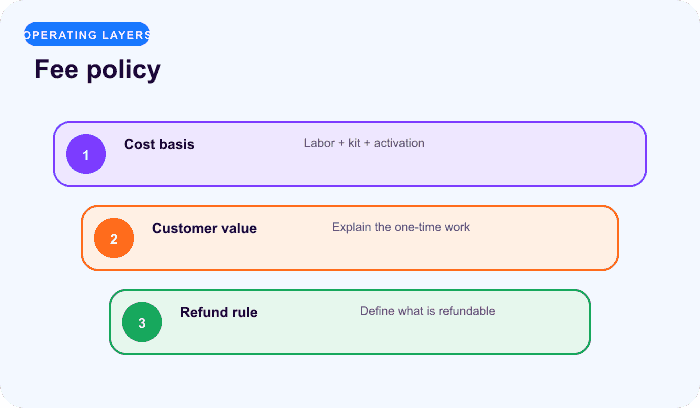
Refund and cancellation states
Cancellation and refund are separate. A useful policy maps money to actual work status:
| State | Policy starting point | Evidence |
|---|---|---|
| Paid; work not started | Full fee refund, subject to local rules | Work-status timestamp |
| Partially completed | Proportionate treatment where lawful and disclosed | Completed tasks and costs |
| Fully delivered | Published policy plus statutory and merchant-fault remedies | Acceptance/completion record |
| Merchant cannot deliver | Refund undelivered setup and any required amount | Reason and refund record |
| Future renewals cancelled | Stop future billing; evaluate the past fee separately | Cancellation and work status |
Do not publish “non-refundable” as a universal rule. Rights differ by country, customer, goods/services, and delivery state. US ROSCA and UK distance-selling guidance illustrate why recurring terms, price, cancellation, and deposits must be reviewed by region (US Code, UK guidance). This is general information, not legal advice.
WooCommerce can record full and partial refunds. An automatic gateway refund depends on gateway support; a manual WooCommerce refund does not itself return money through the processor (WooCommerce refunds).
Examples by business type
| Business | One-time work | Candidate treatment | Warning |
|---|---|---|---|
| Self-serve SaaS | None beyond automation | No fee | Do not invent activation work |
| Assisted SaaS | Migration and administrator training | Scoped implementation fee | Define volume and revisions |
| Service retainer | Discovery, audit, portal setup | Onboarding fee | Keep normal monthly work out |
| Subscription box | Reusable container or welcome kit | Fee or separate product | Use a product if stock/returns matter |
| Membership | Orientation, credential, assessment | Joining fee when cost is real | Automatic digital access may justify $0 |
What to measure
Track qualified checkout conversion, initial contribution, fee cost coverage, refunded fee amount, fee-related support contacts, onboarding completion time, and disputes. Compare like-for-like cohorts with the same offer, traffic source, country, tax display, and period.
Do not claim that fees improve “customer quality” or conversion without a controlled first-party result. A fee can filter some customers and deter others; only the merchant's evidence can establish the net effect.
Current ArraySubs behavior
ArraySubs 1.8.9 ships sign-up fees in core for simple products and individual variations. The fee appears separately in product/cart data, is stored on the subscription, and is excluded from renewal totals.
Important current boundaries:
- a free trial delays the recurring line but the sign-up fee is still due;
- the fee is added once per subscription cart line, not multiplied by quantity;
- multiple subscription-line fees aggregate into one taxable Woo fee line;
- full refund of a linked order triggers immediate cancellation, while a partial refund does not automatically cancel only because it is partial;
- there is no fee-specific policy engine or dedicated Woo Subscriptions-style sign-up-fee coupon type.
Verify tax, coupons, gateway refund, quantity, and reporting with the exact checkout setup before launch. Use a separate product line when the upfront item needs quantity multiplication, stock, shipping, warranty, or distinct refunds.
The setup steps live in the flat monthly fee recipe, trial plus fee recipe, and high setup/low monthly recipe.
Final recommendation
Use a sign-up fee when it funds a real one-time outcome and the amount follows a documented cost and subsidy policy. Itemize the fee, today’s total, renewal terms, delivery state, and refund rule. Otherwise, simplify the offer and put continuing value in the recurring price.
Read the adjacent Free Trial, Paid Trial, or No Trial framework before combining a fee with an evaluation period.
Compare ArraySubs plans after the product, gateway, and refund requirements are clear.
Frequently asked questions
When should a subscription charge a sign-up fee?
When activation creates a real customer-specific cost such as migration, installation, onboarding labor, provisioning, or a welcome kit.
How do I calculate a fair fee?
Add direct setup labor, materials, per-customer vendor cost, and measured rework. Recover the chosen share and subtract any planned subsidy. Do not copy a universal percentage.
Is a sign-up fee refundable after cancellation?
Cancellation and refund are separate. Publish what happens before work, during partial delivery, and after completion while respecting mandatory rights.
Can a free trial charge a sign-up fee?
Yes. WooCommerce Subscriptions and current ArraySubs can charge the one-time fee while delaying the recurring price. Disclose the exact due-today amount.
Does the ArraySubs fee repeat or multiply by quantity?
It does not repeat on renewals. In ArraySubs 1.8.9 it is added once per subscription cart line rather than multiplied by quantity.
Disclosure, verification, and update log
ArraySubs is the product discussed by this site. WooCommerce documentation, government guidance, and ArraySubs 1.8.9/Pro 1.1.0 source were reviewed on July 13, 2026. This source review did not execute live tax, coupon, gateway, refund, or quantity tests.
- July 2026: Initial publication; cost framework, refund boundaries, and current ArraySubs fee lifecycle verified.
Continue from strategy to setup
Use a recipe when the model is settled
These articles own the decision and operating model. The ArraySubs feature map and recipes cover the exact product, billing, and customer-workflow configuration.
Written by
Emran // ArrayHash
Research and practical guidance for WooCommerce subscription operators and implementation teams.
Technical review
ArraySubs Engineering Team
Reviewed against current ArraySubs code, product documentation, and the linked primary platform sources.