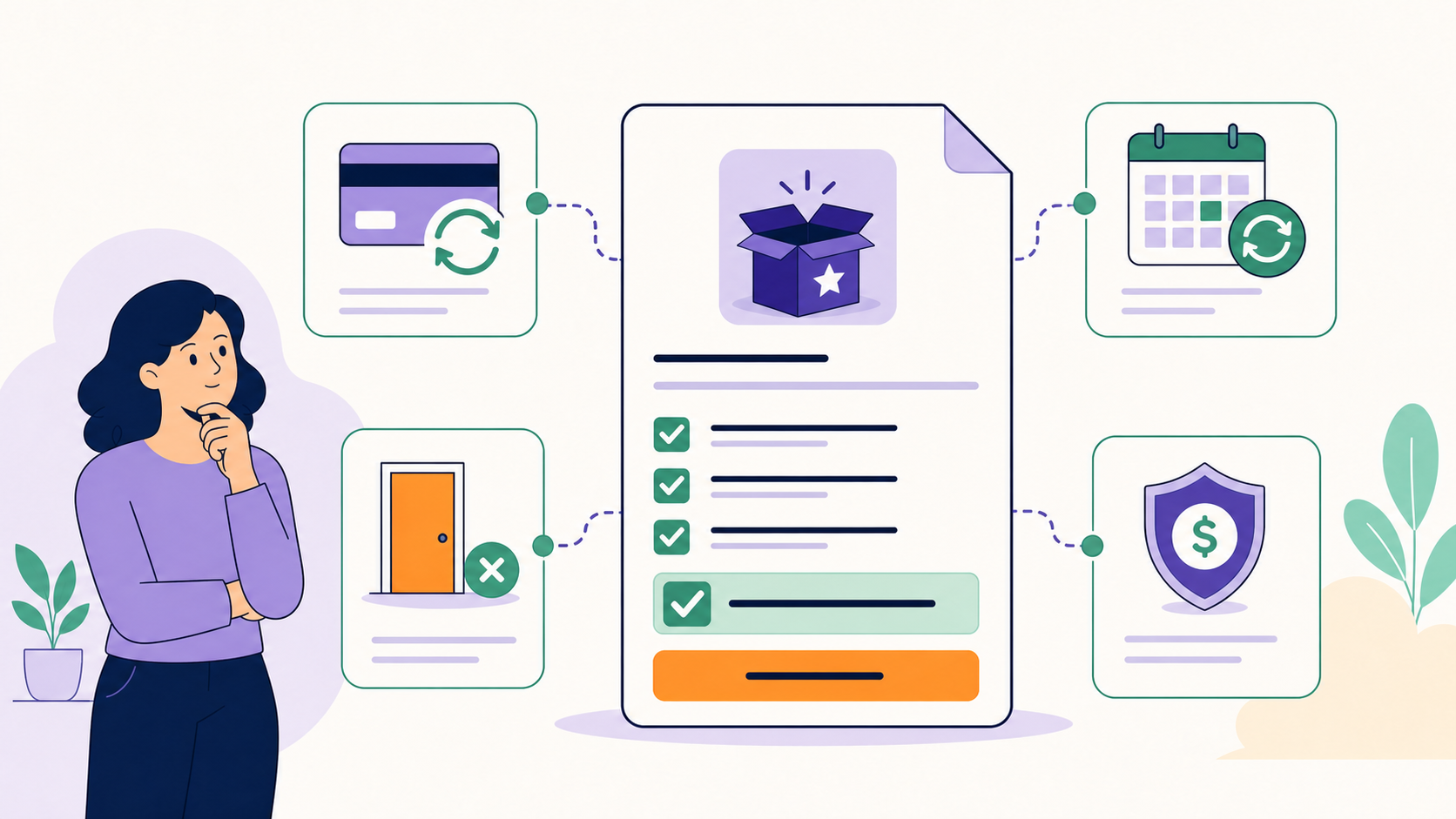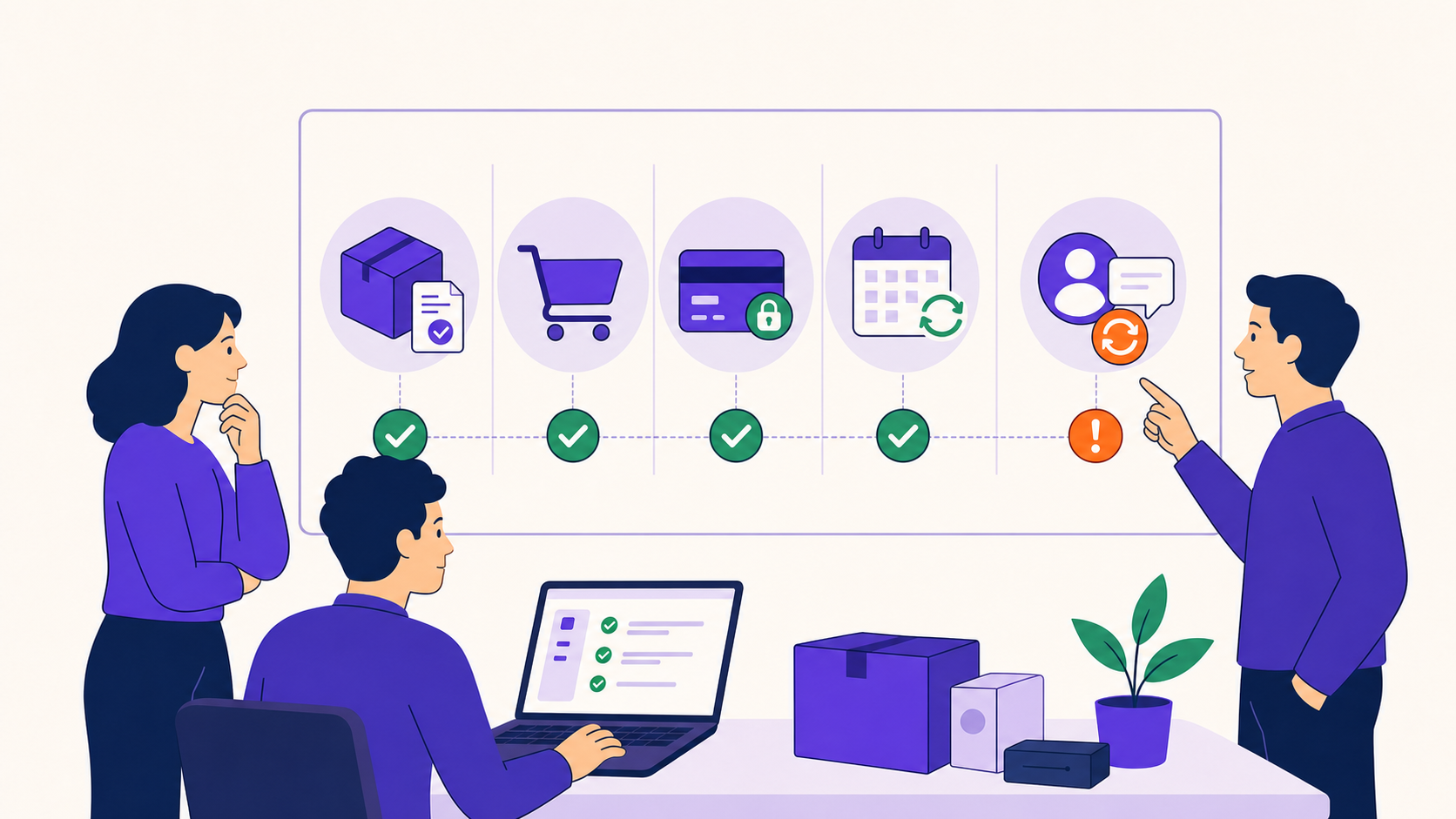
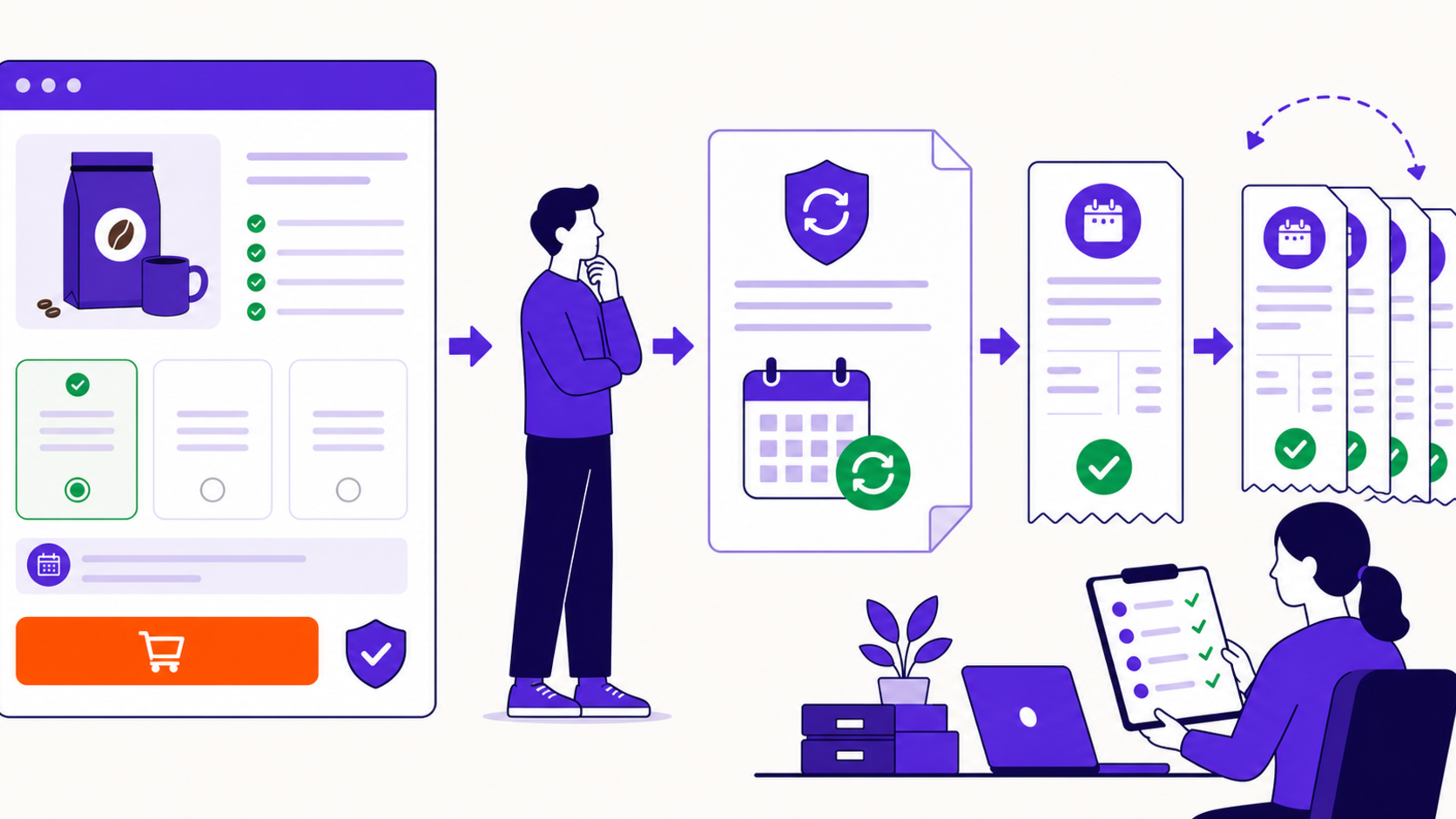
A strong WooCommerce subscription product page makes the complete agreement understandable before checkout: what the customer receives, what is due today, the recurring amount and cadence, the first renewal date, the minimum term, shipping or access rules, cancellation timing, and the next action. Clarity is the conversion system; decoration supports it.
Key takeaways
- Put the offer, price sequence, and primary action in the first screen.
- State “due today” and “renews at” as separate facts.
- Explain fulfillment, access, cancellation, and refunds before the buyer commits.
- Use proof that is specific, attributable, and relevant to the offer.
- Test the page with the real product variation, cart, gateway, tax, and shipping path.
Start with the subscription promise
The page should answer four questions in order: What do I get? What do I pay today? What happens later? How do I stop or change it? WooCommerce recommends showing recurring totals and subscription terms clearly, while online negative-option offers can also be subject to disclosure, consent, and cancellation requirements (creating a subscription product, ROSCA). Legal obligations vary, so have qualified counsel review the actual offer and markets served.
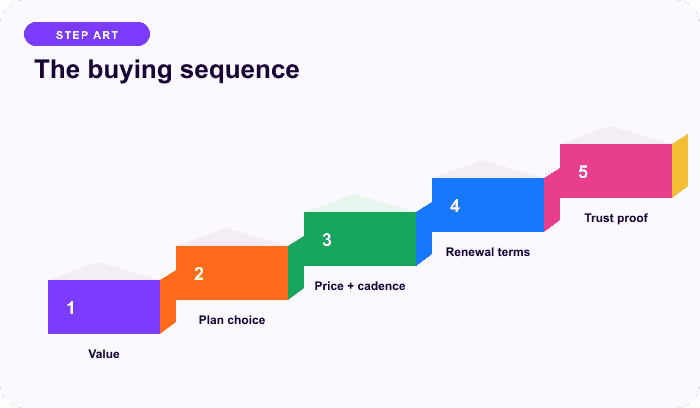
The headline should identify the outcome, not merely the product type. A short supporting sentence can name the audience and recurring delivery. The price block should remain close to the product selector and action button so the buyer does not have to reconstruct the deal from distant sections.
The first-screen information hierarchy
Use one dominant decision path:
- outcome-focused title;
- one-sentence offer summary;
- included quantity, tier, or service level;
- amount due today;
- later recurring amount and cadence;
- first renewal date or a precise schedule rule;
- one primary add-to-cart or start-subscription action;
- a compact trust statement directly relevant to payment, delivery, or cancellation.
When variations change price, cadence, trial, or entitlement, update the complete summary together. A customer who switches from monthly to annual should not see the old renewal sentence beside the new price.
Write the price as a sequence
“From $20” is rarely enough. Prefer explicit sentences:
- No trial: “$30 due today, then $30 every month. Next payment: August 13, 2026.”
- Free trial: “$0 due today. Then $30 monthly from August 13, 2026.”
- Signup fee: “$50 setup fee plus $30 for the first month today; $30 monthly afterward.”
- Intro price: “Payments 1–3: $20 each. Payment 4 onward: $35 monthly.”
The exact checkout total can still change with tax and shipping, but the page should explain which components are fixed and which are calculated later. Do not imply that an ordinary one-time coupon will recur unless the configured renewal mechanism has been tested.
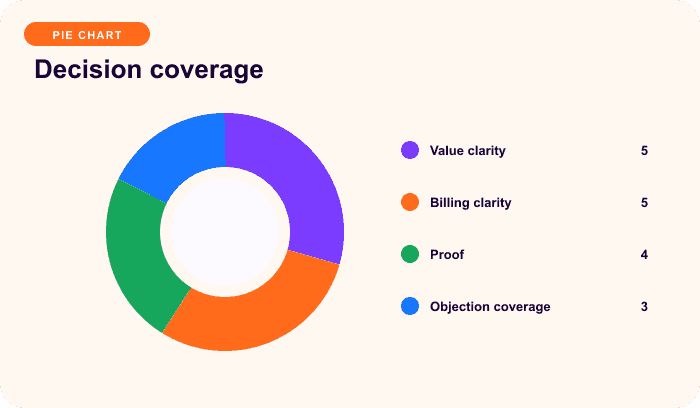
Illustrative amounts, not conversion data.
Show what continues between charges
A subscription page sells an operating relationship. Explain the customer-visible lifecycle:
| Offer type | Page must clarify |
|---|---|
| Physical goods | contents, quantity, shipment cadence, shipping charge, cutoff, substitutions |
| Digital access | included areas, access start, grace/on-hold behavior, download rights |
| Service | scope, capacity, booking rules, response time, unused allowance |
| Membership | benefits, eligibility, renewal, cancellation, access end |
| Fixed-cycle program | total payments, total duration, last delivery or access date |
Billing and shipping are not automatically the same schedule. If one quarterly payment funds three monthly boxes, show that relationship and use a fulfillment system capable of tracking all three obligations. ArraySubs Pro’s Subscription Shipping controls renewal shipping charges; it is not an independent box scheduler.
Use proof that reduces a real objection
Strong proof is attributable and close to the claim it supports: a customer quote with permission, a short case description, verified review source, compatibility statement, security explanation, or a factual support promise. Avoid unqualified “best,” invented customer counts, vague logos, and percentages without a source and measurement window.
Place proof after the core offer, not in competition with it. One relevant testimonial about reliable monthly delivery is more useful than a carousel of unrelated praise.
Make terms scannable without hiding them
Use a compact summary near the primary action and a detailed section farther down. Include:
- recurring amount, interval, and currency;
- today’s amount and first renewal timing;
- trial and signup-fee interaction;
- minimum or fixed term, if any;
- cancellation method and effective timing;
- refund and credit policy link;
- shipping, tax, and address rules;
- plan-change or pause availability;
- support contact and response expectations.
Cancellation and refund are separate outcomes. “Cancel at period end” can prevent the next renewal while preserving paid access; immediate cancellation can end access now without proving a refund occurred. The customer confirmation should name both results.
The operating model behind the page
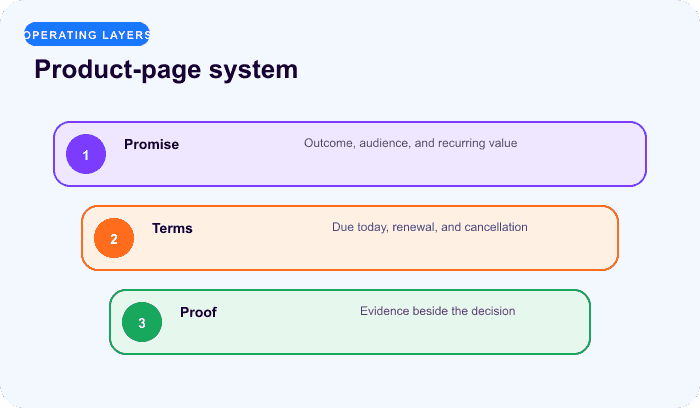
The page is accurate only when its claims match product configuration and downstream behavior. Before launch, buy the real product in a sandbox and verify:
- every variation and price sequence;
- cart and checkout recurring totals;
- tax and shipping lines;
- manual and automatic gateway behavior in scope;
- renewal order amount and date;
- trial, coupon, signup-fee, and zero-total interactions;
- customer emails and My Account actions;
- cancellation and failed-payment outcomes;
- mobile layout, keyboard navigation, labels, and contrast.
For the end-to-end process, use the WooCommerce subscription launch checklist. If the underlying model is not settled, begin with WooCommerce subscription product types.
Final recommendation
Design the product page as the readable version of the subscription contract. Lead with the outcome, show the complete price sequence, explain what happens between payments, and prove the exact checkout and renewal behavior before publishing. Compare ArraySubs plans when you are ready to implement the model.
Frequently asked questions
What should be above the fold on a subscription product page?
Show the outcome, included plan or quantity, amount due today, recurring amount and cadence, first renewal timing, variation selector when needed, and one primary action. Add one short trust statement that addresses a payment, delivery, cancellation, or support concern.
Should I show the total contract value?
Show it when the agreement has a fixed payment count or minimum commitment. For an ongoing cancel-anytime offer, show the recurring amount, cadence, next date, and cancellation terms rather than inventing a finite total.
Where should cancellation information appear?
Put a plain-language summary near the purchase action and link to the full policy. State whether cancellation is immediate or at period end, when future charges stop, what happens to access or shipments, and whether refunds are separate.
Do testimonials increase subscription conversion?
Relevant, attributable proof can reduce uncertainty, but there is no universal lift. Test proof placement using your own completed-checkout, refund, support, and retention data rather than publishing an unsupported benchmark.
How do I test a WooCommerce subscription product page?
Complete checkout with every important variation and gateway, inspect the resulting subscription and order, run a renewal, test a failed or manual payment where applicable, and verify mobile, accessibility, tax, shipping, emails, cancellation, and account management.
Disclosure, verification, and update log
- July 2026: Verified against current WooCommerce subscription-product guidance, ROSCA source material, and ArraySubs product behavior. Examples are illustrative; legal and tax outcomes require qualified review.
Continue from strategy to setup
Use a recipe when the model is settled
These articles own the decision and operating model. The ArraySubs feature map and recipes cover the exact product, billing, and customer-workflow configuration.
Written by
Emran // ArrayHash
Research and practical guidance for WooCommerce subscription operators and implementation teams.
Technical review
ArraySubs Engineering Team
Reviewed against current ArraySubs code, product documentation, and the linked primary platform sources.