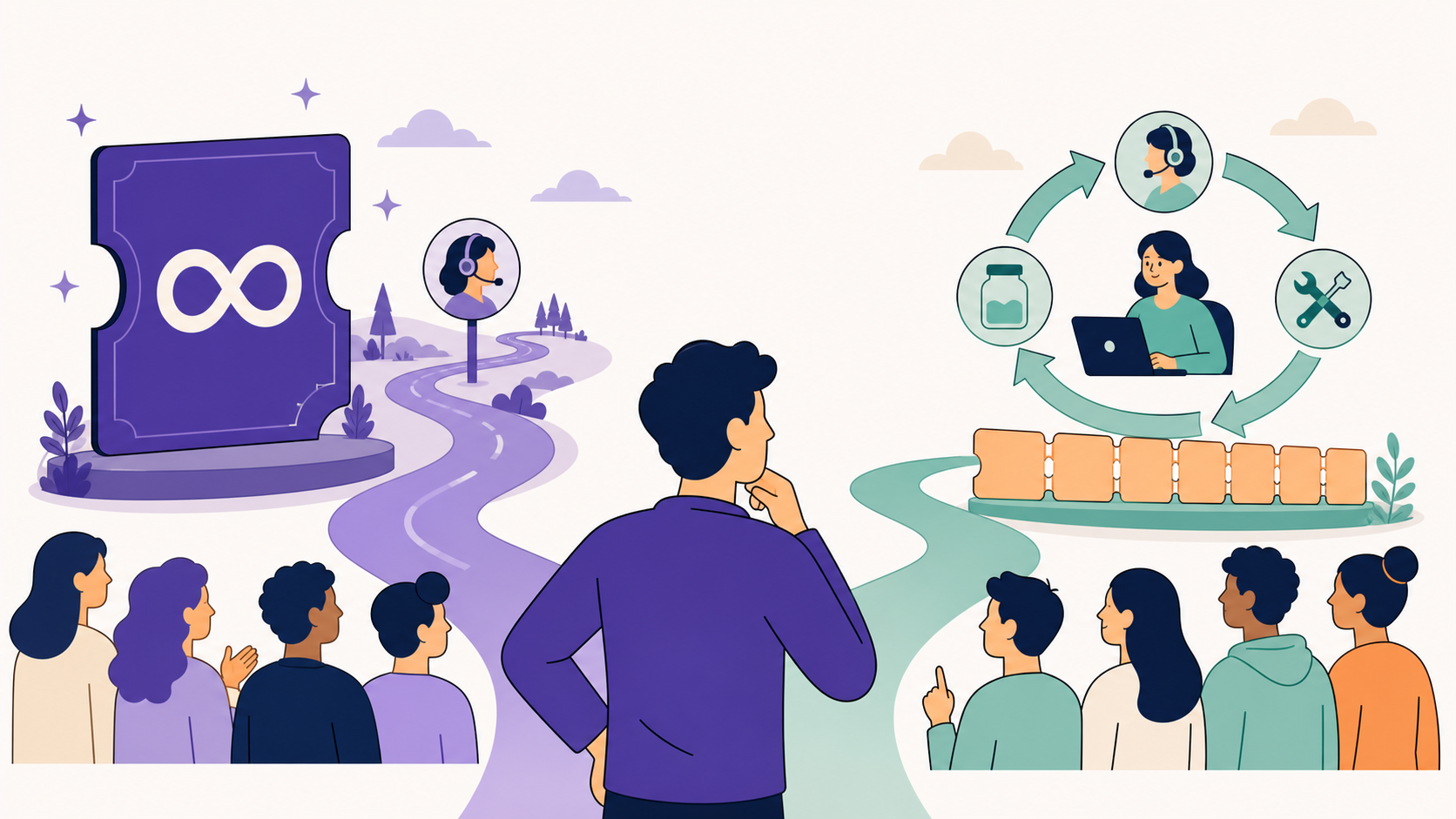
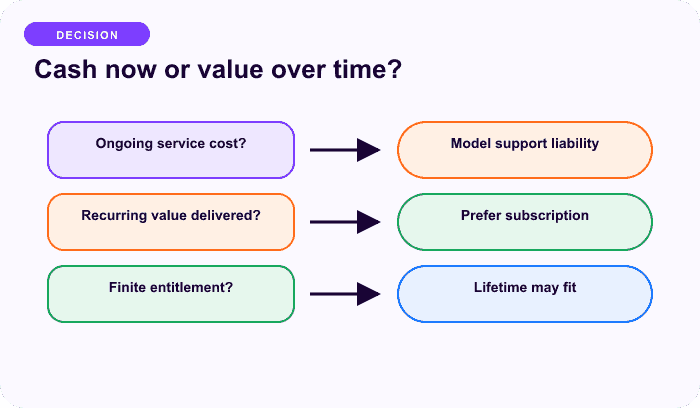
Choose a lifetime deal when one upfront price can fund the buyer's expected long-term support, infrastructure, updates, refunds, and risk reserve. Choose recurring billing when value and costs continue over time. Compare lifetime price with realized recurring contribution—not revenue alone—and define exactly whose lifetime, which benefits, usage limits, updates, support, and termination rights are included.
Cash is not contribution. A lifetime cohort can create strong launch cash and still become costly after years of support and infrastructure without another payment.
Key takeaways
- “No renewal” does not mean “no future cost.”
- Lifetime price divided by recurring price is gross-payment equivalence, not profit break-even.
- Price lifetime from immediate costs, future-cost scenarios, a risk reserve, and required contribution.
- Hosted, usage-heavy, support-intensive, and continuously updated services usually align better with recurring or hybrid pricing.
- ArraySubs Free ships Lifetime Deal billing with no scheduled renewal, but access still depends on the stated terms and subscription status.
Define the models before comparing them
| Model | Payment pattern | Merchant obligation | Primary risk |
|---|---|---|---|
| Lifetime deal | One payment | Defined ongoing entitlement | Long-tail cost without later payment |
| Open recurring | Payment each period | Continue while eligible | Cancellation, failures, recurring delivery cost |
| Fixed-cycle | Set periodic payment count | Deliver each paid cycle, then expire | Collection and fulfillment |
| Prepaid fixed term | One payment for a finite term | Deliver the whole term | Refund and unfulfilled obligation |
| Perpetual license | Usually one payment | Continued use under license scope | Version, updates, transfer ambiguity |
Complete this sentence before publishing:
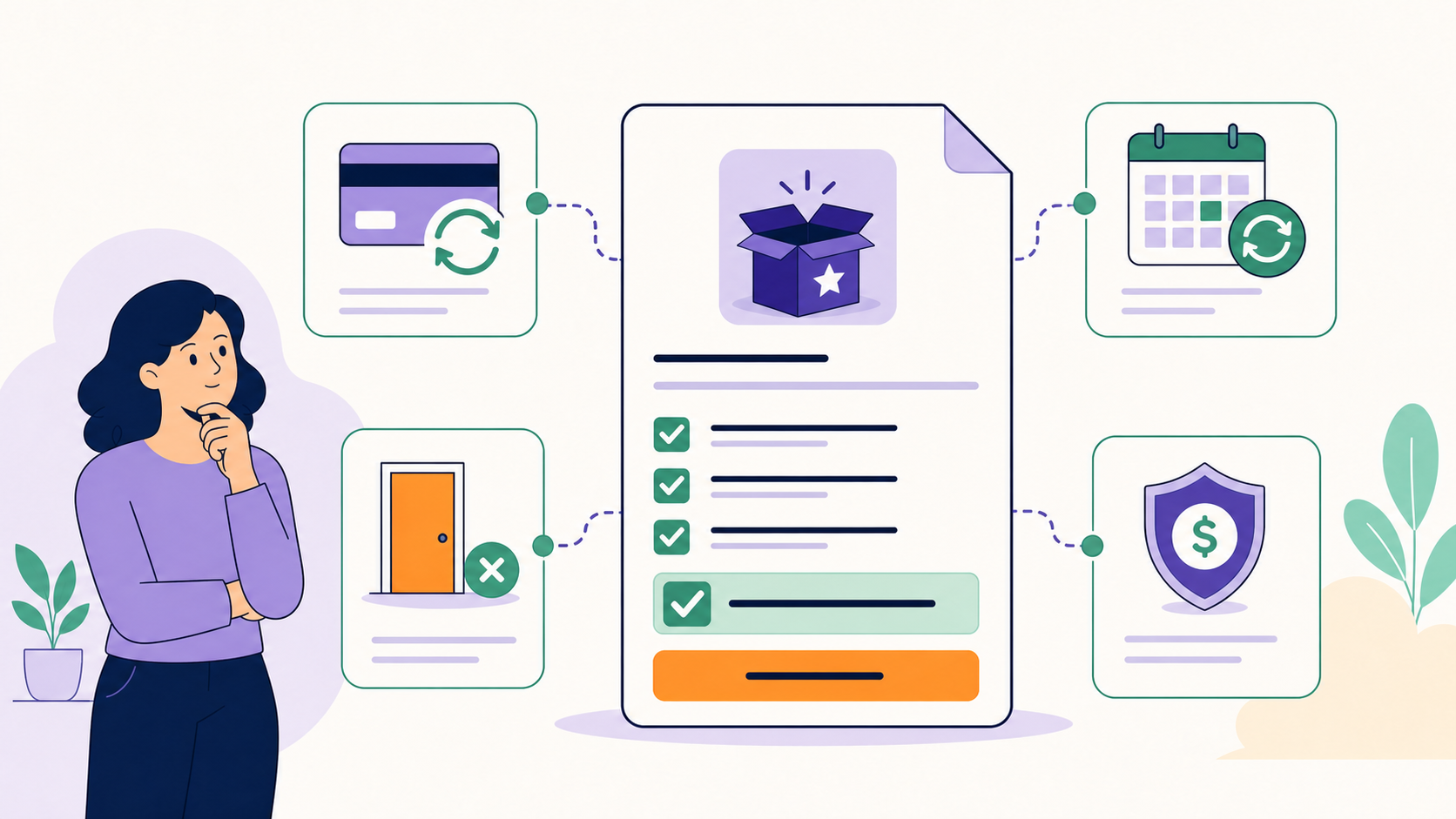
One payment grants [buyer/account/license] access to [specific product/version/content/service] for [defined lifetime/end condition], including [updates/support/cloud/usage scope], subject to [limits, refund, suspension, and discontinuation terms].
Lifetime access, future major versions, compatibility/security maintenance, human support, hosted services, API/AI usage, storage, community, and new content are separate promises. Do not compress them into one “lifetime” badge.
Build a lifetime price floor
Let L be lifetime price, A acquisition cost, O onboarding cost, G initial payment cost, Q refund/chargeback allowance, Cₜ expected service cost in year t, H the planning horizon, and T required contribution:
Undiscounted service reserve through H = Σ Cₜ
Illustrative lifetime price floor = A + O + G + Q + reserve_H + T
Annual cost Cₜ can include observed support tickets, loaded support cost, hosting, storage, API/email/AI, third-party licenses, security/compatibility allocation, updates/content, and moderation.
This is an internal management model, not an accounting provision or revenue-recognition rule. Use low/base/high scenarios and qualified accounting, tax, and legal advice.
Recurring contribution is earned only when payments succeed:
Recurring contribution through n paid periods
= Σ (payment_k − gateway cost_k − variable service cost_k)
− acquisition − onboarding − refunds
Gross equivalence is not break-even
Gross-payment equivalence = lifetime price ÷ recurring price per period
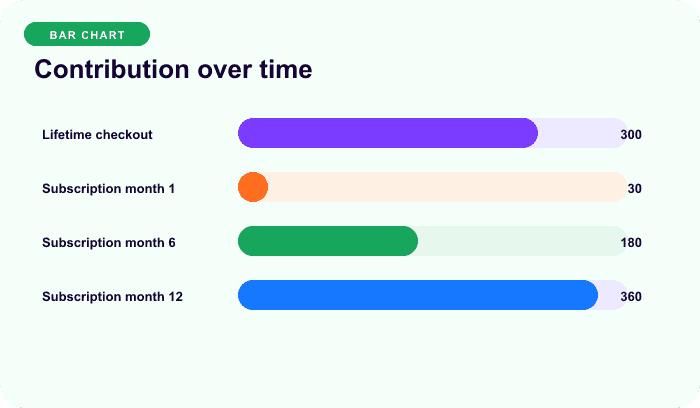
A $300 lifetime price divided by a $120 annual price equals 2.5 annual payments. That does not include support, hosting, updates, acquisition, refunds, failed renewals, or scope differences. Never label it “profit break-even.”
Worked matched-cost scenario
Assume the same entitlement is sold for $300 lifetime or $120/year, with $60 immediate acquisition/payment/onboarding cost and $36 support/infrastructure per active year. Ignore tax, refunds, chargebacks, discounting, price increases, and fixed overhead.
| Service year | Lifetime cumulative contribution | Recurring cumulative contribution if paid each year |
|---|---|---|
| 1 | $204 | $24 |
| 2 | $168 | $108 |
| 3 | $132 | $192 |
| 4 | $96 | $276 |
| 5 | $60 | $360 |
| 6 | $24 | $444 |
| 7 | -$12 | $528 |
Scenario arithmetic, not a forecast. Every shown recurring payment is assumed to succeed.
Lifetime starts with more contribution but loses $36 for each modeled service year. Recurring starts lower and funds later years only after successful renewal. Under these inputs, recurring exceeds lifetime in year three; another product can produce a different crossover or none at all.
Match model to continuing cost
| Product | Better starting model | Safer boundary or hybrid |
|---|---|---|
| Static download archive | One-time/lifetime | Define exact files/version and support |
| Self-hosted plugin/theme | Recurring or hybrid | Perpetual version + annual updates/support |
| Hosted SaaS | Recurring | Lifetime core + recurring hosted service |
| API, AI, storage, email | Recurring/usage | One-time credit pack with explicit units |
| Moderated community | Recurring | Capped founding cohort with reserve |
| Stable self-paced course | Lifetime/hybrid | Current course lifetime; coaching/community paid |
| Expanding library | Recurring/hybrid | Current content lifetime; future releases recurring |
| Physical replenishment | Recurring | Prepaid finite gift term, never lifetime fulfillment |
| Consulting support | Fixed package/retainer | Defined hours and deliverables |
A lifetime offer is a candidate only when entitlement scope is bounded, future costs are modelable, usage/support can be limited honestly, the business can fund low/base/high scenarios, and every customer surface can show the same promise.
Use hybrids to isolate continuing cost
Useful structures include:
- perpetual use of a purchased major version plus paid maintenance or future major versions;
- lifetime local/core capability plus recurring cloud sync, API, AI, email, storage, or monitoring;
- lifetime access to content available at purchase plus a paid future-release pass;
- lifetime product access with a clearly stated support window;
- a capped founding cohort whose exact terms are recorded, while future buyers use recurring;
- one-time credit pack plus later top-ups or subscription.
Grandfathering means preserving the recorded scope sold to an older cohort. Store eligibility dates, SKU/version/tier, receipt, support, update, cloud, site-limit, and major-version terms independently from mutable current product copy. Do not silently convert a one-time cohort into auto-renewal.
Make the checkout promise complete
Show the full one-time amount and “no scheduled recurring charge” near the purchase action. Define whose/product's lifetime, included versions and content, updates, support, hosted services, usage limits, transfer, refunds, suspension, discontinuation, taxes, third-party exclusions, and where the entitlement can be verified.
Avoid fake scarcity, unsupported crossed-out prices, hidden fees, “save forever” without a comparison horizon, and recurring add-ons that are visually buried. FTC staff guidance identifies hidden costs, forced continuity, misdirection, and false hierarchy as interface risks (Bringing Dark Patterns to Light). This is design context, not jurisdiction-neutral legal advice.
Pilot with a hard loss ceiling
When cost history is weak:
- cap the lifetime cohort before launch;
- record low/base/high cost and stop triggers;
- keep lifetime and recurring scope comparable or state differences;
- preserve the exact checkout evidence shown to each cohort;
- review support, active usage, infrastructure, refunds, and reserve before another cohort;
- stop when capacity or reserve triggers are reached.
Measure realized contribution, support/infrastructure per active lifetime customer, successful recurring payments, refunds, access-status outcomes, and remaining modeled reserve. Do not declare lifetime the winner from launch cash or recurring the winner from scheduled renewal value.
Current ArraySubs behavior
ArraySubs Free 1.8.9 includes a Lifetime Deal billing period for simple and variable subscription products. Checkout identifies “No recurring charges,” creates a managed subscription record, keeps next payment empty, rejects renewal-invoice creation, and bypasses payment-count expiration. Pro is not required merely for lifetime billing.
Do not translate that into immutable permanent access. Current customer cancellation can change an active lifetime record to Cancelled, and status-based Members Access can remove mapped roles when no other qualifying subscription exists. Refund-to-entitlement behavior and end-of-period cancellation also require live verification.
Use “ongoing access under the stated entitlement and status terms,” not an unconditional promise that access can never end. The Lifetime Deal recipe owns the setup steps.
For the recurring alternative, read Monthly and Annual Subscription Plans. For finite choices, read Customer-Chosen Subscription Duration.
Final recommendation
Choose lifetime only when the promise can be bounded and one price can fund the modeled long tail. Choose recurring when ongoing value creates ongoing cost. Use a hybrid when a durable asset can be separated from support, cloud, usage, or future releases.
Compare ArraySubs plans for the wider feature set; Lifetime Deal billing itself is included in core.
Frequently asked questions
What is the difference between a lifetime deal and a subscription?
Lifetime takes one payment for a defined ongoing entitlement with no recurring renewal. A subscription charges on a stated cadence while service or access continues.
How should I price a lifetime deal?
Model immediate costs, refunds, long-term support/infrastructure/update scenarios, and required contribution. Cap the first cohort when history is weak.
How many recurring payments equal a lifetime price?
Division gives gross-payment equivalence only. It is not profit break-even because it omits costs, failures, refunds, and scope.
Does lifetime include support and updates forever?
Not automatically. Access, versions, compatibility/security updates, support, cloud services, and new content are separate promises that must be stated.
Can ArraySubs sell lifetime and recurring products?
Yes. Current core supports recurring periods and Lifetime Deal billing. Define entitlement, cancellation, refund, support, and updates separately.
Disclosure, verification, and update log
ArraySubs is the product discussed by this site. ArraySubs 1.8.9/Pro 1.1.0 source and current official WooCommerce guidance were reviewed July 13, 2026. No live checkout, cancellation, refund, or access-removal test was run. Reserve examples are internal planning aids, not accounting or legal conclusions.
- July 2026: Initial publication; lifetime no-renewal behavior and status/access caveats verified in source.
Continue from strategy to setup
Use a recipe when the model is settled
These articles own the decision and operating model. The ArraySubs feature map and recipes cover the exact product, billing, and customer-workflow configuration.
Written by
Emran // ArrayHash
Research and practical guidance for WooCommerce subscription operators and implementation teams.
Technical review
ArraySubs Engineering Team
Reviewed against current ArraySubs code, product documentation, and the linked primary platform sources.