
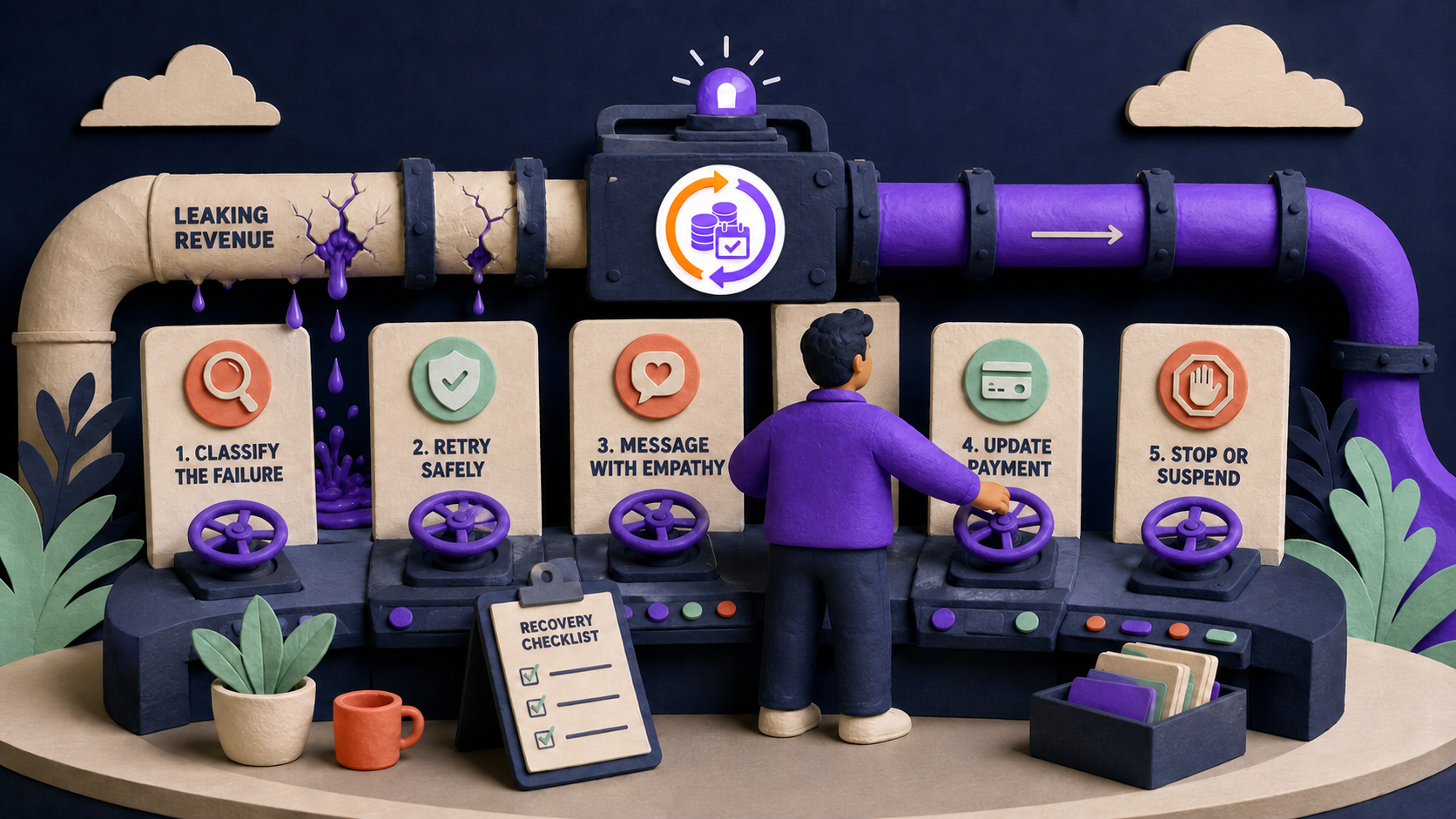
An involuntary-churn recovery checklist must cover more than retries: verify gateway and token health, prevent avoidable expiration failures, classify declines, coordinate retries and customer messages, define grace and access rules, reconcile webhooks and renewal orders, give support safe recovery tools, and measure closed cohorts only after every eligible invoice reaches a final state.
This checklist covers payment-driven churn, not customers who intentionally cancel. Voluntary cancellation, save offers, and cancellation UX need a separate strategy.
Key takeaways
- Separate preventable method problems, customer-action failures, technical faults, and provider-owned recovery.
- Coordinate local retries with remote retries and both grace boundaries.
- Require support to verify payment and state before retrying or promising restoration.
- Treat Mark Resolved as an audit action, not evidence that payment was collected.
- Measure eligible failed-renewal cohorts to a final state instead of using a point-in-time risk card as recovered revenue.
How should this involuntary churn checklist be used?
Use it as a continuous control loop:
prevent → detect → classify → recover → reconcile → learn
                          ↘ final policy ↗

Assign an owner and evidence source to every checked item. “Enabled retries” is not enough. Record which gateway owns them, what makes a renewal eligible, how duplicates are prevented, when they stop, and which test proves recovery restored access and the next billing date.
A recovery program fails at its weakest handoff. A good email cannot fix an invalid token. A successful gateway payment cannot fix access if its webhook never reconciles the order. An active remote subscription cannot prove the local renewal is paid.
1. Gateway, token, webhook, and scheduler readiness
- Use supported current versions of WooCommerce, ArraySubs, ArraySubs Pro, and each payment gateway.
- Confirm HTTPS, live/test mode, account connection, currency, and store timezone.
- Test initial signup and a genuine off-session renewal in the gateway sandbox.
- Test successful, failed, delayed, duplicated, and out-of-order webhook events.
- Test authentication-required recovery and method replacement.
- Verify WordPress cron and Action Scheduler execute on time without a growing backlog.
- Confirm the local subscription, parent order, renewal order, customer/token reference, currency, and remote agreement correspond.
- Store gateway tokens only; never collect full card numbers or CVC in email, tickets, notes, or screenshots.
- Document who owns retries for every gateway.
WooCommerce's subscription health and troubleshooting guidance includes scheduled actions, plugins/environment, orders, gateways, and subscription state—not just the decline response (WooCommerce Subscriptions health check, WooCommerce troubleshooting framework).

Evidence to retain
Record safe IDs and timestamps, not secrets: subscription/order IDs, remote object IDs, gateway event IDs, scheduled-action IDs, token/customer references, status changes, and signed-webhook result. Redact customer identity and any credential material from shared captures.
2. Pre-renewal prevention
- Decide whether an upcoming-renewal reminder is useful for the product and appropriate for the customer promise.
- Enable card-expiry notices only when the gateway supplies reliable expiration evidence.
- Provide a gateway-hosted method-update or reauthorization path.
- Make billing and contact information easy to update from an authenticated account.
- Monitor webhook failures, token errors, provider incidents, and scheduled-action backlog before renewal dates.
- Verify the customer can recognize the store, subscription, and destination domain in notices.
- Do not claim ArraySubs operates a network account updater.
Read Expired Cards and Subscription Recovery for the distinction between a network-updated credential, a portal update, and a fully recovered renewal.
3. Failure detection and classification
- Record the first failure time, renewal order, subscription, gateway, remote event/payment, and safe reason/code.
- Deduplicate event processing.
- Before charging again, check whether the remote payment already succeeded.
- Preserve raw provider evidence safely for operations and show customer-friendly language externally.
- Classify the next action as retry later, update method, authenticate, stop/escalate, or technical/reconcile.
- Escalate lost/stolen, revoked, fraud, dispute, or invalid-account evidence rather than blindly retrying.
- Separate provider-owned recovery from local collection.
Stripe documents decline codes and advises using provider/network evidence rather than guessing from one broad label (Stripe card declines). PayPal and Paddle can own retries and past-due recovery remotely (PayPal payment failure retry, Paddle payment recovery).
4. Retry-policy controls
- Identify local, manual/customer, and remote-provider collection paths.
- Do not let local and provider retry engines overlap for the same obligation.
- Use decline-adaptive timing where the integration genuinely supports it.
- Cap attempts and define provider, lifecycle, and policy stop conditions.
- Align retries with the active grace, on-hold grace, access, and fulfillment cutoffs.
- Test the boundary where the final retry and hourly overdue checker can run near the same time.
- Before a manual retry, check for in-flight or recently successful remote attempts.
- Verify concurrency locks and payment idempotency/reconciliation separately.
Current ArraySubs Pro Stripe inspection found a fixed local schedule of up to three retries roughly 24 hours apart. Its normalized failure category does not currently change that cadence. Do not market it as Stripe Smart Retries; Smart Retries belong to Stripe Billing's provider-owned invoices (Stripe Revenue Recovery, Stripe Smart Retries).
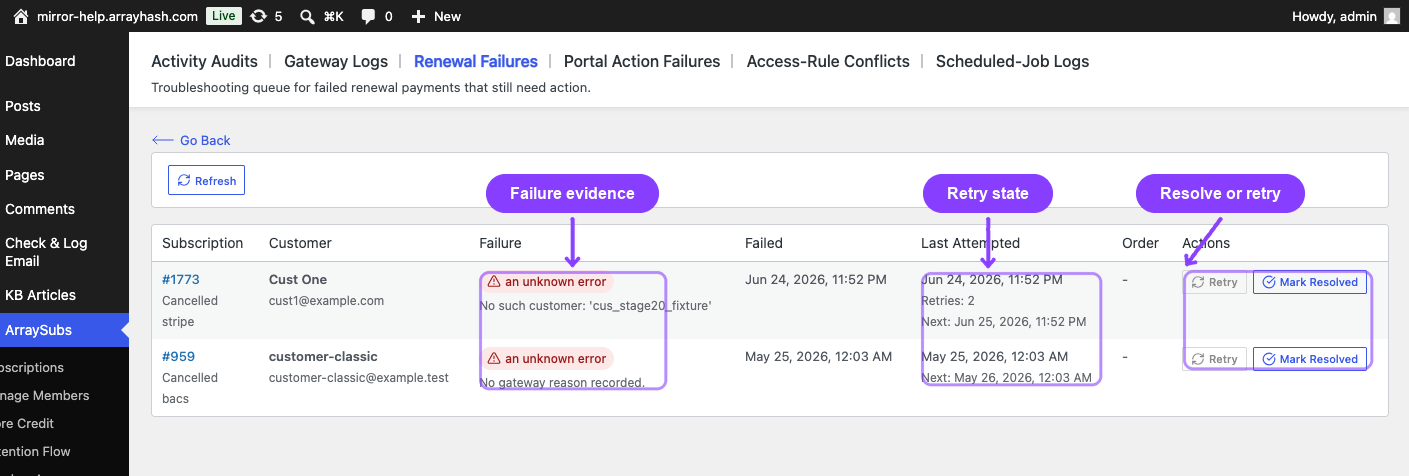
Retry is an active collection action and needs duplicate/in-flight checks. Mark Resolved closes or updates an administrative record; it does not itself pay the renewal order.
5. Customer communication
- Send a calm notice only after failure is verified.
- Include subscription, safe reason, amount when reliable, current state, secure action, deadline, consequence, and support.
- Coordinate ArraySubs, WooCommerce, Stripe, PayPal, Paddle, and automation-platform messages.
- Send another message only when it adds a retry, deadline, access change, or final state.
- Stop after payment, cancellation, downgrade, dispute, or verified manual resolution.
- Authenticate the sending domain and monitor bounces, complaints, and broken links.
- Never ask customers to email card details or security codes.
Use the failed-payment email sequence playbook for adaptable state-based templates. Google documents authentication and other sender requirements for Gmail, with additional expectations for higher-volume senders (Google email sender guidelines). Compliance with those guidelines does not guarantee inbox placement.
6. Grace, access, and fulfillment
- Define payment, access, fulfillment, and lifecycle clocks separately.
- State what remains available during active grace.
- State what changes when the subscription moves on hold.
- Configure and test roles, content rules, downloads, features, APIs, and caches explicitly.
- Stop physical shipment or human-delivered service at the correct operational cutoff.
- Define cancellation versus fallback downgrade.
- Document customer data and credit retention.
- Align the local final state with the remote provider's recovery or cancellation state.
Current ArraySubs core uses a two-phase grace policy with three active days and seven on-hold days as current defaults; the fields are configurable and overdue checks run hourly. Those defaults are not benchmarks. Default active-subscription access does not include on-hold, but explicit status/role rules can vary.
7. Customer-facing recovery path
- Keep authenticated account access available while recovery remains eligible.
- Show the actual subscription state and exact renewal that needs attention.
- Provide Pay Now, method update, authentication, or reauthorization according to gateway capability.
- Hide actions that no longer apply.
- Test mobile, accessibility, session expiry, and return from provider-hosted pages.
- Verify action links cannot expose or mutate another customer's subscription.
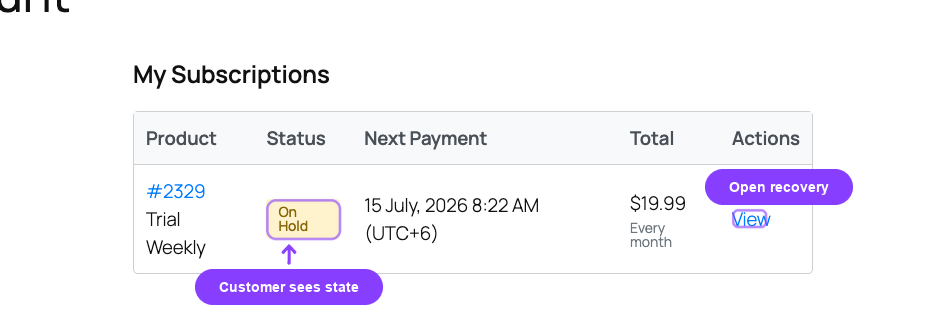
A customer should not need to understand order taxonomy to recover, but the action must still target the correct renewal behind the scenes.
8. Support operations and payment-data safety
- Give agents a short identity-verification script and least-privilege access.
- Never request PAN, CVC, raw payment tokens, or screenshots containing them.
- Show the exact order, subscription, gateway, attempts, next retry, and last provider event.
- Distinguish “method updated,” “retry requested,” “payment received,” and “fully restored.”
- Use a secure Pay Now/update/reauthorization link instead of taking payment data.
- Require a second check before manual retry or lifecycle override.
- Record manual actions and customer promises in the audit trail.
The PCI Security Standards Council prohibits storing card verification codes after authorization (PCI SSC FAQ 1533). That applies even when someone proposes encrypting the code “for support.”
9. Reconciliation and restoration
- Verify exactly one successful charge and one paid renewal order.
- Confirm transaction reference, amount, currency, and subscription/order relationship.
- Confirm local and remote subscription status.
- Restore the intended roles, content, feature limits, API access, shipment, or service state.
- Remove obsolete failure metadata and close/unschedule retries.
- Stop failure messages and send one accurate confirmation.
- Verify the next renewal date and scheduled actions.
- Process delayed or out-of-order webhooks idempotently.
- Investigate any disagreement before marking the failure record resolved.
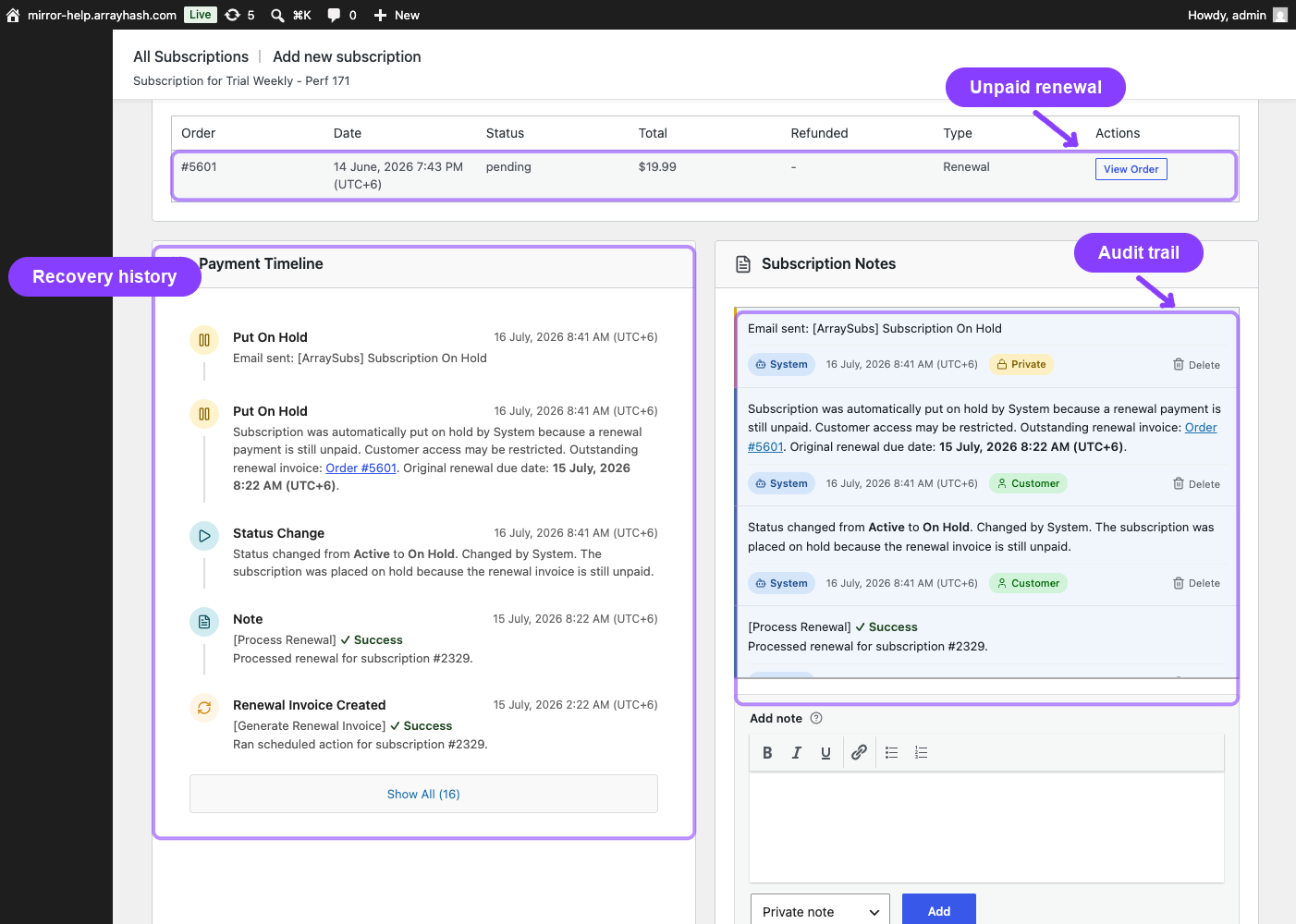
Reconciliation is where “the charge worked” becomes “the customer is actually recovered.”
10. Closed-cohort measurement and postmortem
- Define an eligible failed-renewal cohort and a final observation date.
- Follow every invoice to recovered, final loss, excluded, or still unresolved.
- Track amount, gateway, category, attempts, channel, method update, and elapsed time.
- Separate retry-only, customer-assisted, support-assisted, and updater-assisted recovery where evidence permits.
- Exclude voluntary cancellation and unrelated refunds or chargebacks.
- Segment only when sample size and privacy permit.
- Assign recurring technical causes to an owner with a due date.
Use these formulas:
invoice recovery rate
= recovered eligible failed renewal invoices
  ÷ eligible failed renewal invoices at final observation

gross revenue recovery rate
= successfully collected eligible failed-renewal amount
  ÷ eligible failed-renewal amount at final observation

median time to recovery
= median(success time − first verified failure time)
Choose an observation window long enough to cover the full retry and grace policy. Report open invoices separately instead of silently treating them as recovered or lost.
ArraySubs revenue-at-risk analytics can estimate normalized MRR exposure for on-hold and pending-cancellation subscriptions. That is useful for prioritization, but it is not a closed failed-invoice denominator and does not prove recovered revenue.
Postmortem questions
- Which failures were preventable?
- Which failures needed customer action, and was that action reachable?
- Which retries were unnecessary or contradictory?
- Which payments succeeded remotely but failed to reconcile locally?
- Which customers paid but did not regain access?
- Which physical or service fulfillments escaped the correct cutoff?
- Which messages were duplicated, late, misleading, or unsafe?
- Which cause deserves a code, configuration, gateway, or process owner?
Current ArraySubs boundary summary
Current first-party review on July 16, 2026 found:
- core two-phase grace, lifecycle emails, renewal invoices, notes, and shared scheduling;
- Pro automatic gateway paths, including local Stripe collection and remote PayPal/Paddle coordination;
- fixed local Stripe retry timing rather than decline-adaptive scheduling;
- a Pro Renewal Failures audit with Retry and Mark Resolved actions;
- customer payment-failed, admin, on-hold, cancelled, card-expiring event, and auto-downgrade lifecycle messages;
- a point-in-time revenue-at-risk estimate that should not be labeled cohort recovery.
This was a source and interface review, not a statistically valid gateway matrix or recovery benchmark.
For implementation, start with a documented lenient grace recipe or strict grace recipe and keep the complete failed-payment recovery guide beside this checklist.
Final recommendation
Run involuntary-churn recovery as an auditable control system. Prevent what can be prevented, route each failure by the required remedy, let only one engine own collection, preserve a safe customer path, and verify every recovered payment through order, status, access, fulfillment, messages, and next renewal before counting it.
After the checklist passes in sandbox and controlled live monitoring, review ArraySubs Pro pricing or explore subscription operations.
Frequently asked questions
What is involuntary subscription churn?
It is the loss of a subscription because payment or billing operations failed rather than because the customer intentionally chose to cancel. Keep it separate from voluntary churn in reporting.
Are retries enough to reduce involuntary churn?
No. Token health, gateway ownership, customer action, webhooks, order state, grace, access, support, and restoration can each break recovery.
Does Mark Resolved collect a failed renewal payment in ArraySubs?
No. It is an administrative record action. Verify the paid renewal order and lifecycle state independently.
Is ArraySubs retry timing decline-aware?
Current inspected local Stripe timing is fixed at up to three retries roughly 24 hours apart. The normalized failure category does not currently choose a different cadence.
Should on-hold always remove customer access?
Default active-subscription qualification ends on hold, but explicit subscription-status and role behavior can preserve selected access. Test every protected surface.
How long should a failed invoice remain in the measurement cohort?
Until the full retry and grace window has closed and the invoice reaches a final outcome. Report still-open invoices separately.
Author, technical review, and verification environment
Author: Emran, ArrayHash — product and editorial work across WooCommerce subscription operations.
Technical reviewer: ArraySubs Engineering Team — review scope includes gateway ownership, retry/grace boundaries, renewal audits, payment reconciliation, customer recovery, and analytics semantics.
Verification environment: Source and UI review of ArraySubs 1.8.11 and ArraySubs Pro 1.1.2 on July 16, 2026, plus current official WooCommerce, Stripe, PayPal, Paddle, Google, and PCI SSC guidance. No statistically valid recovery cohort or live gateway matrix was run.
Disclosure, limitations, and update log
- Commercial disclosure: ArraySubs is an ArrayHash product. Current product behavior and limitations are stated explicitly.
- Limitations: Gateways, network rules, webhooks, scheduler reliability, plugins, and business policy vary. This is operational guidance, not PCI or legal advice.
- July 16, 2026: First publication. Verified the audit action semantics, retry/grace boundaries, portal evidence, revenue-at-risk caveat, and full prevention-to-measurement checklist.
Continue from strategy to setup
Use a recipe when the model is settled
These articles own the decision and operating model. The ArraySubs feature map and recipes cover the exact product, billing, and customer-workflow configuration.
Written by
Emran // ArrayHash
Research and practical guidance for WooCommerce subscription operators and implementation teams.
Technical review
ArraySubs Engineering Team
Reviewed against current ArraySubs code, product documentation, and the linked primary platform sources.