
Gated WooCommerce content can rank only to the extent that search engines can crawl useful public material. With ArraySubs server-side gating, an unauthorized crawler receives the same teaser or denial output as a guest, not the protected body. Publish a substantial public answer, gate the premium section, keep metadata honest, and test the rendered guest response in Google Search Console.
Indexing a useful public teaser and indexing the complete paywalled article are different architectures. Structured data describes the latter when implemented correctly; it does not unlock a body that the crawler never receives.
Key takeaways
- Search engines index the response they can fetch; schema cannot reveal a server-omitted premium body.
- Current ArraySubs does not whitelist Googlebot; an unauthorized crawler gets the guest policy.
- Partial server-side gating preserves a useful public shell more naturally than replacing the whole page.
- Google paywall markup is for content Google can access and the publisher intends to index; it is not access control.
- Test guest, non-member, member, cache, canonical, robots, structured data, social previews, and Search Console independently.
What can a search crawler see on a gated page?
A crawler can process the status, headers, metadata, HTML, rendered resources, links, and structured data available to its request. If server-side authorization replaces the premium body with a denial message, the protected body is absent from that response.

Current ArraySubs full content gating can replace the main post content for denied visitors. Archive behavior can also omit, lock, or show items according to current rule settings. The inspected implementation does not automatically add Google paywall schema, canonical tags, noindex, snippet controls, or a special Googlebot entitlement.
That is the secure default for content that should not be delivered to unauthorized clients. It also means the omitted premium text is not made indexable by adding isAccessibleForFree: false to the public shell.
How does partial ArraySubs content gating affect SEO?
ArraySubs currently supports:
[arraysubs_restrict]shortcode;- server-rendered Gutenberg Restricted Content block;
- Elementor container conditions;
- PHP/helper integration.
For a denied visitor, the protected fragment is omitted or replaced while surrounding public content stays in the server response. The public shell can be crawled and indexed subject to ordinary quality and technical signals.
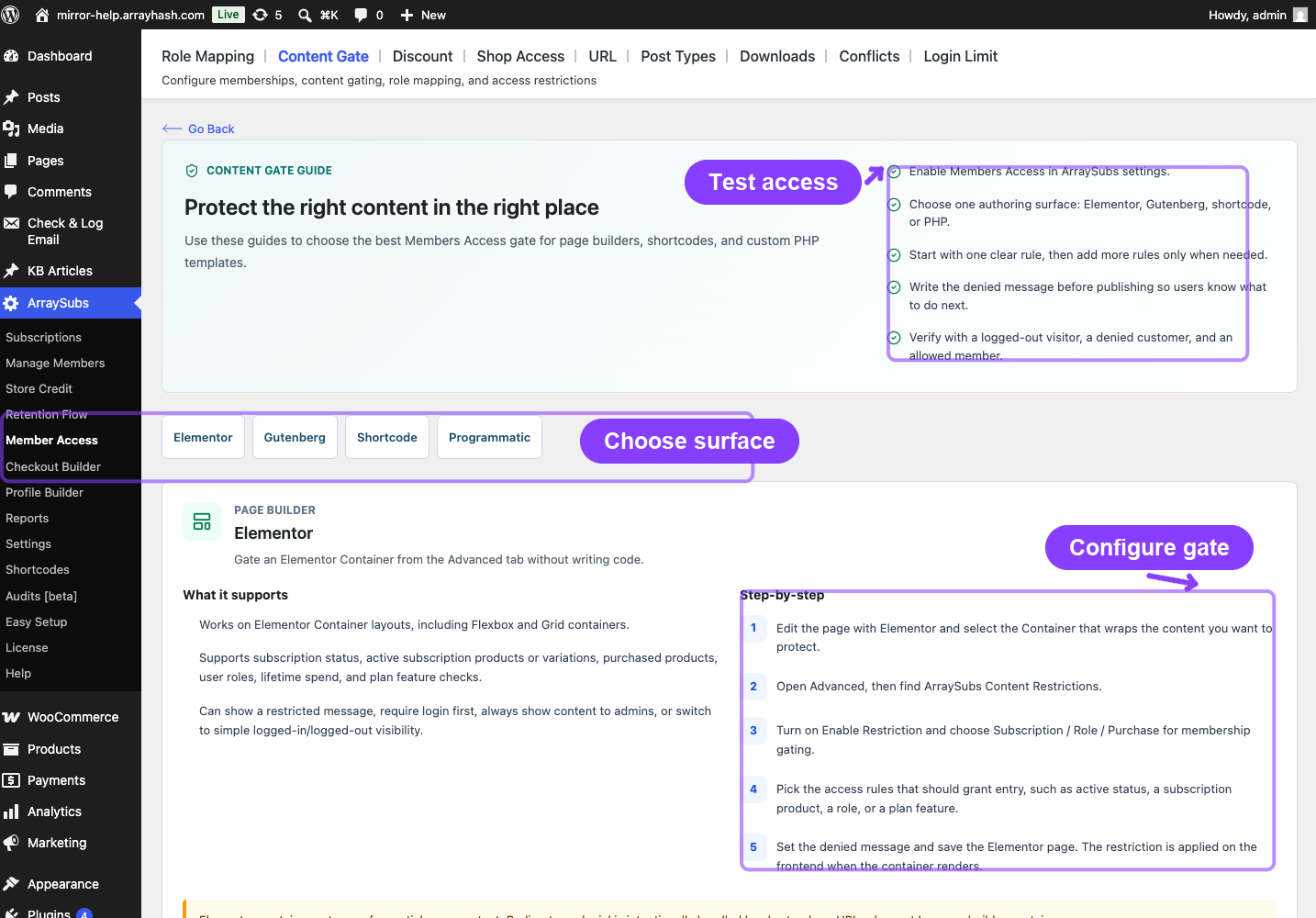
The protected fragment still needs separate file/API protection. A gated block that links to a public PDF, video URL, JSON endpoint, or image original does not secure the asset.
Which SEO architecture should gated content use?
| Architecture | Guest/crawler receives | What can rank | Best fit | Main caveat |
|---|---|---|---|---|
| Public answer + premium section | useful answer, evidence, navigation, premium boundary | public portion and page topic | course, report, tutorial, resource acquisition | premium details are not crawlable by default |
| Fully paywalled article with authorized crawler access | complete article under a controlled paywall policy plus matching markup | potentially the complete article | publisher intentionally using Google's paywall pattern | requires separate access/crawler architecture; not automatic in ArraySubs |
| Fully private/noindex resource | login/denial or no public resource | no organic acquisition goal | customer workspace, licensed files, private community | requires public landing alternatives if discovery matters |

Choose before writing. A fully private resource should not be assigned an organic traffic target. A search-acquisition page needs enough public value to deserve the click independently of the premium upsell.
Write two promises before drafting: the search promise describes the complete value an unauthorized visitor receives, and the member promise describes the additional outcome behind the gate. If either sentence is vague, the boundary is not ready.
For example, “learn how to choose a protected-download architecture” can be the public promise, while “use the member-only configuration worksheet and red-team test sheet” is the paid promise. The public title, description, headings, and internal links should satisfy the first sentence. The gate card and member onboarding should deliver the second. This separation prevents metadata from advertising material that the crawler and search visitor cannot obtain.
Review the two promises whenever a section moves across the boundary. A content edit can change search intent and conversion truth even when the URL, canonical, and access rule remain unchanged.
How much content should remain public?
There is no universal percentage or word count. Use the ANSWER framework:
- A — Answer: Resolve the query directly in 40–60 words.
- N — Name the tradeoff: State what remains premium and why.
- S — Show evidence: Include an original example, table, screenshot, or tested workflow.
- W — Way forward: Give a usable public checklist or decision path.
- E — Entitlement boundary: Mark where premium material begins.
- R — Relevant CTA: Offer login, plan comparison, or membership after delivering the answer.

The public section should satisfy the informational intent it targets. Premium material can supply templates, datasets, tools, deep implementation, personalized output, or community/service value. Hiding the basic answer behind an inaccurate “complete guide” title creates poor search and reader expectations.
How should archive visibility be configured?
Current ArraySubs post-type rules can choose archive behavior separately from body restriction. A collection can be hidden, shown with a lock, or listed normally while the content is restricted.
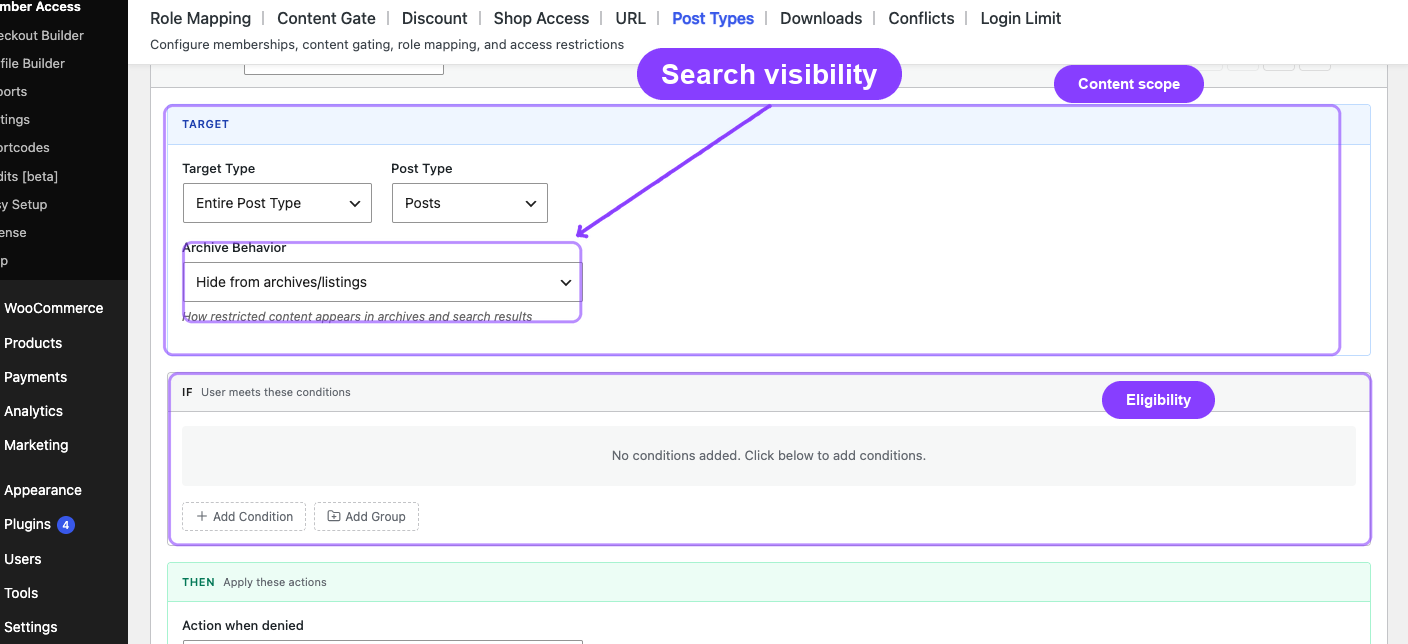
Use hide/private behavior for customer-only or confidential resources. Use lock/listing behavior when titles and descriptions help members discover what exists. Use public previews when discovery is a deliberate acquisition channel. Test pagination, internal search, taxonomy, feeds, sitemaps, related content, and cached archives.
What should titles and descriptions promise?
The title and meta description should describe what a search visitor can actually receive. If the public page answers the main question and offers a premium worksheet, say so. If only a login form appears, do not promise the complete analysis.
Open Graph and social metadata can leak premium excerpts even when the body is gated. Test social crawlers, messaging previews, excerpts, feeds, JSON-LD, image metadata, and authoring tools.
Canonical, noindex, and snippet controls
- Canonical: Consolidates duplicate or similar URLs; it does not make unavailable premium content indexable (Google canonical URLs).
noindex: Keeps a page out of search when Google can crawl and see the directive.nosnippet/max-snippet: Limits search snippets; it does not secure the page.data-nosnippet: Excludes selected visible text from snippets; it is not an entitlement check.- X-Robots-Tag: Useful for non-HTML resources, subject to crawlability and correct headers.
Google documents these robots and snippet controls (Google robots meta). Choose them per public/private strategy. Blocking crawl in robots.txt can prevent a crawler from seeing a page-level noindex.
When should paywalled-content structured data be used?
Google documents isAccessibleForFree: false with hasPart and a CSS selector for paywalled sections (Google subscription and paywalled content markup). Use it when:
- the complete content is intentionally available to Google under the publisher's controlled paywall policy;
- the markup identifies the actual gated section;
- crawler and user treatment follows the same declared policy;
- visible content, HTML, and schema agree.

Do not show full content only to a self-declared Googlebot while ordinary unauthorized users get nothing. User-agent trust is weak access control and can become cloaking. Google says paywall markup helps distinguish legitimate paywalled content from cloaking, but the architecture must actually make the content available under that policy.
ArraySubs does not automatically emit this schema for every custom gate. Implement and validate it separately when it applies. Do not mark premium text that is absent from the crawlable response as if schema made it present.
Can gated content appear in AI search experiences?
Google's current AI-features guidance says ordinary indexing, quality, preview, and SEO controls apply; no special AI file or schema is required (Google AI features and your website). A system cannot cite protected detail it cannot access through its authorized retrieval path.
Publish clear public definitions, evidence, entity relationships, tables, and direct answers when discovery is the goal. Do not expose confidential member content merely to chase citations.
How can cache leak or hide gated content?
Shared caches can serve member HTML to guests or guest denial HTML to members.
Test:
- guest warms page; member requests it;
- member warms page; guest requests it;
- login and logout transitions;
- entitlement activation, hold, cancellation, expiration, and switch;
- desktop/mobile and cookie-vary behavior;
- CDN, full-page cache, fragment cache, edge render, and service worker;
- HTML source and network/API responses.

Authorization must happen before protected data enters a shared response. Client-side removal after delivery is not suitable for confidential content.
Gated-content rendering test matrix
| Persona/tool | Expected public content | Expected premium content | SEO/access check |
|---|---|---|---|
| Logged-out guest | public answer and navigation | omitted or denial | view source/rendered HTML; status |
| Logged-in non-member | same public answer | omitted or denial | no stale member cache |
| Active member | public answer | full authorized section | correct canonical/robots unless intentionally different |
| Google URL Inspection live test | guest policy unless separate paywall architecture exists | no unauthorized secret content | rendered HTML, canonical, robots, screenshot |
| Social preview crawler | accurate title/image/description | no protected excerpt in metadata | Open Graph/Twitter output |
Also test logged-out access after membership activation, hold, cancellation, expiration, switch, and cache purge.
How should gated-content SEO be measured?
Use a funnel with guardrails:
organic entrances
→ engaged public readers
→ gate or CTA views
→ login/pricing clicks
→ checkout starts
→ completed memberships
gate-to-membership conversion
= attributed memberships
  ÷ unique nonmembers who viewed the gate
Report the attribution rule and observation window. Monitor organic clicks, indexed pages, query/landing mix, scroll to gate, return-to-SERP behavior, login success, support tickets, existing-member denial, cache incidents, cancellation, refunds, and premium activation.
Do not claim rankings or AI citations from schema. Compare closed cohorts and annotate rule/content changes.
SEO and access audit checklist
- Page has a clear organic or private purpose.
- First 150 words provide the promised public answer when acquisition is intended.
- Public evidence and navigation are useful without membership.
- Premium boundary and benefit are explicit.
- Protected HTML/files/APIs are absent for unauthorized users when confidentiality matters.
- Title, description, social preview, and schema match guest-visible content.
- Canonical and robots directives follow the selected architecture.
- Paywall markup is used only when Google can access the identified content legitimately.
- Account, login, payment recovery, privacy, and support remain reachable.
- Guest/member/cache tests pass in both directions.
- Search Console live rendering is reviewed.
- Metrics use explicit denominators and guardrails.
Use the inline content-gating recipe after choosing the public/premium boundary, and read WooCommerce Content Restriction Strategy for rule governance.
When should content stay fully private?
Customer workspaces, licensed source files, personal output, internal community pages, private downloads, regulated information, and high-value proprietary tools may have no organic acquisition role. Use noindex/private navigation and public explanation pages rather than weakening authorization for search.
Final recommendation
Decide what search visitors may genuinely receive, publish a substantial public answer, authorize premium material server-side, and keep metadata/schema honest. Validate the rendered guest response, member response, cache, robots, canonical, social previews, and Search Console independently. Treat structured data as description—not an access key or ranking shortcut.
After the architecture is proven, review ArraySubs Pro pricing and member experience features.
Frequently asked questions
Does gated membership content hurt SEO?
Content a crawler cannot access cannot contribute its full text to indexing. A useful public shell or authorized paywall architecture can still support discovery, but no outcome is guaranteed.
Is partial restriction more SEO-friendly than a full gate?
It naturally preserves crawlable public material, but quality and implementation matter. A thin teaser can still be unhelpful, and private fragments must remain secure.
Does ArraySubs show premium content to Googlebot?
Current inspected code does not whitelist Googlebot. A crawler without entitlement receives the guest/denied response.
Can paywall schema make hidden content indexable?
No. It describes paywalled sections that Google can access under a legitimate policy. It does not reveal content omitted server-side.
Should private member resources use noindex?
Usually, when they have no search-acquisition purpose. Also protect them with authorization; noindex is not security.
Does a canonical make a premium page rank through a public version?
A canonical consolidates duplicate URL signals; it does not grant crawler access or transfer unavailable text automatically.
Author, technical review, and verification environment
Author: Emran, ArrayHash — product and editorial work across WooCommerce content, membership, and technical SEO.
Technical reviewer: ArraySubs Engineering Team — review scope includes server-side rendering, partial gates, archive modes, cache risk, metadata/schema boundaries, and live UI evidence.
Verification environment: Source and live UI review of ArraySubs 1.8.11 and ArraySubs Pro 1.1.2 on July 16, 2026, plus current Google Search documentation. No Search Console property or live cache configuration was changed.
Disclosure, limitations, and update log
- Commercial disclosure: ArraySubs is an ArrayHash product. No ranking, indexing, conversion, or AI-citation outcome is promised.
- Limitations: Themes, SEO plugins, caches, CDNs, structured data, crawl policy, and content quality vary. Partial gating is not file protection.
- July 16, 2026: First publication. Verified current server-side gate rendering, no crawler exception/schema automation, public/premium architecture, cache test matrix, and current Google paywall guidance.
Continue from strategy to setup
Use a recipe when the model is settled
These articles own the decision and operating model. The ArraySubs feature map and recipes cover the exact product, billing, and customer-workflow configuration.
Written by
Emran // ArrayHash
Research and practical guidance for WooCommerce subscription operators and implementation teams.
Technical review
ArraySubs Engineering Team
Reviewed against current ArraySubs code, product documentation, and the linked primary platform sources.