

Use content dripping when sequence, pacing, cohort timing, or ongoing release creates real member value—not merely to delay access. Choose an explicit anchor, release interval, catch-up policy, notification path, and expiry rule; show members what is available next. Offer immediate access when reference use, urgent results, self-paced learning, or experienced members make waiting harmful.
Dripping is a curriculum and experience policy implemented through access rules. It should not be used as a dark pattern to prevent members from consuming the value they reasonably expected.
Key takeaways
- Drip only when waiting benefits the member or reflects a genuine release model.
- Relative, fixed-cohort, completion-sequence, and editorial release need different anchors and operations.
- Current ArraySubs supplies relative rule delays from a qualifying subscription start—not fixed-date or completion triggers.
- A multi-step ArraySubs sequence uses independently governed rules for each release point.
- Measure activation, release reach, catch-up, support burden, access errors, and cancellation in closed cohorts; page views are not proof of learning.
Why drip membership content?
Before choosing a schedule, answer five questions:
- Why wait? Prerequisite, cognitive load, cohort coordination, production cadence, service capacity, or a continuing ritual?
- Anchor: Registration, purchase, subscription start, trial end, fixed cohort date, completion, or editorial release?
- Pace: What opens and how often?
- Recovery: What happens to late joiners, paused/on-hold members, returning members, and missed releases?
- Communication: How does a member discover newly available and still-locked content?

Good reasons to drip include:
- each step depends on a prior concept or action;
- live coaching and discussion follow a cohort calendar;
- ongoing release is part of the member promise;
- a short onboarding path reduces initial overwhelm;
- operational or human-service capacity must be staged transparently;
- sequential storytelling or spoilers matter.
Bad reasons include hiding the advertised archive, delaying an urgent outcome, or trying to make cancellation harder without adding new value.
Should content be dripped or available immediately?
Immediate or hybrid access is often better when:
- the product is a reference or lookup library;
- the member has an urgent problem;
- beginner and expert needs differ widely;
- the sale clearly promised an existing archive;
- lessons have no dependency sequence;
- work, leave, travel, disability, or caregiving require flexible pace;
- access may end before delayed value is available.
A hybrid can open the reference library immediately while staging an onboarding path, cohort workshops, or advanced projects.
| Model | Anchor | Best-fit hypothesis | Main risk |
|---|---|---|---|
| Immediate/self-paced | purchase or access grant | reference, urgent outcome, experienced user | overwhelm or binge-and-leave |
| Relative-time | each member's start | evergreen onboarding or course | every member has a different calendar |
| Cohort/fixed-date | shared date | live program, season, group discussion | late joiners and timezone coordination |
| Completion/sequence | prerequisite event | skill path where order matters | false blocking and tracking failures |
| Editorial release | publication schedule | newsletter, research, community | weak early library and production dependency |
| Hybrid | more than one | onboarding drip plus open resources | confusing policy complexity |

How should the drip anchor be chosen?
The anchor is the event from which availability is calculated.
- Registration: useful for free onboarding, but account creation may not equal purchase.
- Purchase/order: useful for one-time access, but refund and pending payment need rules.
- Subscription start: useful for evergreen recurring membership.
- Trial end/first payment: useful when expensive content should wait for collection.
- Fixed cohort date: useful when everyone joins one live experience.
- Completion event: useful when a prerequisite is truly enforced.
- Editorial release: useful when content is published for everyone on a cadence.
State the anchor in member language: “Lesson 2 opens seven days after your membership starts,” not “schedule rule = 7.” If trial time should not count, a subscription-start anchor is insufficient by itself.
What does current ArraySubs content scheduling do?
Current ArraySubs ScheduleEvaluator applies a relative delay at request time.
It currently:
- allows immediately when scheduling is disabled;
- denies guests for scheduled rules;
- converts days, weeks, and months to seconds;
- treats a month as exactly 30 days;
- finds qualifying subscriptions, defaulting to active and trial unless explicit status conditions alter the candidates;
- evaluates the rule conditions against each candidate;
- selects the earliest qualifying subscription start;
- unlocks at
earliest start + delayin UTC.
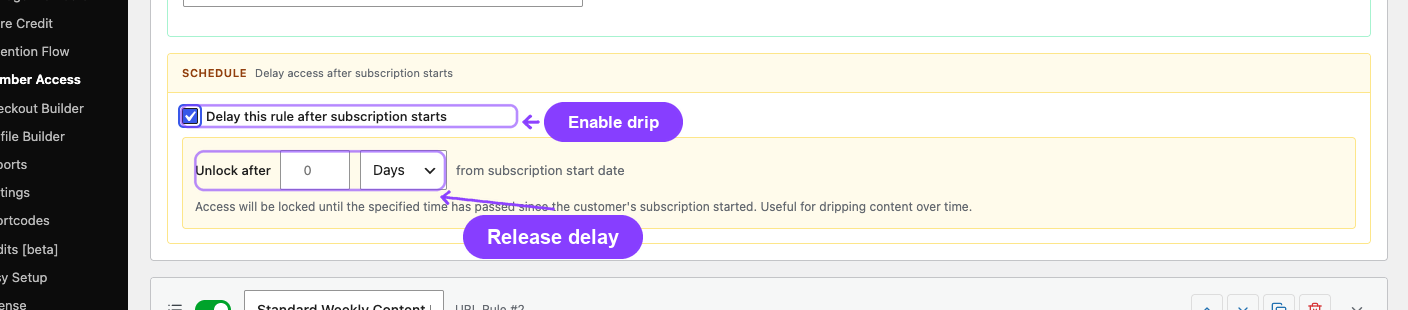
Schedule fields currently appear on post-type/taxonomy/selected-post rules, URL rules, download rules, shop-access rules, and discount rules.
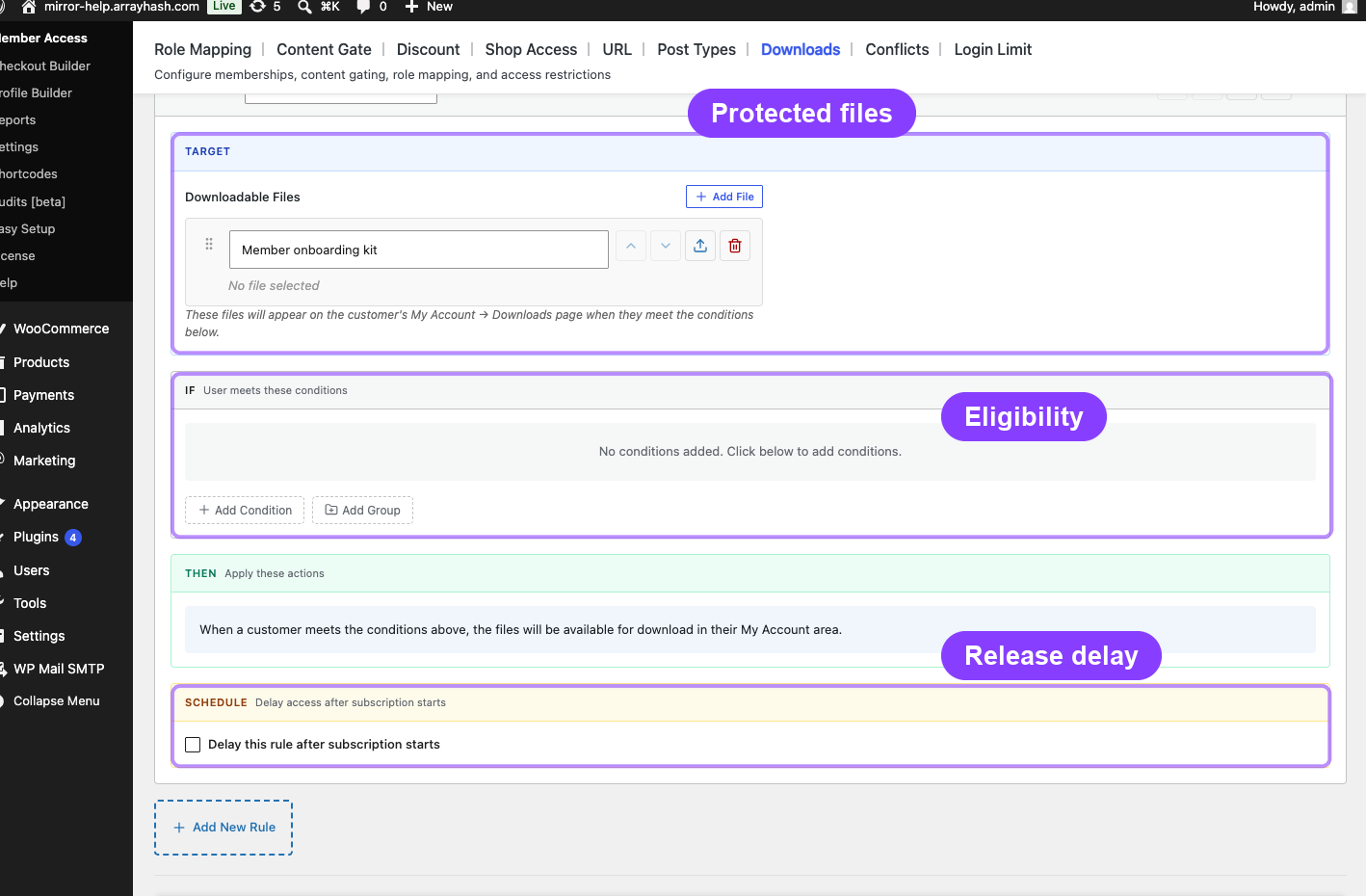
Current role mapping and the inspected partial Content Gate guide do not expose the shared schedule section. Per-post metadata restrictions also do not use that same schedule path in the inspected primary flow.
What ArraySubs does not currently provide
The inspected source did not show:
- fixed-calendar content release fields;
- content-completion/prerequisite triggers;
- one curriculum object that generates the entire sequence;
- an unlock-email scheduler tied to rule availability;
- a per-member “advance to lesson” control;
- a separate pause-the-drip-clock mechanism;
- calendar-month arithmetic.
Pro Fixed Period Membership calendar end dates are membership-term controls, not a fixed-date content-release engine.
What edge cases affect ArraySubs drip timing?
Multiple qualifying subscriptions
The earliest qualifying start wins. An older qualifying subscription can make newly added plan content open immediately. Tight product/variation/feature conditions are essential.
Rejoining
An older subscription can continue to anchor the delay if it still qualifies under the queried status and conditions. If it no longer qualifies, a new start may become the anchor. Do not promise reset or preserved progression without a real fixture.
Trials
Active-subscription conditions include trial. Time begins from the stored subscription start, not automatically from the first paid renewal. If paid access should begin only after trial, use explicit status/condition design and test it.
On hold and pause
Default candidates are active/trial, though explicit statuses can change that. The elapsed timestamp does not automatically pause while a subscription is on hold. Access qualification and time arithmetic must be considered together.
Months, timezone, and daylight saving
Current months are fixed 30-day durations and unlock comparison uses UTC timestamps. Do not describe them as calendar months. Format customer-facing dates in site-local time and test daylight-saving transitions where applicable.

How should a drip sequence be designed?
Give immediate access to orientation, support, the schedule, and the first useful result. A member should not pay and meet an empty dashboard.
Use this template:
| Release | Member outcome | Prerequisite | Anchor/delay | Format | Notification | Catch-up | Expiry |
|---|---|---|---|---|---|---|---|
| 0 | first useful result | none | immediate | quick start + checklist | onboarding | always open | none |
| 1 | next milestone | prior action if enforced elsewhere | chosen delay | lesson/resource | account/email | summary/replay | policy |
| 2 | applied practice | prior knowledge | chosen delay | workshop/template | calendar + portal | office hours/FAQ | policy |
| ongoing | recurring value | none or prior release | editorial cadence | research/community | digest | archive | term policy |
Each unique relative delay in current ArraySubs needs its own rule. Name them consistently—for example, Course X — Week 00, Week 01, and Week 02—and keep them in one inventory with owner, target, condition, delay, message, test member, and rollback.
What should late joiners and returning members experience?
A late joiner should not be stranded beside a moving program.

Choose one:
- catch up immediately with recordings and a summary;
- join the next cohort;
- receive a compressed orientation path;
- progress on a member-relative clock while live events remain cohort-based;
- receive a documented support accommodation.
Define paused, on-hold, cancelled, refunded, upgraded, downgraded, and rejoined behavior. Decide whether already unlocked resources remain, whether expiry is independent, and whether a new plan inherits old release time.
How should unlock notifications work?
An access rule evaluated at request time does not automatically create an email event. A reliable notification path needs:
calculated unlock event/date
→ notification job
→ access re-check at send time
→ deep link
→ delivery evidence
→ suppress if cancelled or ineligible

Current ArraySubs rule scheduling does not visibly schedule a matching unlock email. A separate automation must share or reproduce the unlock source and re-check eligibility at send time. Manually scheduled emails can drift after start-date edits, switches, cancellations, or rule changes.
How should content dripping be measured?
Define a closed cohort and the release eligibility date.
release reach
= eligible members using a release
  ÷ members whose release window opened

on-time reach
= eligible members using release before the next release
  ÷ members whose release window opened

sequence continuation
= members reaching release N+1
  ÷ members reaching release N

catch-up rate
= late members reaching the current release within the window
  ÷ members who fell behind

support burden
= drip/access support contacts
  ÷ members with an opened release
For an immediate-versus-drip experiment, predefine cohort assignment, content/offer held constant, meaningful-use event, observation window, cancellations/refunds/access failures, exclusions, and uncertainty. Do not infer learning from a page view or causation from a simple before/after.
Content-drip governance checklist
- Every delay has a member-benefit hypothesis.
- Immediate access includes orientation, support, and one useful result.
- Anchor and timezone are stated clearly.
- Locked items explain purpose and availability where appropriate.
- Navigation shows current and upcoming value.
- Late joiner and catch-up policy exists.
- Trial, pause, hold, cancel, refund, rejoin, upgrade, and downgrade are defined.
- Notification re-checks access at send time.
- Expiry is separate from progression.
- Support accommodation/override has owner and audit.
- Each ArraySubs release rule has a unique name, test, and rollback.
- Metrics use opened release windows and closed cohorts.
For gate implementation, use combined conditions, URL prefix lockdown, or inline content gating without duplicating configuration here.
When is ArraySubs not the best drip engine?
ArraySubs fits relative subscription-start delays across WordPress/WooCommerce resources. Use an LMS or another authoritative progression system when completion prerequisites, fixed cohort calendars, quizzes, grading, certificates, assignments, SCORM, routine per-member overrides, precise pause/resume clocks, calendar months, or built-in unlock notifications are mandatory.
Final recommendation
Drip only when waiting creates a better outcome. Choose the model and anchor explicitly, open orientation and first value immediately, design catch-up and lifecycle behavior, keep notifications reconciled with access, and measure release eligibility and meaningful use rather than assuming weekly delay improves retention.
After confirming that relative rule delays match the program, review ArraySubs Pro pricing and member experience features.
Frequently asked questions
Should membership content be dripped or available all at once?
Use immediate access for reference, urgent, self-paced, or mixed-experience libraries. Drip when prerequisites, cohorts, production cadence, or staged service creates genuine member value.
What is the best drip schedule?
There is no universal schedule. Select pace from content dependency, member capacity, support cadence, and first-party cohort tests.
Should trial time count toward drip access?
Only if that is the policy. Current ArraySubs relative timing begins at the qualifying subscription start, and trial commonly qualifies, so waiting until payment requires deliberate conditions.
Does pausing a subscription pause the drip clock?
Current arithmetic remains anchored to the start date; no separate pause-clock abstraction was found. Status can affect access eligibility but does not automatically shift elapsed time.
Can ArraySubs release content on a fixed date?
The inspected rule UI/source supports relative delays, not a fixed-calendar release trigger. Fixed Period Membership end dates are a different feature.
Does ArraySubs email members when content unlocks?
No built-in unlock-notification scheduler was found in the inspected Members Access scheduling path. Use a separate, reconciled notification workflow if needed.
Author, technical review, and verification environment
Author: Emran, ArrayHash — product and editorial work across membership curriculum, access, and lifecycle strategy.
Technical reviewer: ArraySubs Engineering Team — review scope includes ScheduleEvaluator, qualifying statuses, anchors, units, surfaces, multiple-subscription edge cases, and notification boundaries.
Verification environment: Source and live UI review of ArraySubs 1.8.11 and ArraySubs Pro 1.1.2 on July 16, 2026, plus current WooCommerce Memberships and MemberPress documentation. No live time-travel, scheduler, or learning-outcome experiment was run.
Disclosure, limitations, and update log
- Commercial disclosure: ArraySubs is an ArrayHash product. Unsupported fixed-date, completion, notification, and pause-clock capabilities are stated explicitly.
- Limitations: Content, pedagogy, member capacity, status data, timezones, and external automations vary. No retention or completion uplift is claimed.
- July 16, 2026: First publication. Verified current relative-delay semantics, earliest-start anchor, 30-day month, supported surfaces, edge cases, live schedule UI, and non-native capabilities.
Continue from strategy to setup
Use a recipe when the model is settled
These articles own the decision and operating model. The ArraySubs feature map and recipes cover the exact product, billing, and customer-workflow configuration.
Written by
Emran // ArrayHash
Research and practical guidance for WooCommerce subscription operators and implementation teams.
Technical review
ArraySubs Engineering Team
Reviewed against current ArraySubs code, product documentation, and the linked primary platform sources.