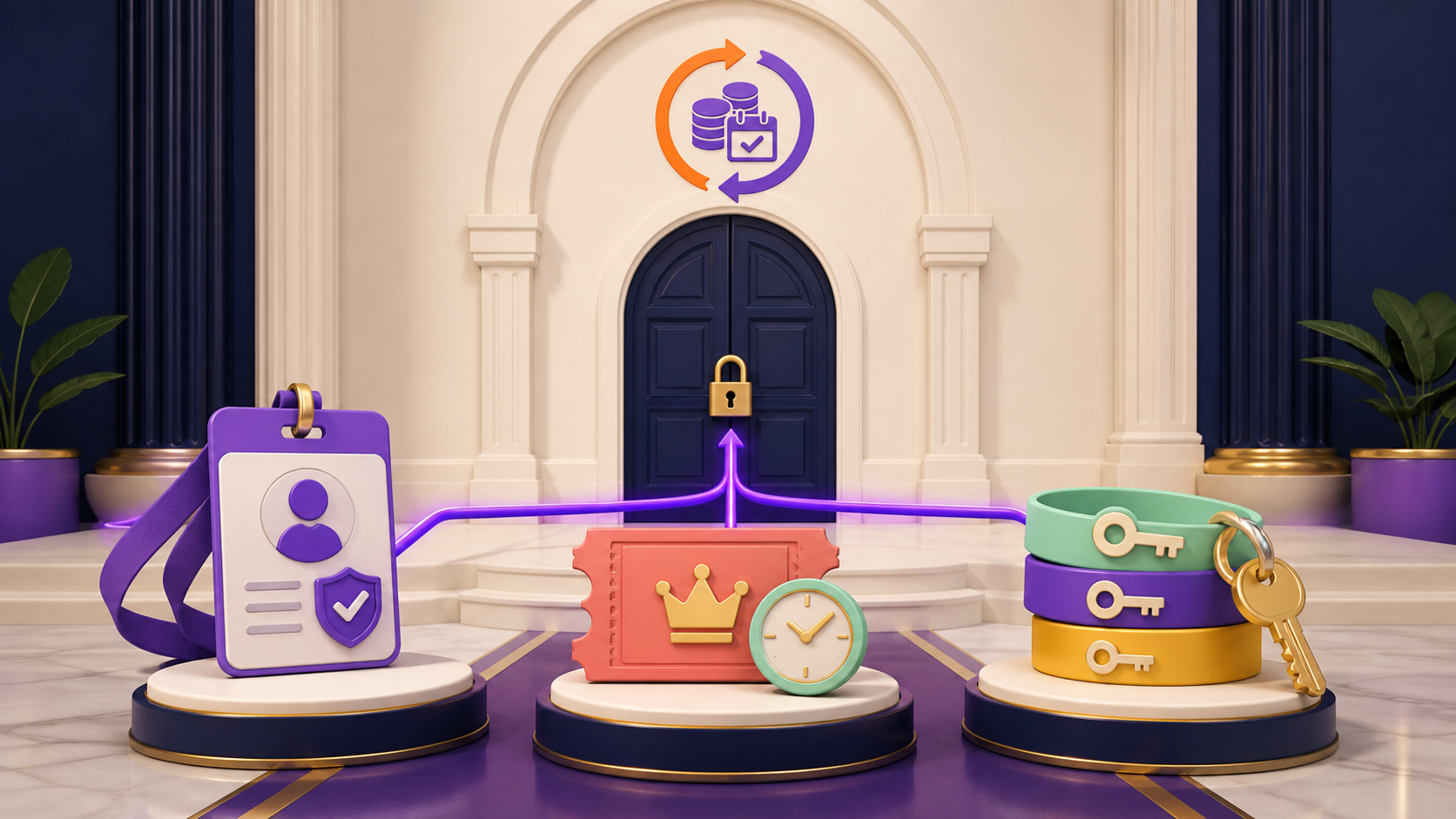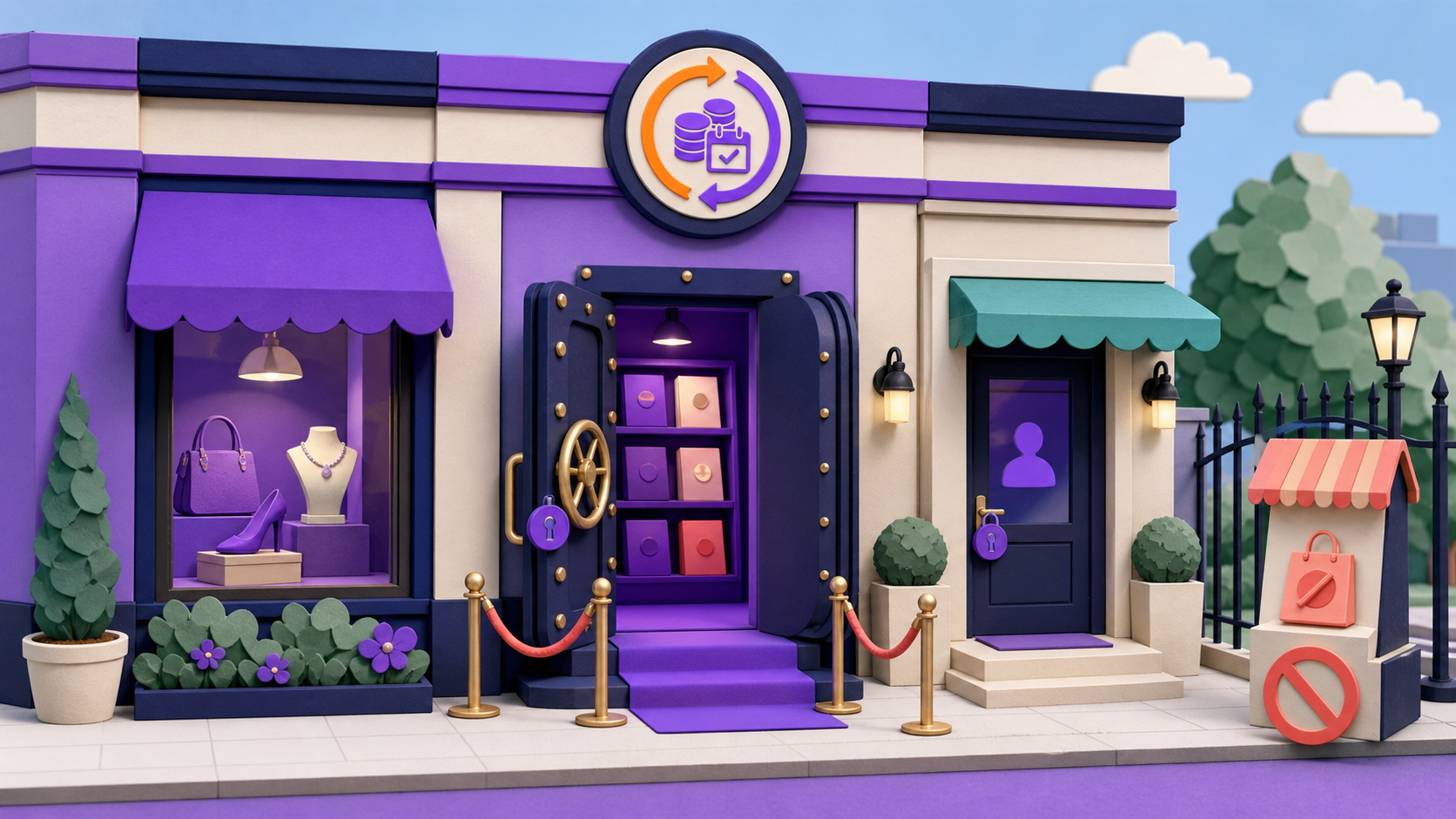
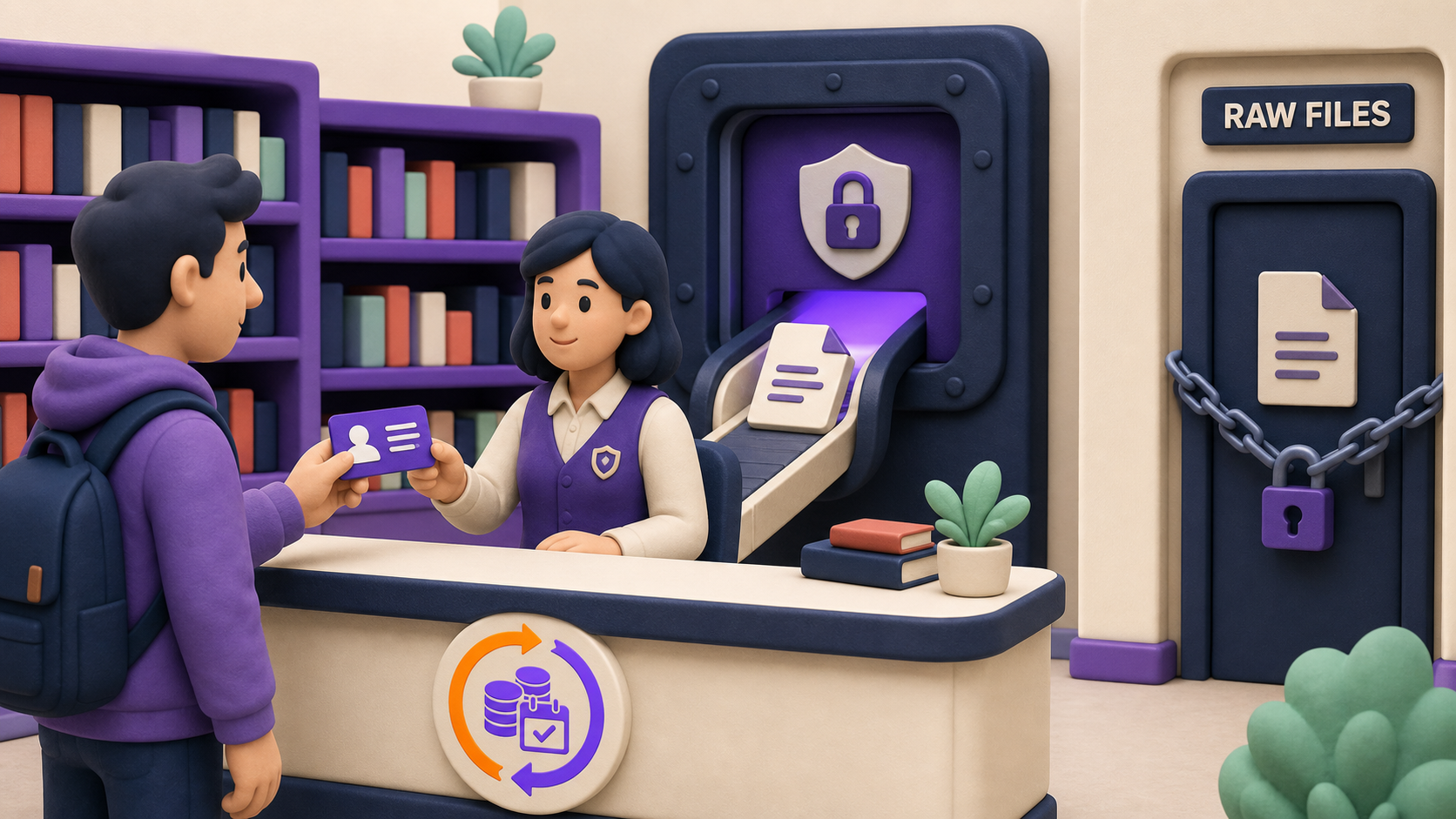
To protect membership downloads in WordPress, authorize the member every time the file is requested and prevent direct public access to the underlying object. ArraySubs checks login, a WordPress nonce, current membership conditions, and any release schedule. Sensitive files still need private origin storage or server/CDN enforcement because a public Media Library or permanent CDN URL can bypass the protected endpoint.
A hidden download button is presentation. A protected page is navigation control. Neither one makes a publicly reachable PDF, ZIP, video, or workbook private.
Key takeaways
- Protect the object, not only the page or link that points to it.
- ArraySubs rechecks the logged-in user's current conditions and schedule when its download endpoint is called.
- A WordPress nonce helps prevent forged requests; it is not authentication, a one-use link, or DRM.
- Local uploads and external/CDN files require their own storage policy so a raw URL cannot bypass membership rules.
- Test copied links, another account, cancellation, expiration, caches, logs, backups, and the direct file path.
What does a protected membership download actually require?
There are four different boundaries:
- A protected page prevents an unauthorized visitor from seeing the page body.
- A protected link reveals the download action only to an eligible user.
- A protected request verifies the requester and current entitlement before delivery.
- A protected object cannot be fetched from an alternative public URL.
Strong delivery needs all four where the asset has material value. If the final object remains public, the first three controls can be bypassed by copying its raw address.

This is access control, not digital-rights management. An authorized member can still save a delivered file, photograph a screen, or share its contents. Watermarking, license enforcement, account-sharing controls, legal terms, and leak response are separate layers.
How ArraySubs membership downloads work
Qualifying ArraySubs files appear alongside ordinary downloadable products in WooCommerce My Account → Downloads. A download rule can contain one or more files, access conditions, an optional release schedule, and administrative settings.
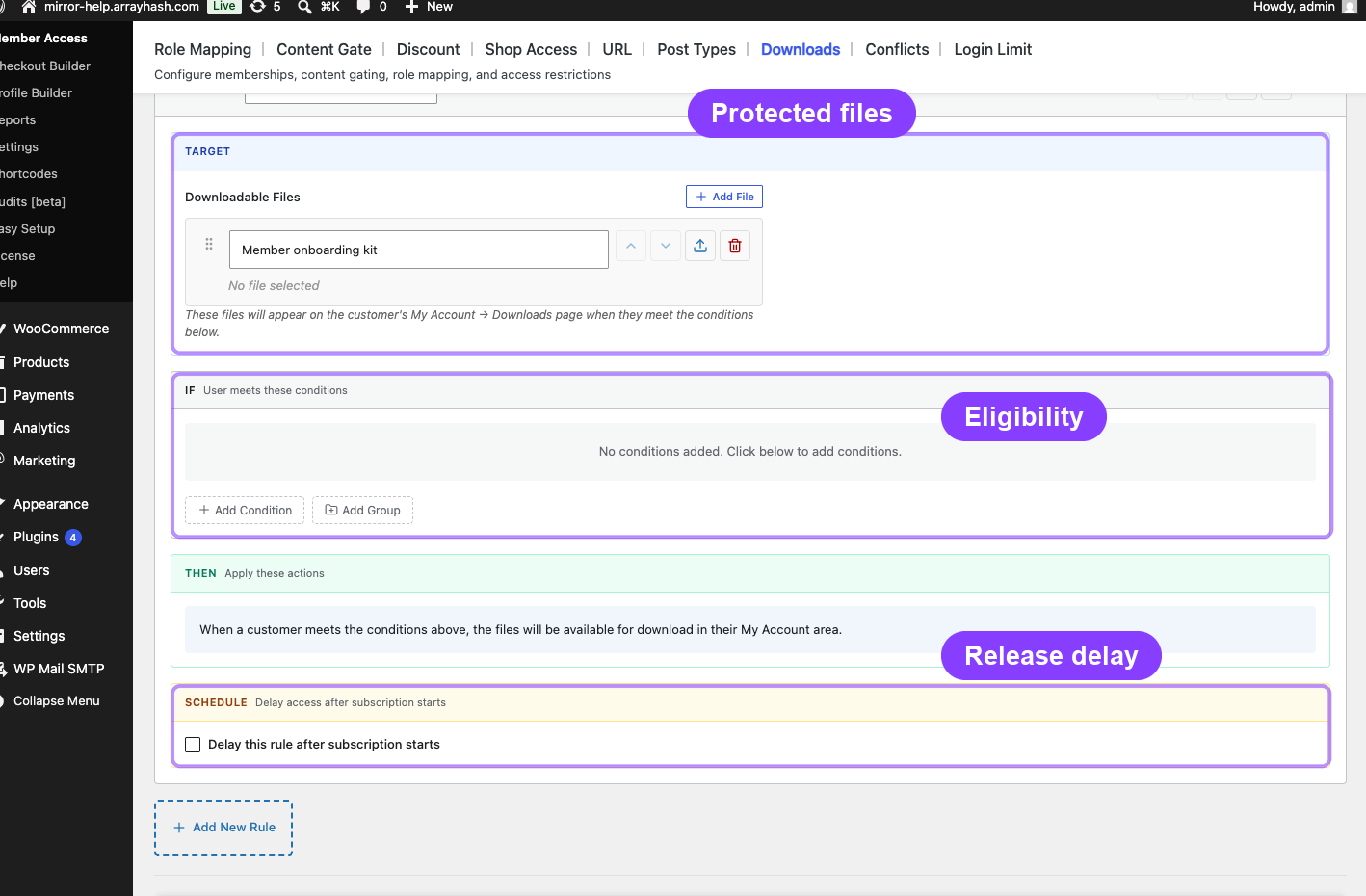
When the ArraySubs endpoint receives a request, the inspected 1.8.11 implementation:
- validates the WordPress nonce;
- requires a logged-in user;
- resolves the requested rule and file;
- confirms both remain enabled and valid;
- evaluates that user's current access conditions;
- applies the configured schedule or drip gate;
- checks relevant legacy limit state when stored;
- streams a recognized local file through PHP or redirects to an external URL.
The important security property is the request-time entitlement check. A member who no longer qualifies can be denied by the endpoint even if the link was previously visible. That conclusion assumes a shared cache is not serving an old response and the raw object has no separate public path.
Why a WordPress nonce is not a signed one-time download URL
WordPress states that nonces must not be relied on for authentication or authorization (WordPress Nonces). They are action- and session-context tokens designed primarily to reduce forged requests. By default, a nonce may validate across a time window rather than being consumed after one use.
Therefore, describe an ArraySubs link accurately:
- the nonce helps validate request context;
- login identifies the current account;
- the condition evaluator checks current entitlement;
- the schedule checks timing;
- the storage layer determines whether another URL can bypass the endpoint.

A short-lived object-storage signature is different. It grants temporary access to a particular private object and normally expires quickly. It can be useful after the application has authorized the member, especially for large files, but it still is not DRM.
Can a public Media Library URL bypass the rule?
Yes. Suppose the protected button calls an ArraySubs URL, but the PDF also exists at:
/wp-content/uploads/2026/07/member-report.pdf
If that address returns the file to a logged-out browser, the object is public. Removing it from the page does not change that.
WooCommerce documents several downloadable-product delivery methods and cautions that server compatibility and directory configuration matter (Digital/Downloadable Product Handling and Approved Download Directories). For valuable membership assets, use a directory or object store that the public web server cannot serve directly without an authorization handoff.
Local protected delivery
A practical local pattern is:
My Account link
→ application authorization
→ internal protected file path
→ X-Accel-Redirect, X-Sendfile, or controlled PHP stream
The application makes the decision; the web server performs efficient delivery. NGINX, Apache, and managed hosts differ, so confirm the exact mechanism with the host. WooCommerce provides a specific NGINX protected-uploads example, not a universal configuration for every stack.
Private object storage or CDN delivery
For large videos and archives, a common pattern is:
member request
→ current entitlement check
→ short-lived signed object URL or signed cookie
→ private CDN/object
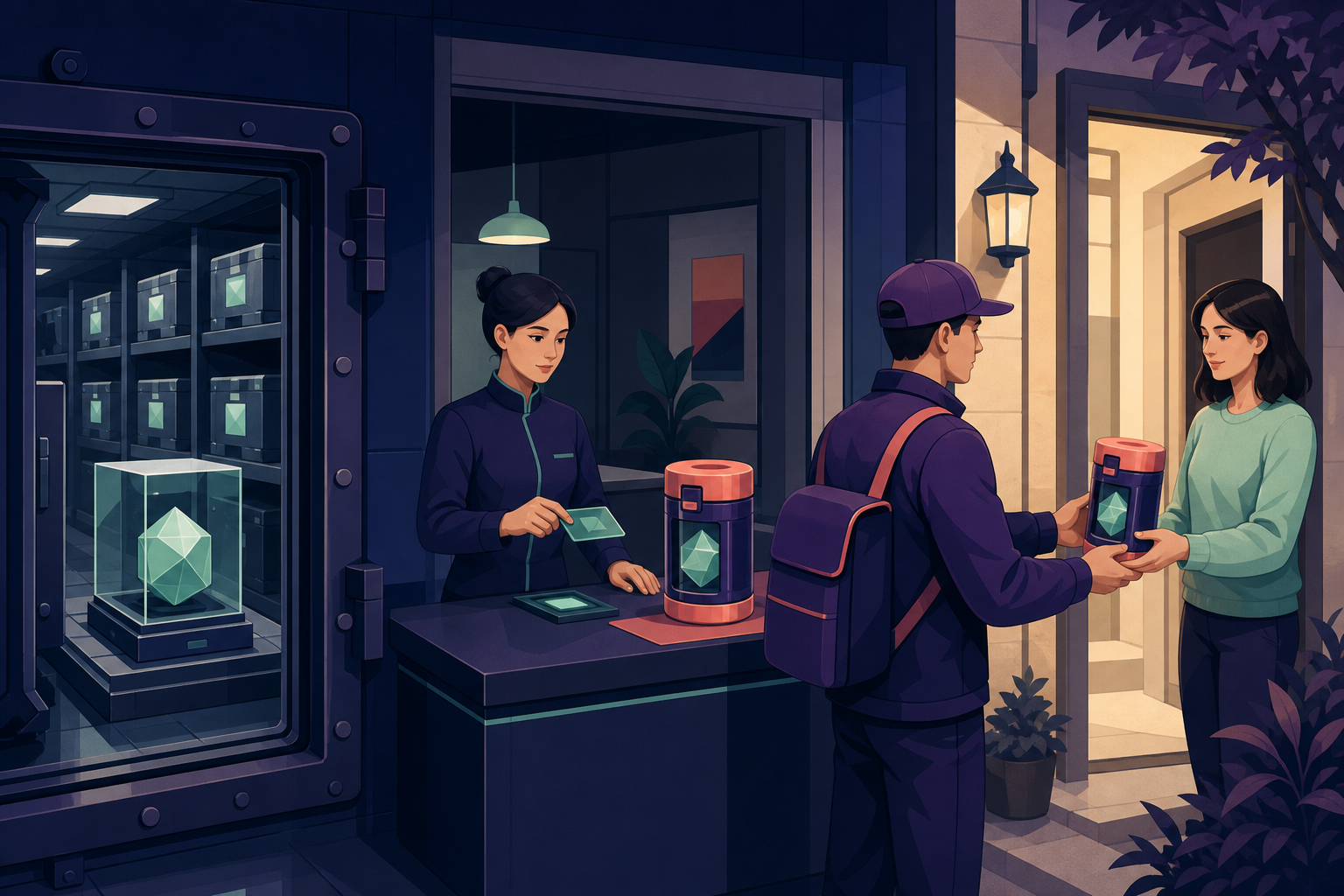
The current inspected ArraySubs behavior redirects external files to their configured destination. If that destination is permanent and public, it becomes shareable. Use private storage and temporary authorization at the storage/CDN layer when the asset warrants it.
Membership-download threat model
| Leak or bypass path | What can go wrong | Required control | ArraySubs role | Infrastructure role |
|---|---|---|---|---|
| Raw uploads URL | Anyone with the address fetches the file | non-public origin or server deny | protected endpoint cannot secure a separate public URL | required |
| Copied ArraySubs endpoint | Another person reuses the link | login, nonce, current entitlement | rechecked on request | session protection still matters |
| External/CDN redirect | final address becomes visible | private object plus short-lived signature/cookie | current code redirects | required for valuable files |
| Shared cache | member response reaches a guest | never publicly cache authorized delivery | dynamic endpoint decision | CDN/cache configuration |
| Account sharing | several people use one valid account | session/device policy and anomaly review | out of scope for file rule | identity and operations |
| Logs/referrers | reusable URLs are retained | safe URL design and redaction | avoid secrets in names | log/analytics policy |
| Backups/origin | another copy is exposed | encryption and least-privilege access | out of scope | required |
OWASP recommends validating authorization on every request and failing safely (OWASP Authorization Cheat Sheet). The table makes clear that an application rule and a private origin solve different parts of the threat model.
Which delivery approach fits the asset?
| Asset sensitivity | Recommended delivery | Why |
|---|---|---|
| Low-risk checklist or bonus worksheet | controlled endpoint may be adequate if direct raw access is blocked | simple; entitlement remains current |
| Paid course asset or valuable report | protected local directory with supported server handoff | application authorizes; origin does not expose raw path |
| Large video or archive | private object storage/CDN with short-lived URLs or cookies | efficient delivery without a permanent public object |
| Regulated or highly confidential document | dedicated platform, stronger identity, auditing, revocation, and security/legal review | WordPress membership gating alone is incomplete |
Do not choose a method only because it is called “secure.” Verify the actual raw URL, cache headers, host behavior, and revocation path.
How to configure a rule without confusing setup with security
Use the membership-download workflow after deciding where the object will live. The strategic sequence is:
- Name the rule by the member outcome, such as “Active Research members receive the July dataset.”
- Add the file and identify whether ArraySubs will recognize it as local or treat it as external.
- Add the narrowest current condition: subscription product, purchase, role, feature, or grouped policy.
- Add a schedule only when release timing is a real product promise.
- Verify that the underlying object itself is private.
- Save, then test the member-facing My Account table with a normal customer account.
- Test direct delivery as a guest, a different user, and a revoked member.
The current Downloads builder exposes files, conditions, and schedules. Backend keys related to older limit behavior are not evidence of a complete current download-limit UI. Do not advertise configurable per-user limits, one-time links, IP binding, watermarking, or audit-grade logs unless a separate verified system provides them.
How should schedules and revocation behave?
A schedule answers when an otherwise eligible member may access the file. It does not replace the membership condition. Test release boundaries in the site's intended timezone and with the correct reference date—subscription start, purchase, or a fixed date according to the configured rule.
Revocation deserves equal attention. Verify:
- on-hold behavior matches the business policy;
- cancellation now versus cancellation at period end behaves as promised;
- expiration removes access at the intended boundary;
- a plan switch grants and removes the correct files;
- overlapping qualifying subscriptions do not cause unintended loss;
- a copied link stops working when the requester no longer qualifies.
If revocation must take effect within minutes, record that requirement and validate every cache layer against it.
Security test plan for protected downloads
Run these tests in a non-production or controlled account context:
- Raw Media Library/uploads address does not serve the file publicly.
- Logged-out request to the protected endpoint is denied.
- Another logged-in user cannot reuse the endpoint URL.
- An active qualifying member can download.
- On-hold, cancelled, expired, and nonqualifying accounts get the intended result.
- A plan switch and overlapping subscriptions produce correct access.
- Drip boundaries use the correct date basis and timezone.
- CDN and page caches never replay an authorized response publicly.
- External objects are private and temporary URLs expire as designed.
- Filenames and query strings contain no personal data or reusable secrets.
- Referrer, analytics, application, web-server, and support logs are reviewed.
- Backups and origin access use least privilege.
- Support has a documented recovery and diagnosis path.

Use browser developer tools or curl to check status, redirect location, response headers, and the raw path. Do not assume a button disappearing means the test passed.
What should happen after a suspected download leak?
Prepare the response before publishing a valuable file. Identify which object or URL was exposed, whether the path bypassed application authorization, which logs can show requests, and whether the file contains personal or regulated data. Preserve evidence before rotating links or deleting logs.
Then close the exposed route, replace any permanent external URL, invalidate relevant CDN/cache entries, and re-test as guest, another account, and a revoked member. If the asset itself escaped, changing the member page cannot recall copies already downloaded. Decide whether to issue a revised watermarked file, notify affected customers, update legal/security stakeholders, or migrate the collection to stronger private delivery.
Finish with a root-cause record: storage boundary, rule state, cache behavior, affected versions, exposure window, proof of remediation, and the control added to prevent recurrence. This turns a one-off link repair into an improvement to the delivery system.
When WordPress is not the right security boundary
Use a specialized document or media platform when the requirement includes regulated data, detailed audit trails, strong identity assurance, per-recipient watermarking, device controls, rapid global revocation, or legal-grade access evidence. ArraySubs is a practical membership authorization layer; it is not a data-loss-prevention or DRM product.
Likewise, do not place a secret in a WordPress page and expect partial content restriction to secure the linked file. See SEO for Gated WooCommerce Content and Partial Content Restriction for the HTML boundary.
Final recommendation
Treat protected downloads as an authorization-and-delivery system. Let ArraySubs decide whether the current account qualifies, but make the origin private, use a delivery method that does not reveal a permanent public object, and test direct paths plus revocation. That layered design is honest, debuggable, and much stronger than hiding a button.
After the architecture passes its red-team checklist, review ArraySubs Pro pricing and the member-experience feature set.
Frequently asked questions
Does hiding a WordPress download link protect the file?
No. If the raw file URL remains publicly reachable, anyone with the address can bypass the hidden link.
Are ArraySubs download links single use?
Do not describe them that way. Current links use a WordPress nonce plus login and entitlement checks. WordPress nonces are time-windowed and are not consumed after one successful request.
Can an expired member reuse an old link?
The current ArraySubs endpoint reevaluates the account's conditions and schedule. It should deny a nonqualifying account, assuming no public raw URL or stale cache bypasses that request.
Should protected files stay in the Media Library?
Only if the hosting/storage configuration prevents direct public delivery. A normal public uploads URL is not appropriate for valuable confidential assets.
Does private storage prevent an authorized member from resharing a file?
No. It prevents unauthorized origin access. Once delivered, the member can still save or copy the material; deterrence and leak response require additional controls.
Does partial page gating secure a linked PDF or video?
No. Authorize the file, media stream, or API independently.
Author, technical review, and verification environment
Author: Emran, ArrayHash — product and editorial work across WooCommerce subscriptions, membership access, and technical SEO.
Technical reviewer: ArraySubs Engineering Team — review scope includes request-time conditions, nonce semantics, local/external delivery, origin security, scheduling, and revocation.
Verification environment: Source and read-only live UI review of ArraySubs 1.8.11 and WooCommerce/WordPress documentation on July 16, 2026. No live download rule or customer data was changed.
Disclosure, limitations, and update log
- Commercial disclosure: ArraySubs is an ArrayHash product. This guide does not promise immunity from account sharing or redistribution.
- Limitations: Hosting, server configuration, CDNs, storage providers, caches, and legal requirements vary. Obtain security review for high-risk files.
- July 16, 2026: First publication. Verified current request checks, UI scope, nonce language, direct-object risk, delivery options, and test matrix.
Continue from strategy to setup
Use a recipe when the model is settled
These articles own the decision and operating model. The ArraySubs feature map and recipes cover the exact product, billing, and customer-workflow configuration.
Written by
Emran // ArrayHash
Research and practical guidance for WooCommerce subscription operators and implementation teams.
Technical review
ArraySubs Engineering Team
Reviewed against current ArraySubs code, product documentation, and the linked primary platform sources.