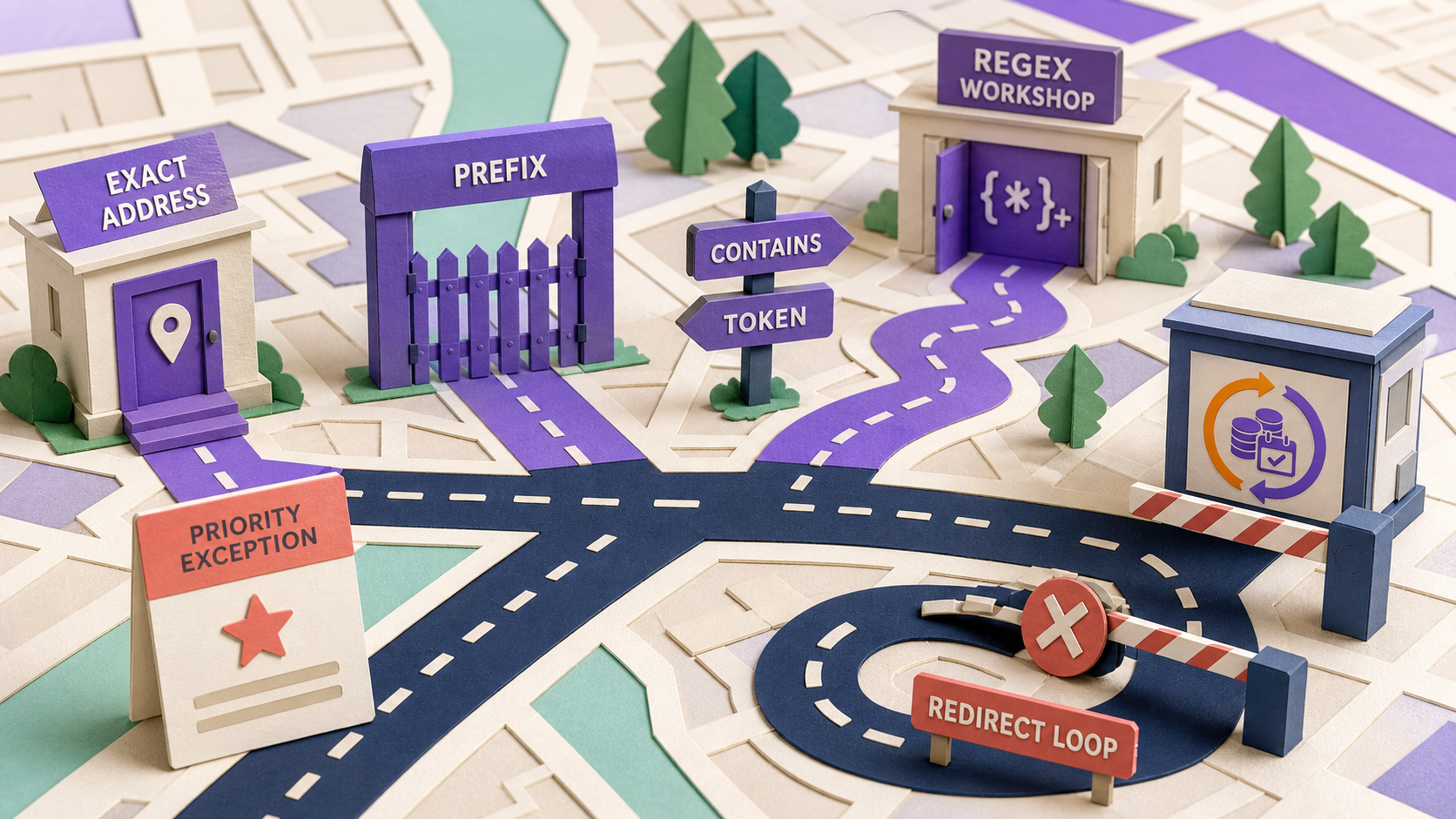

Partial content restriction can preserve organic usefulness and create a legitimate membership conversion moment when a complete public answer appears before a server-side gate. ArraySubs can restrict shortcode, Gutenberg block, or Elementor Container content and return a denial message to nonmembers. Only the public response is crawlable by default, so place the boundary according to search intent and measured reader behavior—not a universal word count.
The best model is not “show 30%, hide 70%.” It is: resolve the visitor's question, prove the answer, explain the premium value, then gate a genuinely deeper asset or procedure.
Key takeaways
- Deliver a useful answer before asking the reader to log in or pay.
- Current ArraySubs partial gates omit or replace protected HTML server-side for denied visitors; they do not merely hide it with CSS.
- Shortcode, Gutenberg, Elementor, and PHP integrations converge on the same restriction behavior but have surface-specific caveats.
- Gated HTML does not protect a public image, PDF, video, or API URL inside it.
- Measure the gate as a funnel with organic, authentication, support, refund, and cache guardrails.
What is partial content restriction?
Partial restriction leaves part of a page public while requiring a qualifying membership condition for another fragment. A good public section can include the direct answer, definitions, evidence, a representative example, limitations, and navigation. The member section can provide the complete implementation, workbook, dataset, template, video, assessment, or ongoing support.

This differs from:
- a hard paywall, where most or all body content is unavailable;
- a meter, where access depends on a count over time;
- a login wall, where identity is required even without a paid condition;
- client-side hiding, where protected HTML may already exist in source or network data.
ArraySubs partial gating is condition-based. The inspected implementation does not provide a publication-wide article-view meter.
How ArraySubs gates content server-side
Current ArraySubs Members Access supports four content surfaces:
[arraysubs_restrict]...[/arraysubs_restrict]shortcode;- server-rendered Gutenberg Restricted Content block;
- Elementor Container restriction controls;
- PHP/helper integration for developers.
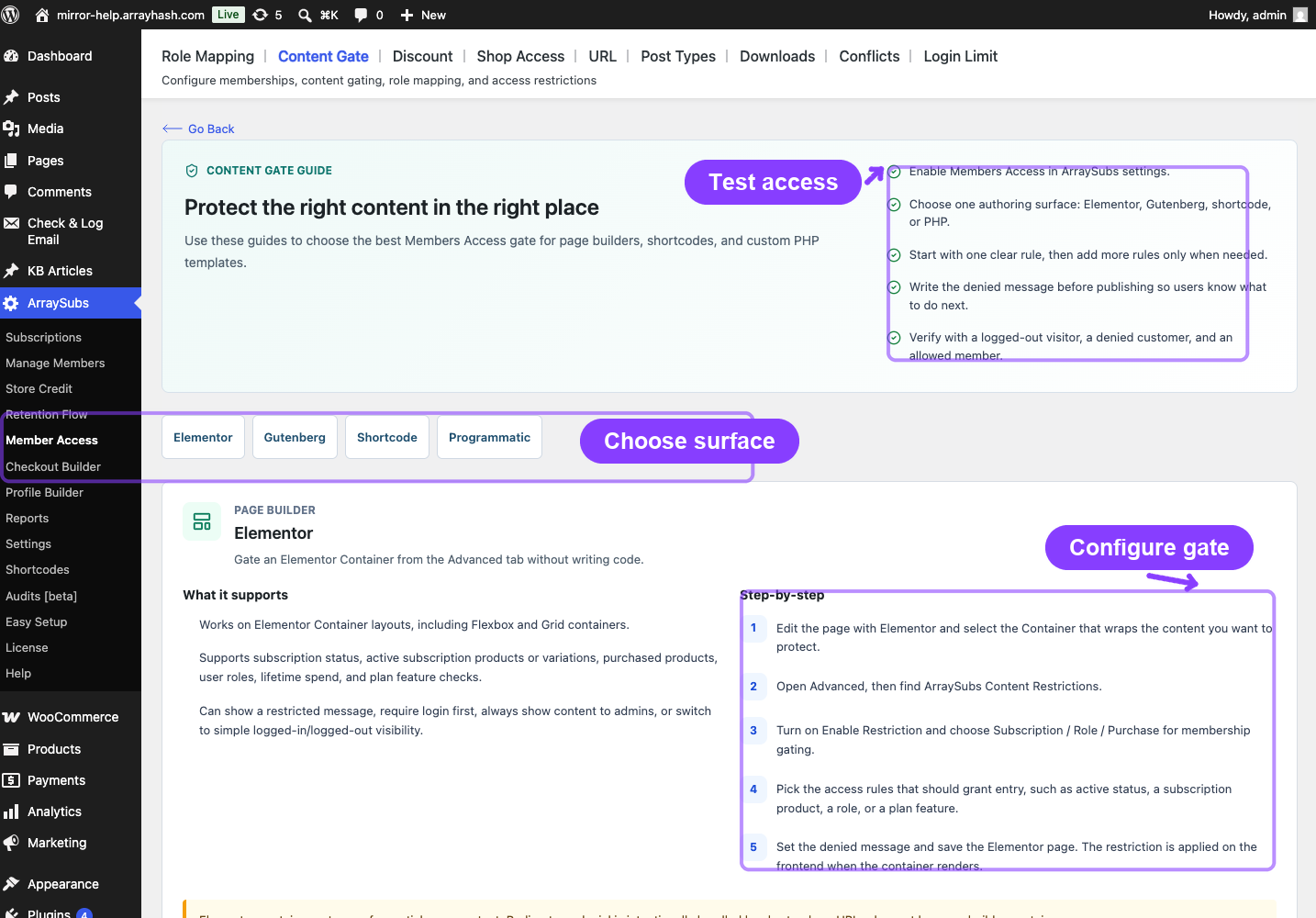
For a normal denied front-end request, protected HTML is replaced or omitted on the server. A visitor cannot reveal it merely by removing a CSS class. The Gutenberg dynamic block delegates to the shared restriction behavior with its rendered inner content. The Elementor integration buffers a container and passes that output through the same gate.
Because partial output may already be in progress, Gutenberg and Elementor gates use an inline denial message instead of redirecting the entire request. Editors should design that message as part of the page, not as an error.
Surface-specific caveats
- The shortcode supports a top-level AND/OR mode but not arbitrary nested groups in shortcode attributes.
- Gutenberg content stays editable in the editor and is gated in normal front-end rendering.
- Elementor preview/editor contexts keep content available for editing.
- Administrators can see protected content by default; QA with a normal denied user.
- A rule with no actual condition behaves as unrestricted in current code.
- The Gutenberg fallback may return raw content if the shortcode handler is unavailable, so test feature/plugin deactivation for confidential material.
High-sensitivity content needs defense in depth. A CMS editor integration is not a substitute for a dedicated secret-management or document-security system.
What can Google crawl and index?
An ordinary crawler receives the guest response unless a separate legitimate paywall architecture grants it access. In the current ArraySubs implementation:
- public introduction, headings, examples, links, and denial message can be crawled;
- the server-omitted premium fragment ordinarily cannot be indexed;
- paywall structured data does not reveal missing HTML;
- ArraySubs does not automatically grant Googlebot a membership entitlement;
- files and APIs need independent authorization.

Google's paywalled-content structured data describes paid sections that Google can access and the publisher intends to index. It is not an access key. If the premium HTML is absent from Google's response, adding isAccessibleForFree: false does not make that text present.
Google also says ordinary SEO requirements apply to AI features and no special AI markup is required (Google AI features and your website). Clear public answers, evidence, and entity relationships may improve usefulness and extractability, but rankings or citations are never guaranteed.
The Resolve → Prove → Bridge → Gate framework
Use this original four-part sequence instead of a fixed percentage.
1. Resolve
Answer the primary query directly in roughly 40–60 words. Name the entities and critical tradeoff. Do not spend five paragraphs promising an answer that begins after checkout.
2. Prove
Validate the answer with at least one tangible item:
- real screenshot;
- original table;
- worked example;
- decision framework;
- source-backed limitation;
- before/after state.
3. Bridge
Explain exactly what the premium section adds. “Unlock the rest” is weak. “Get the 23-case test matrix, downloadable policy worksheet, and implementation walkthrough” is specific.
4. Gate
Restrict the deeper implementation, complete dataset, template, member service, or continuously updated material—not the minimum facts needed to understand the issue or make a safe purchase decision.

What belongs on each side of the gate?
| Public side | Member side |
|---|---|
| direct answer and key definitions | complete implementation walkthrough |
| core decision framework | downloadable template or workbook |
| representative example and screenshot | full case study or dataset |
| material limitations and trust signals | advanced scenarios and member support |
| clear membership-value description | continuously updated premium material |
Never gate safety warnings, material exclusions, or facts needed to determine whether the product is appropriate. Honest conversion begins with informed value, not information asymmetry.
Three partial-gating examples
Premium tutorial
Public: direct answer, prerequisites, architecture, representative screenshot, limitations, and a decision checklist.
Member: exact configuration walkthrough, downloadable QA sheet, troubleshooting tree, and update log.
Research report
Public: methodology, headline findings, one meaningful table, citations, and limitations.
Member: full dataset, segment analysis, workbook, and update feed.
Course lesson
Public: learning outcome and one useful concept.
Member: video, exercises, feedback, and assessment. The video and downloads must be protected separately.
These examples create public value while keeping the paid difference concrete.
How to design the denied message
A good gate card should:
- name the protected asset or outcome;
- tell existing members how to log in;
- state the qualifying plan or condition without exposing account data;
- explain the premium value in concrete language;
- provide a membership/pricing action and a login action;
- preserve the reader's page position or return URL when practical;
- use semantic headings, keyboard access, visible focus, and sufficient contrast;
- explain how to get help when an eligible member is denied.

Avoid false urgency, vague “premium content” labels, inaccessible overlays, and a CTA that takes existing members to checkout. A denial state is also an authentication and support interface.
How should gate depth be tested?
Treat it as a funnel:
eligible page entrance
→ engaged public section
→ gate impression
→ pricing or login click
→ checkout start or login completion
→ membership purchase or member content view
Useful formulas:
gate click-through rate
= unique pricing/login clicks ÷ unique gate impressions
gate-to-member conversion
= attributed new memberships ÷ unique gate impressions
Declare the attribution window and identity method. Do not mix login clicks from existing members with acquisition clicks from prospects.
Record before launch:
- hypothesis;
- primary metric;
- allocation and audience;
- duration rationale;
- stopping rule;
- minimum guardrails;
- planned interpretation if results conflict.
Guardrails should include organic clicks and indexed coverage, engagement to the gate, return-to-SERP or bounce proxy, member login completion, support contacts, authentication errors, refunds/cancellations, and cache incidents. Never publish invented conversion lifts or a universal ideal depth.
Which readers should be separated in a gate experiment?
One blended conversion rate can hide opposite experiences. Segment at least these paths before interpreting the gate:
| Reader path | What the gate is doing | Useful outcome |
|---|---|---|
| New anonymous visitor | explaining the premium difference | pricing exploration or qualified signup |
| Returning anonymous visitor | building on prior familiarity | conversion without excessive repeated friction |
| Logged-in nonmember | identifying the missing condition | upgrade, purchase, or clear not-eligible result |
| Existing entitled member | restoring access after login | successful authentication and content view |
| On-hold or expired member | supporting recovery | Pay Now, method update, renewal, or support resolution |
| Search visitor | satisfying informational intent before the boundary | useful engagement without query mismatch |
| Email/direct visitor | continuing a promised campaign journey | gate behavior consistent with the referring message |
Do not count an existing member's login as acquisition, and do not treat a payment-recovery click as an upgrade. Record the entry source, authentication state, known entitlement state, gate version, action, and final outcome with a declared retention and privacy policy.
When results differ by segment, change the experience before moving the content boundary. Existing members may need a better return URL, lapsed members may need recovery copy, and search visitors may need more public proof. Only prospects who understand the premium offer should feed the primary acquisition test.
Also check whether the experiment changes who reaches the gate. Moving it higher can increase impressions by counting less-engaged readers while lowering the apparent click rate. Compare eligible cohorts and report both page entrances and gate impressions so the denominator remains visible.
Partial-gate SEO and security QA
- Guest page source does not contain the protected text.
- Logged-in nonmember receives the correct denial message.
- Entitled member sees the complete fragment.
- Admin/editor preview is not mistaken for public behavior.
- An empty condition is either deliberately open or fixed before publish.
- Shortcode, Gutenberg, and Elementor output agree where equivalent.
- Feature/plugin deactivation behavior is understood.
- Raw image, PDF, video, download, and API URLs are separately authorized.
- Guest and member caches do not cross after login/logout/status changes.
- Login and pricing links work and preserve context where practical.
- Metadata and structured data describe the public response accurately.
- Google URL Inspection sees the intended guest response.
- Social previews, feeds, excerpts, and JSON endpoints do not leak protected text.

Google's robots and snippet controls affect indexing and previews, not membership authorization. Use them only after deciding whether the public shell should appear in search.
When partial content restriction is a poor fit
Do not use partial gating as the primary boundary for:
- personal customer data;
- regulated or highly confidential records;
- source files whose public media URLs remain reachable;
- content that has no useful public acquisition purpose;
- an application requiring strict tenant isolation;
- a meter based on article-view counts;
- a publisher architecture that intentionally gives an authorized crawler complete paywalled content.
For private resources, create a public explanation page and keep the actual workspace or object behind stronger authorization. For protected files, follow Protecting Membership Downloads in WordPress.
Final recommendation
Place the gate after genuine resolution and evidence, then make the premium value explicit. Authorize the fragment on the server, protect media and APIs independently, and test what guests, members, crawlers, social bots, and caches actually receive. Optimize the boundary with declared funnel metrics and guardrails—not arbitrary percentages or copied benchmarks.
Use the inline content-gating recipe for product-specific setup. After the editorial and security model is proven, review ArraySubs Pro pricing and member-experience features.
Frequently asked questions
Is partial content restriction good for SEO?
It can preserve a useful crawlable public response. It does not guarantee rankings, and the protected fragment omitted from the guest response does not contribute its full text by default.
How much of an article should be public?
There is no universal percentage. Publish enough to resolve the search intent, prove the answer, and explain the premium difference honestly.
Does ArraySubs hide gated content only with CSS?
No. Current normal denied rendering omits or replaces the fragment server-side.
Can Google paywall schema unlock protected content?
No. It describes content Google can legitimately access under a paywall architecture; it does not reveal missing HTML.
Can I gate a video by placing it inside a restricted block?
The embed HTML can be gated, but the video URL or stream needs its own authorization.
Does ArraySubs provide metered article views?
The inspected partial gate is condition-based, not a publication-wide metered-paywall counter.
Author, technical review, and verification environment
Author: Emran, ArrayHash — product and editorial work across WooCommerce membership strategy, conversion, and technical SEO.
Technical reviewer: ArraySubs Engineering Team — review scope includes server-side shortcode/Gutenberg/Elementor behavior, condition defaults, media boundaries, caches, and current UI evidence.
Verification environment: Source and read-only live UI review of ArraySubs 1.8.11 on July 16, 2026, plus current Google paywall, AI-feature, robots, and helpful-content guidance. No live content or restriction rule was saved.
Disclosure, limitations, and update log
- Commercial disclosure: ArraySubs is an ArrayHash product. No ranking, AI-citation, or conversion outcome is promised.
- Limitations: Themes, editors, SEO plugins, caches, CDNs, media providers, and analytics attribution vary. High-sensitivity data requires stronger controls.
- July 16, 2026: First publication. Verified partial-gate surfaces, server rendering, guest crawlability, framework, test metrics, deactivation/cache caveats, and limitations.
Continue from strategy to setup
Use a recipe when the model is settled
These articles own the decision and operating model. The ArraySubs feature map and recipes cover the exact product, billing, and customer-workflow configuration.
Written by
Emran // ArrayHash
Research and practical guidance for WooCommerce subscription operators and implementation teams.
Technical review
ArraySubs Engineering Team
Reviewed against current ArraySubs code, product documentation, and the linked primary platform sources.