

Choose a hard paywall when nearly all premium value can sit behind membership, a meter when readers need several complete samples before conversion, and freemium when selected content should remain permanently public while premium resources stay gated. The best model depends on audience habit, content uniqueness, acquisition channels, implementation accuracy, and the value members receive after subscribing.
These are content-value allocation policies, not merely three modal designs. No model is universally best for search, conversion, or revenue.
Key takeaways
- Hard, metered, and freemium differ in what is public and what event triggers access.
- A real meter needs identity, counting, window, reset, privacy, and anti-bypass rules beyond ordinary subscription checks.
- Freemium needs a stable editorial classification; random free articles are not a strategy.
- Crawl and search behavior depends on delivered content and correct paywall implementation, not the model name.
- Current ArraySubs supports hard, freemium, partial, tiered, and scheduled gates—but no native per-reader article-view meter.
What is the difference between hard, metered, and freemium paywalls?
- Hard paywall: Most or all designated premium items require membership before the reader consumes them.
- Metered paywall: A reader can consume a defined number of otherwise premium items inside a measurement window before access is required.
- Freemium content: A deliberate catalog remains permanently public while another catalog is always premium.
- Partial-content gate: One page includes meaningful public content plus a premium section. It can support hard or freemium strategy; it is not a meter.

The distinction matters operationally. A meter counts reader behavior. A freemium model classifies content. A partial gate checks entitlement for a section. Calling all three “soft paywalls” hides different data, privacy, cache, editorial, and support requirements.
Paywall model comparison
| Dimension | Hard paywall | Metered paywall | Freemium | Partial gate |
|---|---|---|---|---|
| Public value on premium items | low to moderate | several complete samples | permanent public catalog | public portion on same page |
| Trigger | first protected request | count/window threshold | content classification | section entitlement |
| Identity need | login/access check | durable identity plus anonymous handling | content/access classification | current user/access condition |
| Complexity | moderate | highest | editorial + moderate technical | rendering + moderate technical |
| Strength | clear premium boundary | sampling before decision | discovery and trust through full public assets | proves value in context |
| Weakness | limited proof before signup | bypass, privacy, and counting complexity | free content may satisfy the need | manipulative teaser or HTML leakage risk |
| Best-fit hypothesis | highly differentiated premium library | habitual repeat reading with deep inventory | search/social acquisition plus premium depth | advanced tools/workbooks within useful guides |
| Poor fit | public alternatives are abundant and proof is needed | visits are infrequent or identity is unreliable | classification cannot be maintained | public section is thin or private HTML is delivered |
These best-fit cells are hypotheses to test, not performance claims.
How should a publisher choose the model?
Score each candidate qualitatively on ten factors:
- Content uniqueness: Can a reader substitute a free source easily?
- Habit/frequency: Will readers return often enough for a meter to matter?
- Public proof: How much complete value is needed before trust exists?
- Acquisition mix: Search, social, referral, email, direct, partnership, and paid.
- Inventory depth: Is there enough premium breadth after conversion?
- Identity reliability: Login, cookies, cross-device use, and privacy/consent constraints.
- Implementation maturity: Server rendering, access rules, cache variation, analytics, and QA.
- Member aftercare: Onboarding, search/discovery, release cadence, portal, and retention.
- Leak tolerance: Sharing, cached content, anonymous resets, screenshots, and copied files.
- Editorial operations: Can every item receive a stable public/premium classification?
Do not select a meter because it feels “less aggressive.” It is the most complex model here and can become both porous and privacy-heavy when identity is weak.
What value should remain after the reader subscribes?
A paywall can improve the moment of conversion and still fail the membership. Before choosing the gate, describe the first 30 minutes, first week, and first renewal period after purchase.
The member should be able to find a complete next action immediately: a saved reading list, a valuable archive entry, a downloadable tool, an onboarding sequence, an upcoming session, or another benefit that proves the offer. If the entire promise is “the article you just tried to read,” the membership may have weak depth even when the gate converts.
Audit the post-conversion experience with five questions:
- Does checkout return the member to the resource that created intent?
- Can the new member discover two or three related premium assets without searching blindly?
- Is the release cadence visible and credible?
- Can the member manage billing, recover payment, and understand access dates?
- Does the next renewal have a clear reason beyond avoiding a lockout?
Hard paywalls need strong public proof and strong member navigation because the collection itself is hidden. Meters need the paid experience to feel better than repeated counting interruptions. Freemium needs a premium layer that is materially deeper than the public catalog. Partial gates need the protected asset to deliver exactly what the bridge promised.
This aftercare criterion belongs in model selection because a technically perfect gate cannot compensate for a thin premium product.
When should a hard paywall be used?
A hard paywall fits when the premium collection is highly differentiated, the value can be explained through public landing pages and examples, and membership grants a coherent library or service rather than a single hidden article.
Ask:
- Are public headlines, descriptions, author expertise, topic pages, and representative samples strong enough to explain the offer?
- Will login restore access and return the member to the requested resource?
- Should a denied user see a message, login, comparison, 403, or 404?
- Are account, password, payment recovery, support, and legal routes public?
- Can support diagnose why a particular user was denied?
- Does server-side authorization prevent protected content from reaching the browser?
A hard paywall is not equivalent to returning 404 for every premium URL. A public description with a protected body may provide better discovery and member UX, depending on the editorial and search policy.
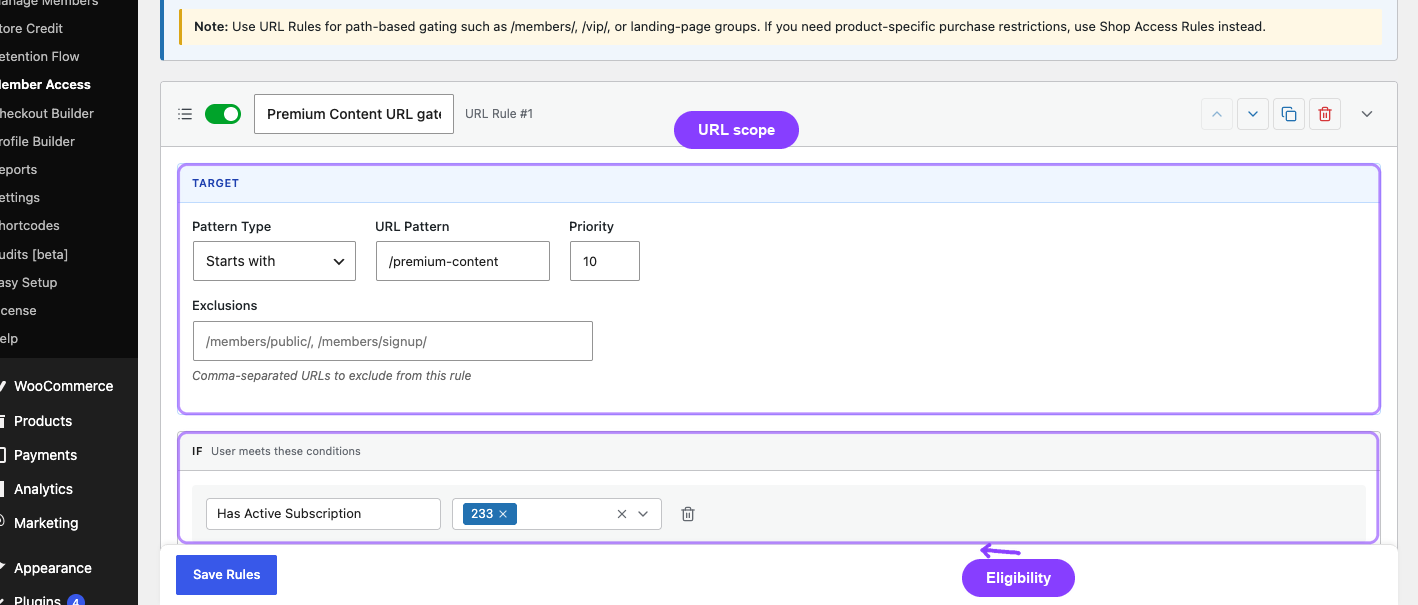
Use the URL-prefix lockdown recipe only after account and recovery exclusions are documented.
What does a real metered paywall require?
Define the meter as a state model:
meter state
= identity
 + eligible content set
 + consumed events
 + measurement window
 + reset policy

Decide:
- whether an open, a meaningful read, or another event counts;
- whether repeat opens count once or repeatedly;
- whether snippets, newsletters, bots, staff, previews, gifts, and referrals count;
- rolling versus calendar measurement window;
- anonymous-to-account merge after login;
- cross-device and private-browsing behavior;
- whether remaining count is visible;
- cookie consent, retention, export, and deletion policy;
- cache-safe evaluation before serving the complete article;
- support overrides and shared/household access.

Perfect bypass prevention is not a realistic promise. Stronger device linkage can increase privacy risk and user frustration. Choose which bypass is tolerated and document it.
Does ArraySubs include a metered paywall?
No publisher-style “three articles per reader per 30 days” meter was found in current ArraySubs core or Pro source. URL rules, lifetime-spend conditions, delayed content, and protected-download limits are not article-view metering.
A custom meter can feed an access condition only after the separate identity/count/window/privacy system exists. ArraySubs should not be marketed as supplying that system today.
When is freemium content the best starting model?
Freemium is often the most reversible strategy because complete public assets can earn discovery and trust while premium resources test willingness to pay.
Use a stable classification such as:
- public: definitions, discovery guides, selected flagship examples, news/awareness;
- premium: datasets, templates, implementation playbooks, tools, complete archive, live sessions, expert review;
- member-earned: personal output, saved workspace, certificate, or authorized download;
- temporary preview: a launch sample with an explicit transition date.

Avoid “everything older than 30 days is free” unless age genuinely maps to value. Avoid moving widely linked public resources behind a paywall without URL, indexing, customer, and communication plans.
Is partial content restriction a freemium or metered paywall?
Partial gating is a presentation pattern. It can place a premium workbook inside a free guide, offer an advanced implementation section to members, or reveal a calculator after login. It does not count prior articles and therefore is not a meter.
The public portion should independently answer a meaningful part of the query. The protected section should deepen execution rather than hide the promised basic answer.

Test:
- Does the title accurately describe what a non-member receives?
- Is the direct answer visible for informational search intent?
- Is protected HTML absent for denied visitors when confidentiality matters?
- Does the gate name the specific premium benefit and eligibility?
- Does the entitled view avoid layout shift, duplicates, and cache leakage?
Current ArraySubs provides Gutenberg, Elementor, shortcode, and programmatic partial-gate surfaces.
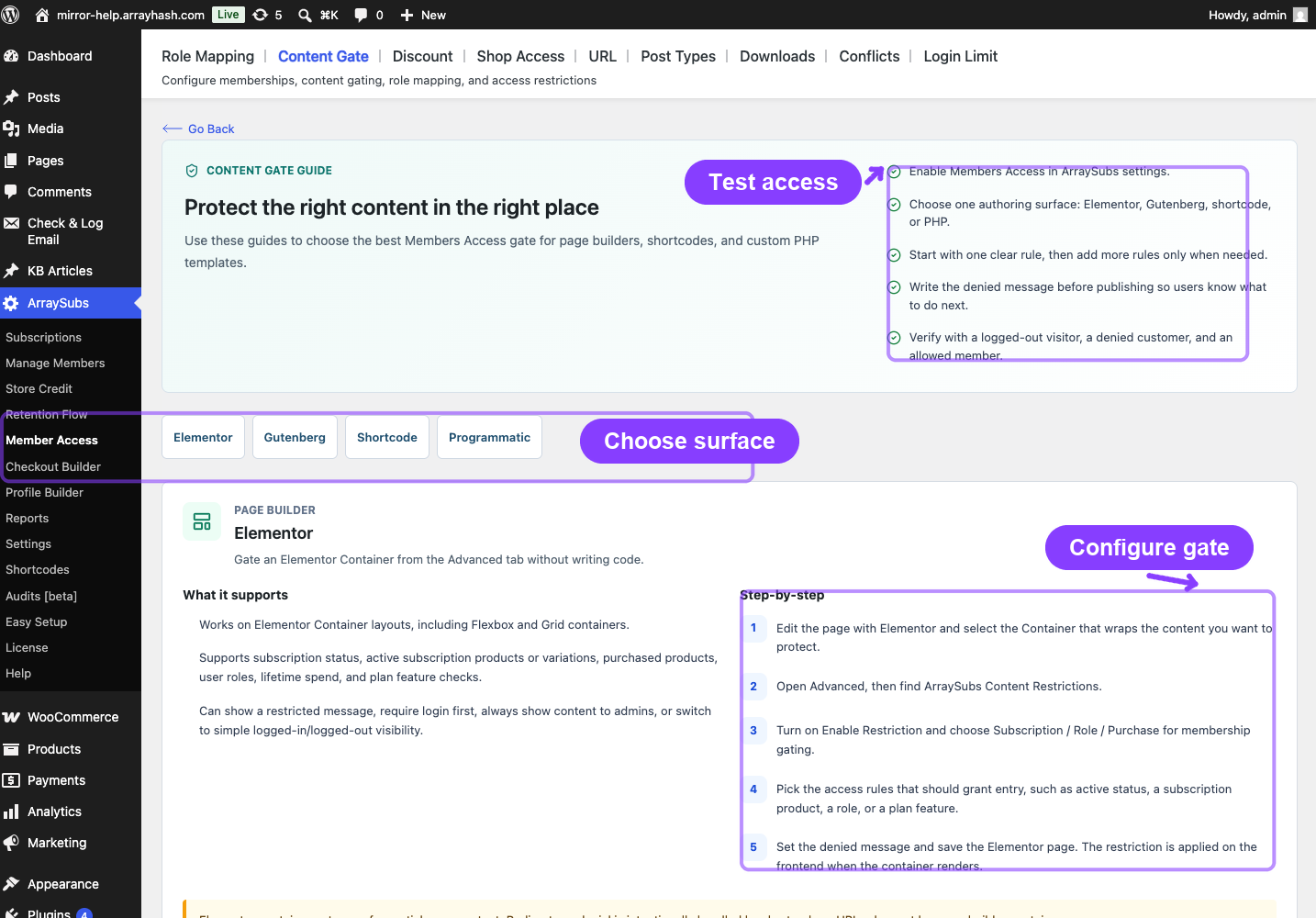
Use the inline content-gating recipe after the public/premium editorial contract is written.
Can paywalled content appear in Google Search?
It can, depending on crawlability, rendering, indexing policy, content quality, and implementation. Google documents isAccessibleForFree and hasPart markup for paywalled content intended to be crawled/indexed and says paywall markup helps distinguish the pattern from cloaking (Google paywalled-content markup). Google also publishes flexible-sampling guidance (Google flexible sampling).

Do not serve rich content only to the crawler. Do not claim markup improves ranking. Structured data must match visible behavior. When content should not reach the browser at all, use server-side authorization rather than client-side concealment.
ArraySubs does not guarantee that every custom gate emits appropriate Google paywall markup. Schema and visible-content parity are implementation responsibilities.
How should paywall performance be measured?
Define eligible events and observation windows.
paywall encounter rate
= eligible sessions encountering a gate
  ÷ eligible sessions

login restoration rate
= denied logged-out visitors who authenticate and gain access
  ÷ visitors starting login from the gate

paywall conversion
= attributed new paid members
  ÷ eligible nonmembers encountering the gate

free-to-premium path rate
= public-content visitors reaching premium explanation
  ÷ public-content visitors

member content activation
= new members consuming a defined premium resource within window
  ÷ new members
Also monitor search landing mix, return frequency, support contacts, access incidents, refunds, cancellation reasons, premium usage, cache leakage, and contribution margin. No benchmark is claimed here.
How should a paywall experiment be designed?
Start with a decision the business can reverse. Examples include moving one coherent collection from public to freemium, adding a partial gate around a workbook, or changing a public product explanation before testing a harder boundary. Do not change the gate model, price, offer copy, checkout, and onboarding simultaneously; the result will not explain which change mattered.
Write an experiment card before launch:
| Field | Required decision |
|---|---|
| Hypothesis | which audience behavior should change, and why this model should cause it |
| Eligible audience | new visitors, returning anonymous readers, logged-in nonmembers, or a defined acquisition channel |
| Primary outcome | one declared conversion or member-activation event |
| Guardrails | search entrances, login completion, support, refunds, cache incidents, and member usage |
| Observation window | long enough to include the relevant return and buying cycle |
| Exclusions | staff, bots, existing members, previews, campaigns, and known technical failures |
| Rollback | exact content/rule state to restore and the owner who can restore it |
Keep existing-member authentication separate from prospect conversion. A login click from a paying member is a restoration event, not a new-sale signal. Likewise, a reader who never reaches the gate should not be included in the gate-impression denominator.
Interpret conflicting results rather than declaring a winner from one rate. A deeper gate may raise checkout starts while reducing organic entrances or increasing refunds. A freemium collection may attract more new visitors but fail to lead them toward premium value. A meter may increase registrations while generating more privacy or counting complaints. The business decision should weigh the primary outcome, guardrails, contribution margin, and member activation together.
After rollout, annotate the exact rule and content version. Compare closed cohorts that experienced the same boundary, then read back acquisition and member outcomes after the planned window. Keep the old policy available until the new model has passed access, cache, search, support, and retention checks.
What does each paywall model require every week?
| Model | Recurring editorial work | Recurring technical work | Recurring support question |
|---|---|---|---|
| Hard | maintain public proof, taxonomy descriptions, and representative samples | audit access, redirects, caches, and recovery routes | “Why can’t I open this, and which plan qualifies?” |
| Metered | maintain the eligible content set and exceptions | validate identity, counts, resets, privacy, and cross-device behavior | “Why did this view count, and can you correct it?” |
| Freemium | classify every new item consistently and review old classifications | keep public/premium routes, feeds, and metadata aligned | “What is included free versus with membership?” |
| Partial | write a complete public answer and a specific premium bridge | verify server rendering plus file/API protection | “I paid—why is this section still locked?” |
Choose the operating burden the team can sustain, not only the mockup that looks best on launch day.
Reversible paywall migration path
- Inventory public, preview, premium, earned, recovery, and staff content.
- Establish baseline discovery, engagement, and member behavior.
- Start with freemium or a clearly bounded premium section.
- Add hard gates to high-value collections with public explanation pages.
- Implement a meter only when repeat frequency, identity, privacy, and data capability justify it.
- Preserve URLs, version rules, annotate changes, compare closed cohorts, and maintain rollback.
Use the broader WooCommerce content restriction strategy for rule governance.
When is ArraySubs not the right paywall system?
ArraySubs fits subscription, purchase, role, and feature-driven access inside WordPress/WooCommerce. It is not a native anonymous/logged-in article meter, newsroom subscription analytics/propensity platform, household identity system, strong DRM solution, or automatic off-WordPress entitlement service.
Final recommendation
Choose the model that matches audience frequency, content uniqueness, public proof, acquisition, identity capability, and member aftercare. Start with a reversible classification, protect server responses correctly, measure closed cohorts, and add a meter only when the organization can operate its identity, privacy, cache, and counting system responsibly.
After choosing a model that ArraySubs actually supports, review ArraySubs Pro pricing and member experience features.
Frequently asked questions
What is the difference between a hard and metered paywall?
A hard paywall requires access at the first protected request. A meter allows a defined number of premium consumptions inside a measurement window before requiring access.
Is freemium the same as partial content restriction?
No. Freemium classifies entire items as public or premium. Partial gating divides one item into public and protected sections. The patterns can be combined.
How many free articles should a meter allow?
There is no universal number. It depends on return frequency, inventory, acquisition, content uniqueness, identity reliability, and first-party cohort tests.
Does paywall structured data improve ranking?
No ranking guarantee exists. It helps describe a legitimate paywall implementation to Google and must match visible content.
Can ArraySubs create a metered paywall?
Current ArraySubs does not include a publisher-style per-reader article meter. It can implement hard, freemium, partial, tiered, and delayed access rules.
How do I prevent paywall leakage through cache?
Authorize before serving protected content and bypass or vary caches with reliable identity/entitlement signals. Test guest-warmed and member-warmed responses in both directions.
Author, technical review, and verification environment
Author: Emran, ArrayHash — product and editorial work across WordPress membership and content-access strategy.
Technical reviewer: ArraySubs Engineering Team — review scope includes restriction surfaces, rendering, archive/denied behavior, scheduling, cache risk, and native-meter boundaries.
Verification environment: Source and live UI review of ArraySubs 1.8.11 and ArraySubs Pro 1.1.2 on July 16, 2026, plus current Google Search, WooCommerce Memberships, and MemberPress documentation. No paywall conversion, search, or cohort experiment was performed.
Disclosure, limitations, and update log
- Commercial disclosure: ArraySubs is an ArrayHash product. No model is presented as universally superior, and the native-meter limitation is explicit.
- Limitations: Search, privacy, identity, cache, content inventory, audience habit, and economics vary. This is strategy guidance, not a ranking promise.
- July 16, 2026: First publication. Verified current gate capabilities, absence of native article metering, rendering/schema responsibility, model comparison, and reversible migration path.
Continue from strategy to setup
Use a recipe when the model is settled
These articles own the decision and operating model. The ArraySubs feature map and recipes cover the exact product, billing, and customer-workflow configuration.
Written by
Emran // ArrayHash
Research and practical guidance for WooCommerce subscription operators and implementation teams.
Technical review
ArraySubs Engineering Team
Reviewed against current ArraySubs code, product documentation, and the linked primary platform sources.