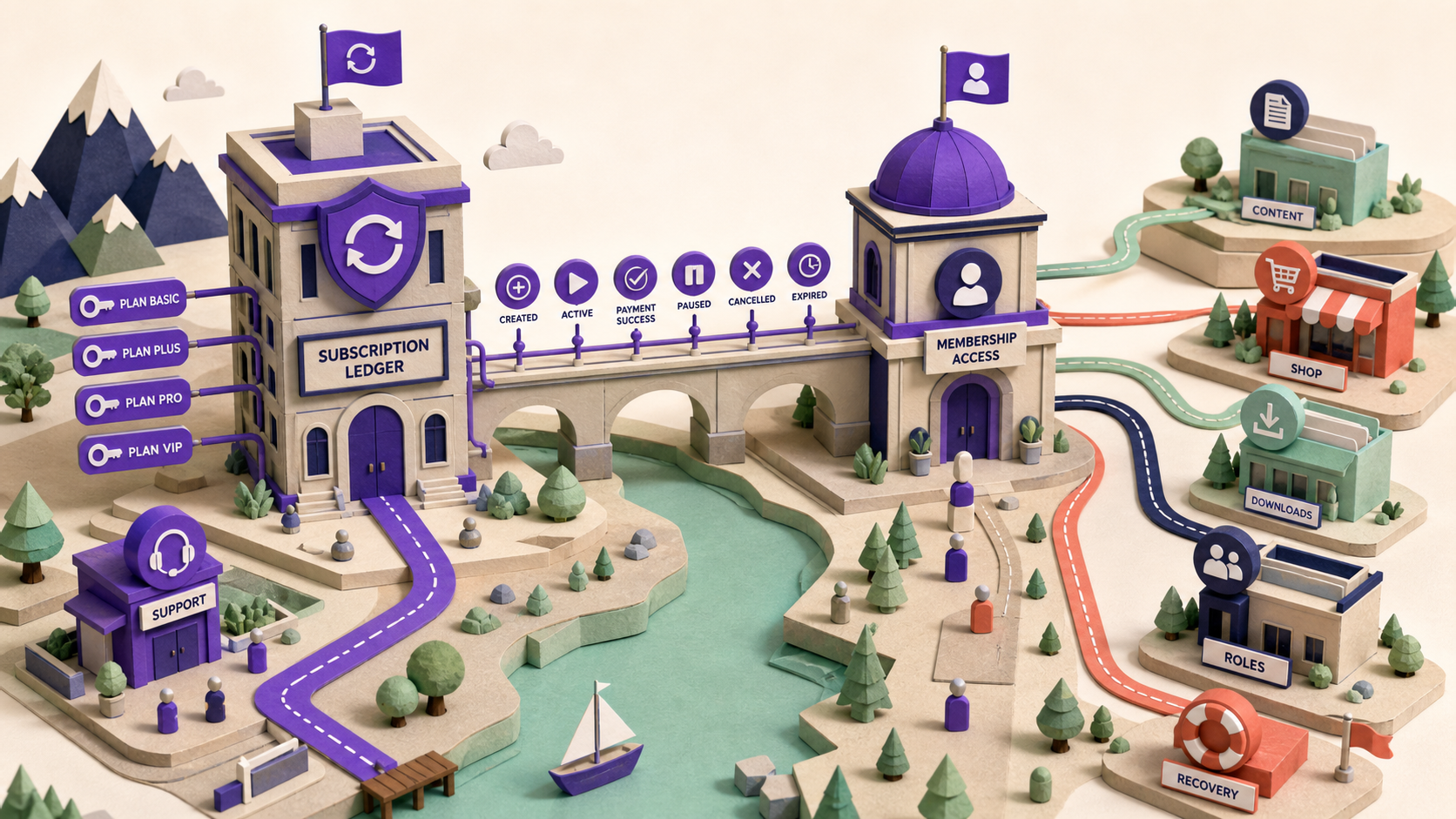

A strong membership level strategy gives each tier a distinct member outcome, not merely more features. Start with one clear paid level, add free access only when it creates a deliberate acquisition path, add tiers when segments need meaningfully different value or service cost, and offer lifetime access only when future obligations remain economically supportable.
There is no evidence-backed rule that every membership should have three tiers. A level is justified only when the intended member can understand its promise and the business can enforce and afford it.
Key takeaways
- Begin with member segments and promises; tiers are packaging, not database labels.
- Free, recurring, fixed-term, and lifetime create different economics and lifecycle duties.
- Use the simplest viable structure as a starting hypothesis, not a universal tier count.
- Design upgrades, downgrades, overlapping plans, refunds, and grandfathering before launch.
- Preserve legacy product identifiers, feature keys, and rules when grandfathering; editing a shared rule can change old access immediately.
What makes a membership tier worth creating?
A tier should change a member outcome or a material delivery constraint, not just add a weak bonus.
tier value
= member outcome
 + access scope
 + service level
 + identity or status

tier sustainability
= expected collected revenue
 − variable delivery and support cost
 − ongoing content and community obligation

Require every proposed level to pass five tests:
- Segment: A named audience has a distinct job, budget, risk, or constraint.
- Promise: Its outcome can be stated without relying on the word “more.”
- Entitlement: The difference is machine-enforceable across every surface.
- Economics: Price and term can support delivery, support, and future obligation.
- Journey: Upgrade, downgrade, cancellation, rejoin, and legacy treatment are defined.
If two levels differ only by decorative copy, an icon, or a rarely used bonus, merge them.
Free, fixed-term, recurring, lifetime, and tiered models compared
| Model | Best-fit hypothesis | Main advantage | Main risk | Required policy |
|---|---|---|---|---|
| Free | acquisition, education, community seeding | low entry friction | content/support cost without revenue | conversion path, limits, inactive-user policy |
| Paid fixed-term | cohort, season, certification, annual access paid upfront | clear end and obligation | renewal cliff and late joiners | end date, earned assets, rejoin |
| Recurring | continuing content, service, or community | revenue tracks ongoing value | churn and payment failure | cadence, grace, cancellation, retention |
| Lifetime/unlimited | bounded digital asset or strategic offer | upfront cash and simple billing | indefinite obligation and legacy complexity | scope, support horizon, exclusions, migration |
| Tiered | materially different segments or cost-to-serve | better fit and expansion path | choice overload and entitlement drift | comparison, switching, downgrade, grandfathering |
WooCommerce Memberships supports access on registration, manual assignment, and product purchase, with unlimited, set-duration, or fixed-date lengths (WooCommerce Memberships Plans). Woo Subscriptions integration adds recurring memberships and switching possibilities (WooCommerce Memberships and Subscriptions integration).
These are implementation possibilities, not an offer recommendation. Start with the promise and economics.
Should a membership include a free level?
Add free only when it has a deliberate job:
- let prospects experience a meaningful but bounded outcome;
- seed a community that becomes more valuable with participation;
- educate users before a complex paid purchase;
- preserve identity and selected data after paid access ends;
- create a permissioned communication or upgrade path.
Ask:
- What result does free deliver without replacing paid?
- Is it permanent, invitation-based, a preview, or merely an account gate?
- Which resources remain public and indexable rather than account-only?
- What behavior signals upgrade intent?
- What moderation, storage, support, and email burden does it create?
- Can a free member recover login and compare plans without a paywall loop?
A free trial is not a free membership. A trial has a defined time and payment expectation. A permanent free level is an ongoing offer with its own cost and lifecycle.
Should membership be recurring or fixed-term?
Use recurring access when value genuinely continues: new research, live events, software capability, community operations, coaching, or replenished services. The renewal should correspond to new value, not merely continued avoidance of lockout.
Use fixed-term access when the program has a coherent end: cohort, season, accreditation window, annual archive, or a specific service period. Define late enrollment, end-of-term assets, re-enrollment, and any renewal offer.
One-time payment can fund a fixed period without becoming lifetime. Several installments can fund a fixed term without making access continue indefinitely. Separate payment schedule from access duration.
When is a lifetime membership sustainable?
“Lifetime” removes the normal renewal checkpoint while future hosting, support, content, moderation, compliance, and migration costs continue.
Use a simple coverage model only as an initial screen:
illustrative lifetime coverage horizon
= net lifetime proceeds
  ÷ expected annual variable delivery and support cost
If net proceeds are $600 and expected variable cost is $60 per year, the arithmetic is 10 years before overhead, inflation, tax, platform cost, new content investment, and opportunity cost. This is an example, not a recommendation or benchmark.

Define:
- whose or what lifetime the term refers to;
- whether future products, tiers, events, and human support are included;
- what happens after a platform migration or product retirement;
- refund, transfer, abuse, account-closure, and fraud policy;
- whether new premium tiers automatically include legacy lifetime members;
- the accounting and legal treatment of ongoing obligations.
Obtain qualified legal/accounting review for the offer wording.
How many membership tiers should you offer?
Offer the minimum number needed to represent meaningful jobs.
- One paid level: best when the audience and outcome are focused.
- Two levels: useful for self-service versus assisted, individual versus professional, or content versus content-plus-community.
- Three levels: useful when core, professional, and team/concierge represent genuinely different use cases.
- Four or more: justifiable for organization sizes, regulated packages, or complex capabilities only when comparison and navigation remain clear.

Good/better/best is presentation, not strategy. “Better has more downloads” is weak if everyone needs the same outcome. “Team adds five seats, shared assets, central billing, and an administrator” is a distinct job.
What should differ between tiers?
A legitimate difference can be:
- outcome or use case;
- content or product scope;
- seats, storage, credits, downloads, or usage quantity;
- speed, freshness, or service response;
- human review, coaching, or priority support;
- commercial usage rights;
- term, commitment, or onboarding;
- identity/status in a community.
Avoid features that are hard to explain, enforce, or support. Every comparison row should map to an entitlement or operational process.
How can ArraySubs model membership levels?
Current ArraySubs can use:
- separate simple subscription products for distinct levels;
- subscription variations for tiers or monthly/annual cadences;
- active subscription product/variation conditions;
- purchase, role, and nested condition rules;
- current core lifetime billing-period products for one-payment, no-recurring-invoice constructs;
- Pro Feature Manager toggle, numeric, or text values;
- Pro Fixed Period Membership for absolute or annual end dates and enrollment windows.
A product or variation is not automatically a durable tier contract. Access rules determine what it unlocks. A WordPress role is a capabilities bundle, not the full commercial history.
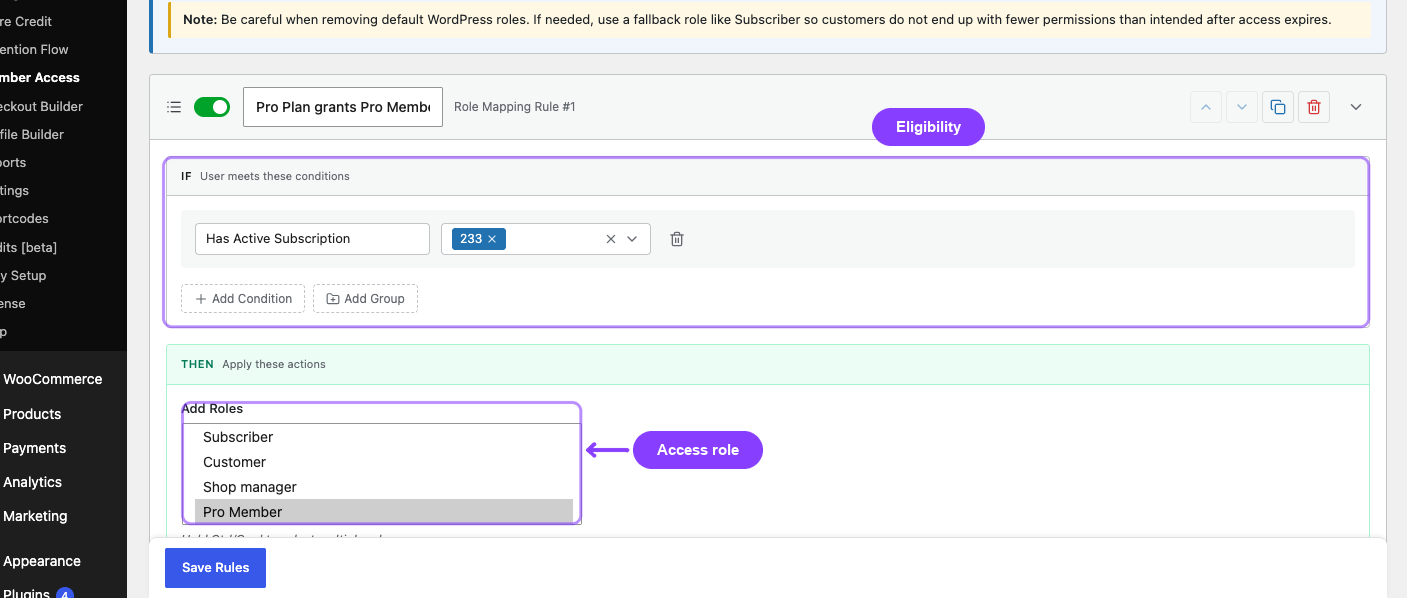
Feature entitlements are useful when several products grant the same benefit or when numeric values need aggregation.
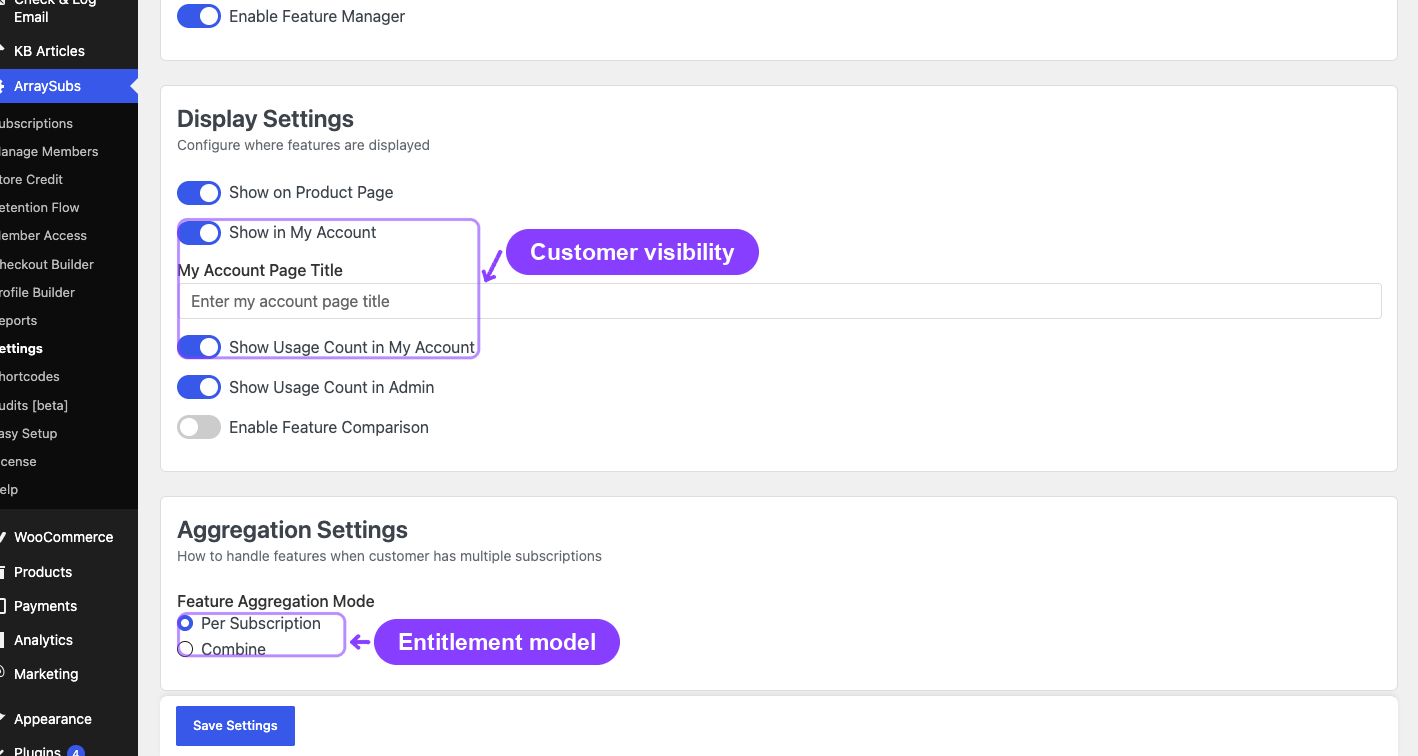
Current feature names act as keys in access evaluation. Renaming a feature can break a gate unless the rules change with it. Purchased and active subscription products can also aggregate numeric values using sum, max, or any; multiple holdings may increase a sum unexpectedly.
Lifetime billing and Fixed Period Membership are different. A lifetime product has no recurring renewal invoices. Fixed Period Membership defines calendar-based end/enrollment behavior. Do not substitute one term for the other.
How should upgrades and downgrades work?
Define the money and access clocks separately:
| Decision | Questions |
|---|---|
| Effective time | immediate or next renewal? |
| Money | charge, credit, defer, or no proration? |
| Access | when do new rights start and old rights stop? |
| Usage | what happens above the lower limit? |
| Content | do downloaded or earned assets remain? |
| Drip | does timing reset, or use an earlier qualifying start? |
| Multiple plans | replace, stack, or prohibit overlap? |
| Gateway | can the current agreement support the switch? |
A downgrade needs a packing policy. If a customer has 12 team seats and moves to a 5-seat plan, do not merely hide the seat field. Define which users retain access, when removal occurs, and what happens to owned data.

How should existing members be grandfathered?
Grandfathering can preserve price, benefits, or both. These are independent.
Keep a legacy product/variation, feature key, and rule when the legacy promise must remain stable. Editing one shared access rule or renaming one feature changes the live decision for all existing members—even if their old price is unchanged.

Document:
- cohort entry date and immutable identifier;
- legacy price and included entitlements;
- switching out and whether return is allowed;
- support and content scope;
- migration/retirement rights;
- refund and cancellation behavior;
- exact rule/product/feature owners.
How should membership levels be measured?
Use closed cohorts and plan versions, not vague “conversion” claims.
free-to-paid conversion
= free members starting paid
  ÷ eligible free cohort

tier mix
= active customers in tier
  ÷ all active paid customers

upgrade rate
= customers upgrading in period
  ÷ customers eligible to upgrade

downgrade rate
= customers downgrading in period
  ÷ customers eligible to downgrade

gross contribution by tier
= collected revenue − refunds − variable delivery/support cost
Also inspect support contacts, feature usage, cancellation reasons, failed-payment recovery, paid-entitlement leakage, and access incidents. Average revenue can rise while customer fit or contribution worsens.
Membership-level simplification checklist
- Every level names a distinct segment and outcome.
- Free has a bounded job and a sustainable cost.
- Recurring value has a visible delivery cadence.
- Fixed-term access has a clear end and rejoin policy.
- Lifetime scope and support horizon are written precisely.
- Every comparison row maps to an enforceable entitlement.
- Upgrade/downgrade timing and money are separate decisions.
- Multiple subscriptions do not stack unintentionally.
- Legacy price and legacy benefits are grandfathered explicitly.
- Product/variation IDs and feature keys have change control.
- Tier metrics use plan versions and closed cohorts.
- Merge levels that do not pass the five-part justification test.
For architecture, read WooCommerce Subscriptions and Memberships Together. Use combined conditions and inline content gating only after the offer contract is complete.
When is ArraySubs not the best tier engine?
Consider another or additional system for complex organization accounts and seat assignment, authoritative usage-based billing, LMS credentials/prerequisites, highly bespoke contracts, an independent association membership ledger, or lifetime offers needing escrow/trust/legal structures beyond plugin access control.
ArraySubs fits product/variation-driven levels where WordPress and WooCommerce content, product, download, discount, role, and feature gates share the same conditions.
Final recommendation
Start with one clear promise and add a level only when a distinct segment, enforceable entitlement, sustainable economics, and complete customer journey justify it. Treat free, fixed-term, recurring, and lifetime as different obligations—not merely price options—and preserve legacy access with versioned products, features, and rules.
After the level architecture and lifecycle tests are documented, review ArraySubs Pro pricing and member experience features.
Frequently asked questions
How many membership levels should I offer?
There is no universal best number. Start with the smallest structure that represents distinct member jobs and add levels only when they pass the segment, promise, entitlement, economics, and journey tests.
Should I have a free membership tier?
Only when it creates a deliberate acquisition, education, community, or fallback path whose content, support, storage, and moderation cost are sustainable.
Is a free trial the same as a free membership?
No. A trial has a defined term and payment expectation. A free membership is an ongoing access level.
Should membership be monthly, annual, fixed-term, or lifetime?
Match the payment and access term to how value is delivered. Separate billing cadence from access duration, and test the lifecycle obligations of each.
Is a WordPress role a membership level?
No. It is a capabilities bundle that can support a level. Product, payment, dates, entitlements, and legacy policy need separate records.
Can one WooCommerce product have monthly and annual options?
Yes, variations can represent cadences, but decide whether both grant identical benefits and how switching, grandfathering, and reporting distinguish them.
Author, technical review, and verification environment
Author: Emran, ArrayHash — product and editorial work across WooCommerce membership packaging and access architecture.
Technical reviewer: ArraySubs Engineering Team — review scope includes product/variation levels, roles, feature aggregation, lifetime products, fixed periods, switching, and access-rule change risk.
Verification environment: Source and live UI review of ArraySubs 1.8.11 and ArraySubs Pro 1.1.2 on July 16, 2026, plus current WooCommerce and WordPress documentation. No pricing conversion, churn, or willingness-to-pay dataset was supplied.
Disclosure, limitations, and update log
- Commercial disclosure: ArraySubs is an ArrayHash product. No tier-count, price, conversion, or retention benchmark is claimed.
- Limitations: Economics, tax, legal wording, service cost, gateway behavior, and customer demand vary. Validate with real cohort and contribution data.
- July 16, 2026: First publication. Verified current level mechanisms, lifetime/fixed-period distinction, feature aggregation/key risks, role boundaries, and grandfathering requirements.
Continue from strategy to setup
Use a recipe when the model is settled
These articles own the decision and operating model. The ArraySubs feature map and recipes cover the exact product, billing, and customer-workflow configuration.
Written by
Emran // ArrayHash
Research and practical guidance for WooCommerce subscription operators and implementation teams.
Technical review
ArraySubs Engineering Team
Reviewed against current ArraySubs code, product documentation, and the linked primary platform sources.